


4. The account plan
Account managers who work without a plan are not lazy. They are busy. And that is exactly where the problem lies: if you have no plan, you react to whatever comes in. The customer who calls gets attention, the customer who is quiet does not. And that is rarely the customer with the greatest potential.
After this chapter:
- You know what an account plan is and how it differs from a customer analysis.
- You determine for which accounts a full plan makes sense and for which it does not.
- Whether you know the nine building blocks and which information belongs to each one.
- Formulate your account objectives so that they can be checked on 31 December.
- You put your opportunities into a pipeline and calculate a weighted forecast.
- You know the rhythm in which you adjust the plan.
Analysis looks back, a plan looks forward
An account plan is a short, concrete document per account setting out where you want to go with this client, why that is achievable and what you are going to do to get there. It usually fits on two to four pages. The difference from the client analysis in chapter 2 lies in the direction: that analysis describes the present, the plan describes what needs to be different next year and which steps lead there. Without an analysis, your plan is a wish list. Without a plan, your analysis is a fine document that nobody opens again.
Such a plan does four things for you. It makes your choices visible: you set out which customers you retain, which you deepen and with which you aim for growth, and in doing so you determine in advance where your hours go. The makes your approach transferable: if you drop out or change roles, the knowledge does not walk out of the door with you. The aligns your colleagues: service, planning and administration all work for the same client and get one single story. And the makes your result measurable: what you wrote down in January can be held up against reality in December.
Two account managers each serve twelve clients. Esther works on the basis of her diary: she visits the clients who ask for a meeting and the clients she feels comfortable with. At the end of the year it turns out she has seen eight of the twelve clients, and her two largest only once. Joost has a plan for each client with an objective and a contact frequency. For his two largest clients, four visits a year are scheduled, plus two conversations with people he did not yet know. He misses things too, but he knows which clients and which subjects he is missing, and he can adjust in the second quarter.
For which accounts do you write a plan?
A full plan for every customer costs more time than it yields. The ABC classification from chapter 2 determines how extensive your plan becomes. For your A customers and key accounts you draw up a complete plan: analysis, objectives, action and contact plan, opportunity pipeline and account team. For your B customers a shortened one-page version with the main conclusion, two or three objectives and a contact frequency will do. For your C clients you do not draw up an individual plan, but a single group approach: how often do you make contact, through which channel, and at what signal does a C customer move up to B.
The nine building blocks
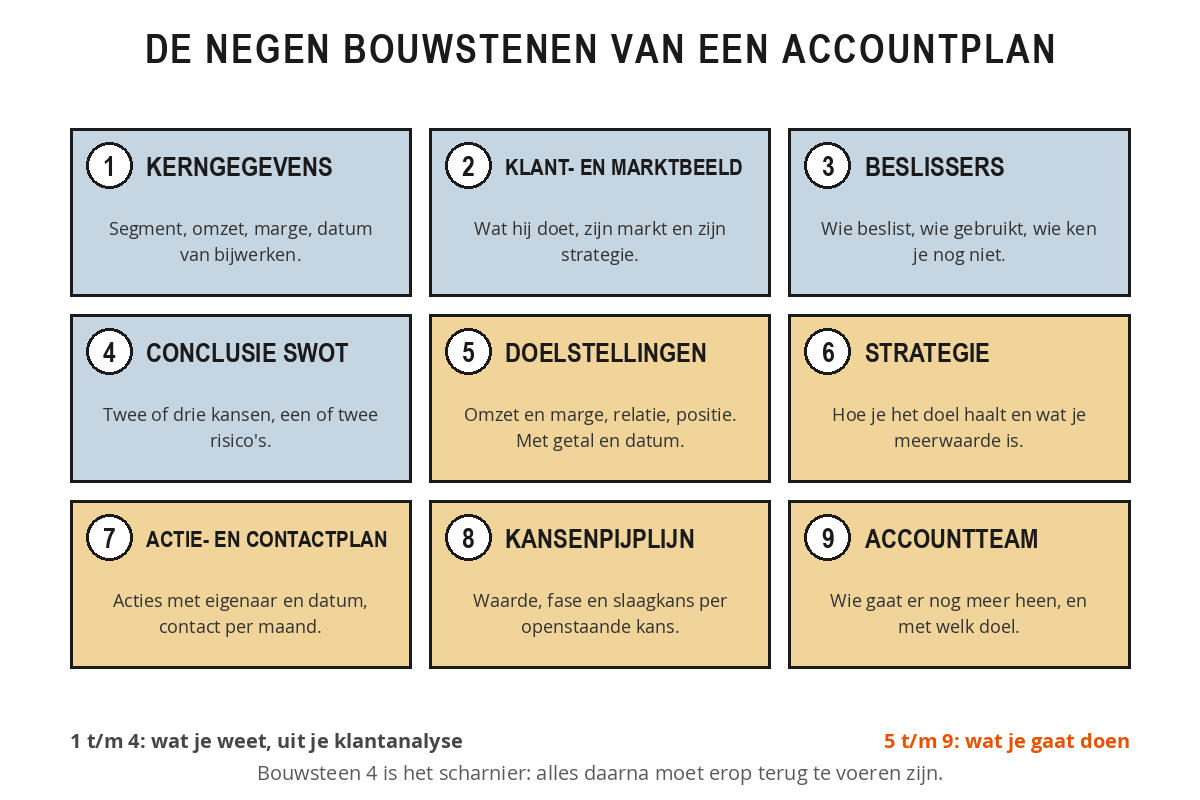
The order is fixed, so that everyone in your organisation reads an account plan in the same way. You fill the first four building blocks with what comes out of your analysis.
- Key details and segment: customer name, segment A, B or C, last year's turnover and margin, the account manager and the date of the last update. That way you can see at a glance whether you are working with an up-to-date plan.
- Customer and market picture: in five to ten lines, what the client does, which market they are in, what their strategy is and which developments influence their decisions.
- Decision-making and relationship map: the people who decide, co-decide and use, with the quality of the relationship for each person. Here you also make visible who you do not yet know.
- Conclusion from the SWOT: two or three opportunities and one or two risks, in short statements. This is the hinge building block: everything that follows must be traceable back to it.
The last five are your own choices.
- Objectives: a small number of verifiable statements about turnover and margin, about the relationship and about your position in the purchasing process.
- Strategy and value proposition: how you intend to achieve the objective and what makes the difference with this client compared with the competitor currently in place.
- Action and contact plan: the concrete actions with an owner and a date, plus the points of contact for the whole year.
- Opportunity pipeline and forecast: the open opportunities at this account, each with a value, a stage and a probability of success.
- Account team and division of roles: who else from your organisation visits this customer alongside you, with what aim, and how that information comes back to you.
A plan does not get better by adding more text. For each building block, choose the information that influences your decisions and leave the rest in your customer system. Three lines under building block 3 — "purchasing decides on price, engineering decides on specification, never spoken to engineering" — are worth more than a complete organisation chart.
Objectives you can tick off
The step that makes the difference sits between your analysis and your actions. From your SWOT you extract a small number of statements that you allow yourself to be judged on over the next twelve months. Such an objective is specific (you name the client, the service and the site), measurable (it contains a number), acceptable (you can influence it and your manager is behind it), realistic (it fits the potential you have established) and time-bound (there is a date attached that falls within your planning period). "Before 1 October" is a date, "later this year" is an intention.
Three kinds of objectives belong in an account plan. Revenue and margin targets say what the customer is going to buy. Relationship objectives state how deep into the organisation you get, for example that by the end of this year you know three contacts in purchasing and operations instead of one. Position objectives say when you are at the table, for example that you will be involved in the budget round in November.
Weak: "More attention for Van Dijk Transport and strengthening the relationship." Sharp: "From 1 July, Van Dijk Transport will also buy replacement parts for the Venlo site, with an annual revenue of 45.000 euro and a margin of at least 22 per cent. Before 1 May I will have spoken not only to purchasing but also to the technical manager and the Venlo site manager." You can either tick off the second formulation in December or you cannot. The first one you can only talk about.
The opportunity pipeline and your forecast
Alongside your objectives, you keep track of which concrete opportunities currently exist within your accounts. An opportunity pipeline is an overview of all open sales opportunities, in which each opportunity sits in a stage and is given a probability of success as a percentage. You multiply that probability by the value. An opportunity of 60,000 euros in the proposal stage with a 50 per cent chance of success gives a weighted forecast of 30,000 euros.
Add that up across all your accounts and you see two things at once: what you are likely to achieve, and where your pipeline is empty. A pipeline that is only full at the bottom looks splendid this month and delivers nothing six months from now.
An opportunity never moves to the next stage on gut feeling. Agree on one piece of hard evidence per stage: the client has described their problem in their own words, the client has received the proposal, the client has talked about price. Without that evidence, the opportunity stays where it is.
From plan to schedule
Objectives without a schedule stay on paper. In the action and contact plan, every line records four things. The action, in verb form: "organise a user meeting with operations in Venlo", not "attention for Venlo". The owner: one name, because with two names it usually doesn't happen, and with a department name it certainly doesn't. The date: a week or a month, and the action belongs in your diary straight away. And the goal it is attached to: if you can't make that link, the action is probably just habit.
In the contact plan you divide the contact moments across your account team. A technical specialist who visits the user hears things you will never get out of purchasing. That information does need to come back to you, and the team should know what the objective is for this customer.
Adjusting four times a year
An account plan that you open once a year is an archive document. Four fixed moments a year keep it alive. You compares the figures: actuals alongside target, per product and per location, because looking only at the total hides the fact that one line is growing while another is falling away. You cleans up your pipeline: moving opportunities, lowering the win probability on opportunities that have not shifted for two quarters, and deleting opportunities the client no longer says anything about. You tests your assumptions: is your picture of the decision-makers still accurate? A new purchasing manager renders part of last quarter's analysis worthless. And your reprioritises your actions: deleting what is no longer relevant, and rescheduling what has not come off, with a reason attached.
You record the outcomes where your colleagues can find them, usually in your customer system. Meeting notes, names of new contacts, plans the customer has voiced and agreements made: that is your organisation's memory. Twenty minutes per A-account per quarter is enough.
Complete the plan for the account you have been working with in the previous chapters.
- Complete the nine building blocks, a maximum of three lines per building block.
- Write objective 1 about revenue or margin, fully verifiable, with a figure and a date.
- Write objective 2, about the relationship or your position, in the same way.
- Put one open opportunity in your pipeline with a value, a stage, a probability of success and the evidence you base that on.
- Note down three actions, each with one owner, a date and the objective it is attached to.
Put your two objectives to a colleague and ask whether he could determine on 31 December whether they have been achieved. If he can't, rewrite them until he can. And look at where you got stuck fastest: that is the point where your analysis still has a gap.
Summary
- An account plan turns your analysis into choices. The analysis describes the present; the plan describes where you want to go and how.
- The weight of the plan follows your segment: comprehensive for A, one page for B, a group approach for C.
- There are nine building blocks: core data, customer and market picture, decision-making and relationship picture, and the conclusion from the SWOT describe what you know; objectives, strategy, action and contact plan, opportunity pipeline and account team describe what you are going to do.
- A good account objective is specific, measurable, acceptable, realistic and time-bound, and always contains a number and a date.
- Three types of objective: turnover and margin, relationship, and position in the purchasing process.
- Value times probability of success gives you your weighted forecast; an opportunity only moves forward if there is an agreed piece of evidence.
- Every action has one owner, a date and a link to an objective.
- Four times a year you go through figures, pipeline, assumptions and actions and record the outcome in your customer system.
What is the difference between a customer analysis and an account plan?
An opportunity with a customer is worth 80,000 euros and is in a stage with a 25 per cent probability of success. What does that mean for your weighted forecast?
Your action plan says: "more attention for the Venlo site, sales team, this year". What is wrong here?
Ready for the next step?
You have completed the free starter of Account Management. The next chapter in the full course is Foundations of communication: Effective communication, noise in the message, the laws of communication and the customer's frame of reference.
Take the 3-day course →From €1875,- excl. VAT · with an experienced trainer