


3. Your customer's decision-making unit
In organisations of any size, a signature is rarely put on paper by one person alone. Around a purchase stands a group of people with differing interests: the decision-making unit, often referred to as the DMU. That group appears on no organisation chart, and that is precisely why you have to draw it yourself.
After this chapter:
- You know what a decision-making unit is and why roles are not job titles.
- You recognise the six roles around a purchasing decision and the question each role asks.
- You know, for each role, which information you need and what you are steering on.
- You can create a DMU map for one of your own accounts in five steps.
- Do you recognise the three signals of a vulnerable position at a client.
Why one contact person is not enough
You know the feeling: the conversation is going well, your contact is enthusiastic and says it "will be fine". Two months later you hear that the assignment has gone to someone else, after a comparison you did not see coming. That almost never happens because your offer was worse. It happens because that comparison involved people who did not know you.
A decision on a purchase of any size is prepared by several people. One watches the money, another the day-to-day practicalities, a third the terms and conditions. They talk to each other at moments when you are not there. The more of those people who know what you stand for, the greater the chance that your story is passed on accurately.
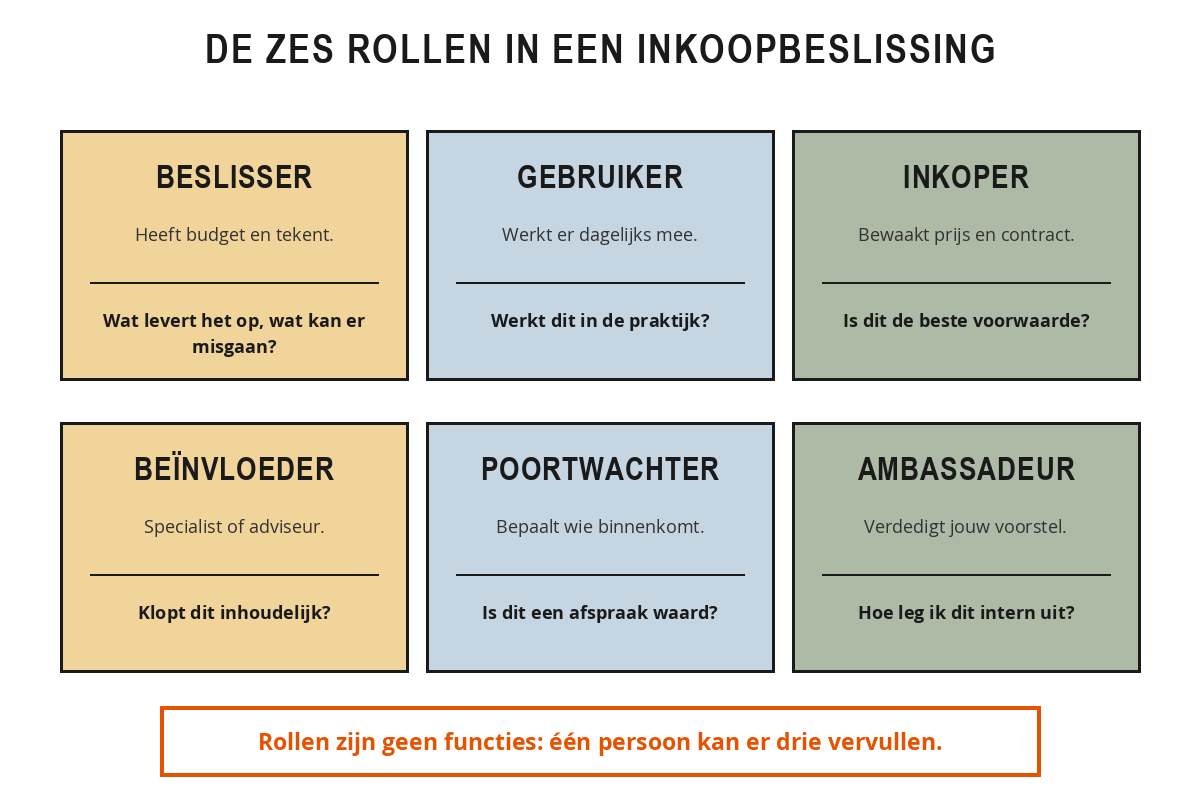
The six roles
The decision-maker holds the budget and signs the contract. He thinks in terms of money, risk and payback time, and rarely talks about details. His question is: what will this bring us and what could go wrong?
The user works with what you supply on a daily basis. They are the first to feel the consequences of a wrong choice and therefore have a great deal of informal influence. Their question: does this work in practice, and am I better off for it?
The buyer guards price, terms and contract. He compares you with alternatives and often works to fixed procedures. His question: are these the best terms we can get?
The influencer is the technical specialist, the quality manager or an external adviser. He does not decide, but his judgement carries a lot of weight during the preparation. His question: is this correct in substance and does it meet our requirements?
The gatekeeper decides who gets in and who gets time. That could be a secretariat, a purchasing portal, or a head of department who prefers to keep contact in their own hands. Their question: is this worth a meeting?
The ambassador wants it to go ahead and defends your proposal when you are not in the room. Without an ambassador, you depend on your own arguments in a discussion you don't attend. Their question: how do I explain this properly internally?
Roles, then, are not job titles. In a small company one person sometimes fills three roles at once, and at a large customer one role is played by four people. So don't look for job titles but for behaviour: who asks which question?
A different preparation for each role
Each role wants to know something different from you and offers you something different. That makes your preparation concrete for each person you speak to.
- Decision-maker: you want to know their criteria, their budget and the moment of decision. You steer on business impact and risk management.
- User: you want to know the current bottlenecks and day-to-day practice. You steer on workability and convenience.
- Buyer: you want to know the procedure, the alternatives and the lead time. You steer on clear terms and total cost rather than on unit price.
- Influencer: you want to know the technical requirements and the hard preconditions. You steer towards evidence and references.
- Gatekeeper: you want to know who is involved and when it is happening. You steer towards a clear reason for a follow-up meeting.
- Ambassador: you want to know where the internal resistance lies and who still has doubts. You steer on arguments he can use internally.
Never send one and the same story to all roles at once. A quotation with four pages of technical detail lands perfectly well with the influencer and costs you the attention of the decision-maker. Write the first half page for the person who signs, and put the supporting detail behind it.
Creating the DMU map
This is how you map out the decision-making unit of an account. It takes fifteen minutes and it almost always throws up a surprise.
- Write down the purchasing decision that is on the table now or will be within a year. Not the customer, but the decision.
- Write down all the names you know and add the role or roles each person fulfils.
- Put a plus, a minus or a question mark next to each name: is this person positively disposed towards you, negatively, or do you not know?
- Mark the roles with no name next to them. Those are your blind spots.
- For each blind spot, decide who you can approach about it, and through whom you can reach that person.
Three signals point to a vulnerable position: you only know one name, you have never spoken to the user, or you do not know when the decision will be made. In each of those three cases, your next action is not an offer but a question.
Bram sells maintenance contracts to a manufacturer of packaging materials. His contact is the head of the technical department, who is enthusiastic and says it will be fine. When Bram draws up the DMU map, the picture becomes thinner. The head of the technical department is a user and an ambassador, but not the decision-maker. The finance manager decides on anything above 50,000 euros and he has never met her. As of this year, purchasing works with a mandatory comparison of three suppliers. Under influencer there is a question mark. His first action is not a new quotation, but a single question to his ambassador: who else is looking at this internally, and how do I get in front of the finance manager? Two weeks later he is sitting in a meeting he would otherwise have missed.
Nadia supplies cleaning services to a care institution and has an excellent relationship with the facilities manager. Her map has four names with a plus, but there is nothing against user. She asks whether she can spend a morning shadowing staff on two wards. There she hears that the team leaders have been grumbling for months about the times at which the vacuuming is done, something that never reached the facilities manager. She adjusts the schedule in her renewal proposal. At the renewal, a contract worth 240,000 euros a year, the decisive argument is not the price, but the fact that the wards themselves asked for her proposal.
Contact at several levels, without going over your contact's head
The question that always follows: how do you explain to your regular contact that you also want to speak to other people, without it feeling as though you are going over his head? Three things help. Ask him rather than going around him; you are in fact asking him for an introduction. Give a reason that offers him something too, for example that you want to speak to the users so that the proposal fits better. And always report back to him what you have heard, so that he never hears about a conversation you had from someone else.
Carry on working with the account from chapter 2.
- Name one purchasing decision this customer faces now or within a year.
- Create the DMU map using the five steps from this chapter.
- For each name, note down one thing that person considers important which has nothing to do with your product.
- Look critically at every plus you have given: what is the evidence for it?
- Choose your most important blind spot and write down how you are going to fill it over the coming month: through whom, on what occasion, and what you will ask that person.
Summary
- The decision-making unit is the group of people who decide on a purchase together. That group appears on no organisation chart, so you draw it yourself.
- The six roles are decision-maker, user, buyer, influencer, gatekeeper and ambassador.
- Roles are not job titles: one person can fulfil three roles, and one role can be played by four people.
- Every role asks a different question, so every conversation requires different preparation: the decision-maker wants effect and risk, the user wants workability, the buyer wants terms, the influencer wants evidence.
- The ambassador defends your proposal in conversations you are not part of. Without an ambassador you are not in the running.
- You build the map in five steps: the decision, names with roles, plus or minus or question mark, blind spots, and a route for each blind spot.
- Three signs of a vulnerable position: only one name you know, never having spoken to the user, or not knowing when the decision will be made.
Your contact is enthusiastic and says the deal is as good as done, but he is not allowed to sign himself. Which roles is he most likely to fulfil?
What does this chapter mean by "roles are not job titles"?
On your DMU map there is no name at all against the role of influencer. According to this chapter, what is your first step?