


4. Planning and monitoring the sprint
Your backlog is in order, the roles are assigned and the sprint can begin. Now the question that trips things up in practice: how much work do you take on, and how do you know halfway through whether you are going to make it? Agile has three answers to that, all three of which go against your gut feeling. The time is fixed instead of the amount of work, you estimate in points instead of hours, and you measure your team's pace afterwards instead of promising it in advance.
After this chapter:
- You know what timeboxing is and at which four levels you apply it.
- You know the rules of a timebox and what happens when the work is not finished.
- You can explain what story points are and how Planning Poker works.
- You know what velocity is, what you use it for and what you do not.
- Read a scrum board and a burndown chart.
Timeboxing
Timeboxing is the most characteristic planning principle of agile. You set aside a fixed period in advance, the timebox, in which an amount of work is taken on. That period is fixed. What fits into it and what the outcome is may vary, but the end date does not move.
That is exactly the inverted triangle from chapter 1, but as a planning instrument. In traditional project management you fix the scope and let the time flex. With timeboxing the time is fixed and the scope adapts.
You apply it at four levels, each nested within the next. At project level the entire project is given a fixed end date, four months for example. At release level each interim delivery gets its own timebox, six weeks for example. At sprint level each sprint is a timebox of one to four weeks, usually two. And at day level even the Daily Stand-up is timeboxed, at exactly fifteen minutes.
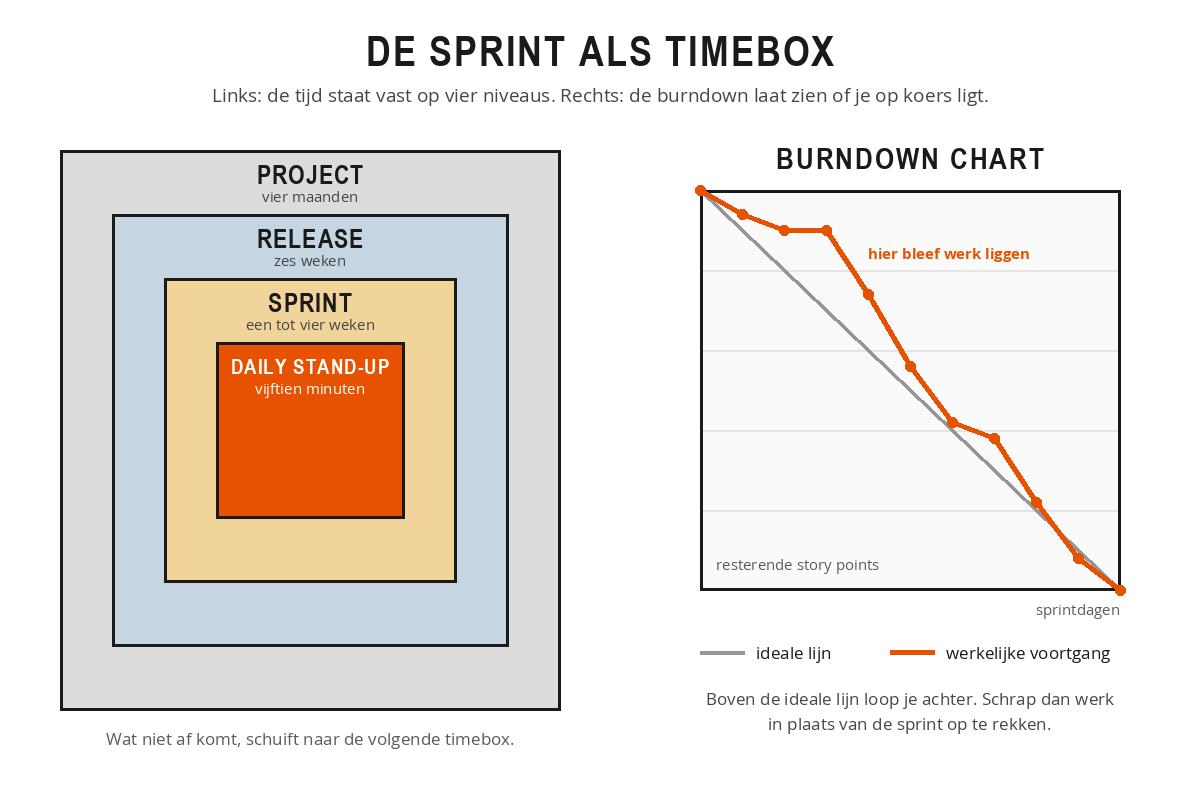
The ground rules of a timebox
A timebox is more than a deadline. Five rules give the instrument its strength. The end date is fixed and does not move. The scope is flexible: whatever is not finished goes into a subsequent timebox. At the end there is always a working result. The team works self-directed within the timebox. And the work is done on the basis of priority, not in order of arrival.
That last rule is the reason chapter 3 was about MoSCoW. You always start with the Must haves, so that what is left over is also the work you can do without. If a sprint gets out of hand, you cut work instead of stretching the deadline. That feels awkward at first, but it is exactly what gives agile its grip: you keep time and budget under control and always deliver something that works.
A timebox that expires without everything being finished is not a failure but a measurement. You now know better how much work fits into a given period. It only becomes a problem if you ignore that measurement and take on just as much again in the next sprint.
Release planning
Before the sprints begin, you draw up a release plan: a high-level overview of which functionality will be delivered in which release, spread across successive sprints. A release might consist of four two-week sprints, together eight weeks of work with a working delivery for the user at the end.
You don't plan in detail who does what; you provide direction and sequence. A release plan gives stakeholders a realistic picture of what they can expect and when. It isn't a promise set in stone, but a signpost that you adjust each sprint.
Story points and Planning Poker
Instead of hours or days, you estimate in story points. A story point expresses how large, complex or risky a story is compared with other stories. A story of 2 points is roughly twice as large as a story of 1 point. Whether that amounts to one day or three in hours is beside the point at that moment. That sounds vague, but it works better than estimating in hours, because people are far better at comparing than at predicting.
Planning Poker is the best-known technique for assigning those points. Each team member gets a set of cards with the Fibonacci sequence: 1, 2, 3, 5, 8, 13, 20, 40, 100. The Product Owner reads out a story, the team asks clarifying questions, and then everyone picks a card at the same time. That simultaneity is the whole point: it means the first or the loudest voice doesn't determine the estimate. If the numbers differ widely, the highest and lowest estimators explain their choice and you estimate again.
A team of five estimates the story "Customer can reset password by email". Four team members put down a 3, one puts down an 8. The estimator with the 8 explains that he is allowing for the security rules and for logging of failed attempts, something the others had not thought of. After the second round everyone arrives at 5. The story is given 5 story points. The value is not in that number, but in the two minutes of explanation: without Planning Poker that logging would only have surfaced in the test phase, and by then it would have blown up the sprint anyway.
Velocity
Velocity is the number of story points a team completes on average per sprint. After three or four sprints you see a pattern. If your team delivers an average of 28 points per sprint, you know that you can select roughly 28 points from the backlog for the next sprint. Not a promise, but a realistic expectation, and a sound defence against a client who would like to cram in 40.
Velocity is emphatically a team measure. You do not compare team A's velocity with team B's, because their points do not mean the same thing. A team at 60 is not twice as productive as a team at 30; they have simply chosen a different unit. As soon as someone starts using velocity to compare teams or to apply pressure, the estimates go up and the instrument is broken.
The scrum board
What you cannot see, you cannot steer. A scrum board shows at a glance where the team stands. At its most basic, three columns: To Do, Doing and Done. Every story or task hangs as a card in the appropriate column, and when a task moves on, you literally or digitally move the card. Many teams add columns such as "In review" or "Test". The principle stays the same: the work is visible, the bottlenecks are visible, and nobody has to ask who is working on what.
Put the board in a place the team passes at least once a day. A board hanging in a closed room, or buried three clicks deep in a digital tool, loses its signalling function. Visibility is half the effect.
The burndown chart
The burndown chart shows how much work is left and how quickly it is decreasing. The horizontal axis shows the sprint days, the vertical axis the remaining number of story points. A straight line from top left to bottom right indicates the ideal progress: if you completed the work evenly, you would follow that line.
The actual line almost never runs exactly along it, and that is a good thing. If it does above the ideal line, more work is left outstanding than planned and you are behind schedule. If it runs below that, the team is ahead of schedule. And a flat stretch on a working day is the signal to watch for: nothing was completed that day, so something has got stuck somewhere. Usually that is one oversized story that three people are waiting on.
This turns the chart into an early warning system rather than an after-the-fact accountability document. If you see on day four that the line is flat, you still have six days to do something about it. If you only spot it in the Review, all you can do is explain why it is not finished.
A team of six at a software supplier has a velocity of 30 and plans a two-week sprint with 31 points: five user stories. On day three the burndown has already been flat for two days at 26 points. The Scrum Master asks in the stand-up what is holding things up. It turns out that the 13-point story, an integration with the customer's accounting system, is waiting for a test account that the customer has not yet created. The team rings the customer that same morning and meanwhile picks up the 5-point story that was scheduled for the next sprint. The test account arrives on day six. At the end of the sprint four of the five stories are finished, 23 points, and the 13-point integration goes back to the Product Backlog. The sprint has not been extended, the velocity over four sprints drops from 30 to 28, and the next sprint planning works from that more realistic figure.
Take a project from your own work and put it on a timebox rhythm.
- What is the total lead time, and into how many releases would you split it?
- Which sprint length do you choose: two, three or four weeks? And why that one?
- Take the three user stories you wrote in chapter 3 and give them an estimate of 1, 2, 3, 5, 8 or 13 points, relative to each other. Ask a colleague to do the same and compare.
- Draw an empty scrum board with To Do, Doing and Done, and place your stories in the appropriate column.
- Which work would you drop first if the sprint threatens to overrun? If you cannot answer that question, your MoSCoW classification is not yet finished.
Summary
- Timeboxing means that the time is fixed and the scope flexes; the end date never moves.
- Four levels: project (four months for example), release (six weeks for example), sprint (one to four weeks) and the Daily Stand-up (fifteen minutes).
- If a sprint gets out of hand, you cut work instead of stretching the deadline; the work that is cut goes back to the Product Backlog.
- A release plan sets out in broad terms which functionality will be delivered when, and you adjust it each sprint.
- Story points express relative size, not hours. Planning Poker with the Fibonacci sequence 1, 2, 3, 5, 8, 13, 20, 40, 100 prevents a single voice from determining the estimate.
- Velocity is the average number of points per sprint for this team, and is not suitable for comparing teams.
- The scrum board (To Do, Doing, Done) shows the status of the work; the burndown chart shows whether you are on track, where a flat section means that something has got stuck.
On day seven of a ten-day sprint the actual line in the burndown chart is clearly above the ideal line. What does that mean?
Team A averages 55 points per sprint, team B achieves 25. What may you conclude from this?
Two days before the end of the sprint it turns out that an 8-point story is not going to be finished. What do you do according to the rules of a timebox?
Ready for the next step?
You have completed the free starter of the Agile Project Management Foundation course. The next chapter in the full course is Waterfall, PRINCE2 and the hybrid choice: The seven principles, themes and processes of PRINCE2, and how organisations combine control and agility within a single project.
Take the 2-day course →From €1300,- excl. VAT · with an experienced trainer included