


3. The general rule for services
Services have no customs papers and no transport documents. Nothing is driven anywhere, nothing is weighed and there is no border you can point to on a form. With a service, everything turns on two questions: who is your customer, and where are they based? The general rule provides the answer.
After this chapter:
- You know the general rule for B2B services and the one for B2C services, and you know how they differ.
- You determine on the basis of documentary evidence whether your customer is acting as a business or as a private individual.
- Do you know which customers without the right to deduct nevertheless fall under the B2B general rule?
- You recognise when the place of establishment is decisive and when a fixed establishment determines the place of supply.
The main rule only applies as long as there is no special rule for that type of service. Services connected with immovable property, logistics, admission to events, restaurant and catering services and the hire of means of transport have their own place-of-supply rules; these are covered in the full course. This chapter is not tax advice and the rules differ from case to case. If you are in doubt about an assignment, put it to your tax adviser or to the Belastingdienst.
Two rules that mirror each other
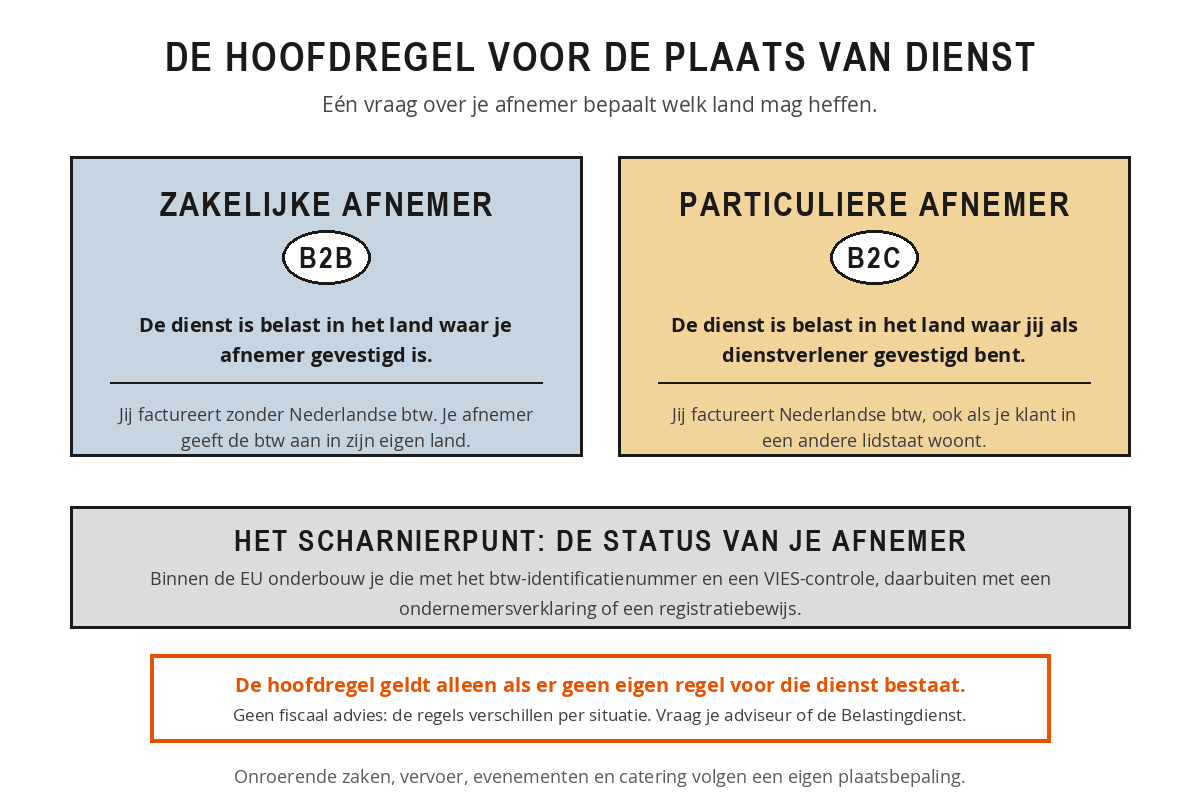
The general rule for B2B services states that a service supplied to a business is taxed in the country where that customer is established. If you carry out market research from Amsterdam for a client in Milan, the levy lies in Italy. You invoice without Dutch VAT and your Italian client declares the VAT in Italy. If the customer is outside the EU, in Switzerland for example, the service is not taxed in the Netherlands; what happens in Switzerland is determined by Swiss legislation.
The main rule for B2C services points the other way. If you supply a private individual, the service is taxed in the country where you as the supplier are established. If you advise a private individual in Spain, you simply put 21% Dutch VAT on the invoice and declare it in your Dutch VAT return.
That difference makes determining the status the pivot of every international service. Get it wrong and you either charge VAT that is not due, or you leave out VAT that you have to bear yourself. In the first case you have an angry client and a credit note, in the second an additional assessment.
Who qualifies as a business for the general rule
For the place of supply, the question is not whether your customer can deduct VAT, but whether he is acting as a business. That distinction is broader than you might think at first sight. Three groups of customers fall under the B2B main rule.
Businesses with taxable turnover are the classic situation: your customer makes supplies subject to VAT and holds a VAT identification number. Businesses that also or exclusively make exempt supplies also fall within this category. A hospital, an insurer or an educational institution has no right, or only a limited right, to deduct VAT, but for the place of supply it counts fully as a business. The reverse-charged VAT is a cost item for them. And finally non-taxable legal persons with a VAT identification number, for example a local authority or a holding company that has a number only for its intra-Community acquisitions. As soon as that number exists, you treat the service as B2B.
A business that takes delivery of a service purely for private purposes falls outside this list. If a Belgian business owner books a photography course with you for his own hobby, that is a B2C service. If he uses the service partly for business and partly privately, he counts as a business for the whole of it.
The evidence you need
For a customer in another member state, your evidence rests on the VAT identification number and the VIES check from chapter 1. You request the number from your customer in writing, preferably before the first invoice goes out. You check it in VIES and request a consultation number while doing so. You save the confirmation with the date and time, or take a screenshot. For regular customers you repeat the check periodically, for example every quarter or with each new assignment. And you record the outcome in your customer file, linked to the invoice numbers to which you have applied the number.
If your customer does not yet have a number because he has only just applied for one, you may still treat him as a business if you establish with reasonable care that he is a business. Proof of the application, an extract from the trade register and a signed contract together form acceptable substantiation. If the number turns out never to be issued, you correct the invoice.
Outside the EU there is no VIES. There you demonstrate business status with other documents. A statement of business status from the tax authority in the customer's country is the strongest, comparable to the form used for VAT refunds. A local VAT or GST registration number combined with an extract from the commercial register also works. And for countries without a VAT system you fall back on an order confirmation, correspondence on company letterhead and a business website that supports the existence of the company.
Design agency Sluisweg in Utrecht works for three customers in the same quarter. For a German machine builder with a valid VAT identification number it designs a product catalogue, EUR 11,500: B2B, taxed in Germany, invoice without Dutch VAT. For a Dutch care institution with no right to deduct it produces a campaign, EUR 6,800. That institution is a business, so B2B, but because both parties are in the Netherlands the standard 21% Dutch VAT applies. And for a private individual in France it designs a logo, EUR 950: B2C, taxed in the Netherlands, so 21% Dutch VAT on the invoice. The same discipline three times, a different assessment three times.
Build the status check into your invoicing process, and not into the head of a single member of staff. A mandatory field "VAT ID checked on (date) / consultation number" in your accounting package prevents an invoice going out without VAT while the evidence is missing.
Dutch VAT charged to a foreign private customer
For a customer without business status, the general rule is reversed. The B2C general rule makes no distinction between a private individual in Maastricht and a private individual in Milan. Both receive an invoice with 21% Dutch VAT. You do not have to register in your customer's country and you do not state any reverse charge wording. In your return the turnover is simply included with domestic supplies.
That feels at odds with the destination principle from chapter 1, and it is. Here the legislator has opted for workability: an adviser who occasionally helps a private individual in another member state would otherwise become liable for VAT in the country of every client. For a number of types of service that outcome has been set aside; those are covered in the full course.
Which establishment supplies or receives the service
As soon as your organisation has more than one establishment, the question of which establishment supplies the service becomes relevant. In B2C, the general rule points to the country where the business is established: the place where management sits, where board decisions are taken and where the central administration is kept.
If a fixed establishment supplies the service, the levy shifts to the country of that establishment. A fixed establishment is a place of business with sufficient permanence and so equipped in terms of staff and technical resources that it can supply or receive services independently. A PO box does not qualify, and neither does a storage facility without staff. An office in Antwerp with two permanent advisers, its own telephone line and its own files does qualify.
If that Antwerp office does the work for a Belgian private individual, the service is taxed in Belgium and you invoice with Belgian VAT from that establishment. If the head office in Utrecht does the work, it remains Dutch VAT. The actual performance is decisive, not the letterhead on which the invoice appears.
On the other side of the table the same question arises. With an international client the place of establishment is the starting point, but if a fixed establishment in another country takes delivery of the service, then the country of that establishment has the right to levy VAT. Four indications then go into your file: the country code of the VAT identification number under which the client takes delivery of the service, the contract and the order confirmation showing the entity that signs, the invoice address and the party paying, and the use made of the advice. A report on a German subsidiary points towards the German establishment, even if the head office is in Sweden.
Advice, consultancy and interim work
Advice, consultancy, legal assistance, accountancy work and interim assignments fall under the general rule. There is no special place-of-supply rule for them. That is precisely why the entire assessment rests on determining status and the question of establishment. This is how you handle such an assignment.
- You establish the customer's status and check the VAT number in VIES, including the consultation number.
- You determine which establishment of the customer receives the service and file the supporting reasoning with the assignment.
- You determine the country of taxation according to the general rule that applies to that status.
- You draw up the invoice: for B2B without VAT and with the customer's VAT number, for B2C with Dutch VAT.
- You process the B2B turnover in the EC Sales List for the correct period.
Advisory firm Hofmans is guiding an acquisition for a Danish group, fee EUR 46,000. The letter of engagement has been signed by the head office in Copenhagen, but the work concerns a Belgian subsidiary and all the contacts are based in Ghent. That Belgian establishment has its own VAT number, its own staff and pays the invoices itself. Hofmans therefore invoices the Belgian establishment, without VAT, stating the Belgian VAT number, and includes the amount in the ICP return. The Copenhagen letterhead was not decisive; the facts were.
In an organisation with several branches, record for each assignment who did the hours and which office concluded the contract. That takes five minutes at the outset and saves you reconstructing it after the fact during an audit.
For each situation, determine whether the B2B or the B2C main rule applies, which country may levy the tax and which item of evidence you put in the file.
- Situation A: you are advising a Polish municipality that only has a VAT identification number for its acquisitions.
- Situation B: a Spanish entrepreneur commissions a garden design for his holiday home, privately.
- Situation C: a Canadian software company purchases your consultancy services and has no VAT number.
- Situation D: an Irish start-up has applied for a VAT number but has not yet received one.
Then take three recent assignments with a foreign client from your own files. For each assignment, assess whether you were dealing with the head office or with a fixed establishment and what shows this, which country may levy the tax under the general rule, what the invoice actually said and whether that is correct. Note which piece of supporting evidence was missing most often in these three files.
Summary
- The main rule has two variants: with a business customer the customer's country levies the tax, with a private customer the country of the service provider.
- Determining the status is the pivotal point. What counts is not the right to deduct, but whether your customer is acting as a business.
- B2B also covers businesses making exempt supplies, such as a hospital or an educational institution, and non-taxable legal persons with a VAT identification number.
- An entrepreneur who purchases a service purely for private purposes is a private individual for that service. Partly business use counts as business use in full.
- Within the EU you substantiate the status with a VIES check, outside it with a declaration of business status, a local registration number or correspondence and contracts.
- A private individual in another member state is simply charged 21% Dutch VAT, without registration in their country and without a reverse charge statement.
- A fixed establishment requires permanence, staff and technical resources. It shifts the levy to its own country; a PO box or an empty warehouse does not.
- For advisory services there is no special place-of-supply rule, so everything rests on the status of the customer and the establishment question.
A Dutch consultancy advises a private individual living in Spain. What does the general rule say?
You supply a service to a hospital in another member state that has no right to deduct input VAT. Which general rule applies?
When does a fixed establishment determine the place of supply of services rather than the place of business?
Ready for the next step?
You have completed the free starter of Cross-border VAT. The next chapter in the full course is Intra-Community acquisitions: The purchasing side: you receive an invoice without VAT and declare that VAT yourself, with the catch-all provision and the special categories of customers.
Take the 2-day course →From €1250,- excl. VAT · with an experienced trainer included