


2. Supplying a business customer in the EU
Cross-border sales to a business customer in another member state are the most common international transaction in small and medium-sized businesses. The rule looks simple: zero rate. The conditions around it are not. This chapter goes through the four conditions, shows what has changed since the quick fixes, and deals with the trickiest variant: the customer who collects the goods themselves.
After this chapter you can:
- Identify when a supply of goods qualifies as an intra-Community supply.
- Testing the four substantive conditions for the zero rate against a specific transaction.
- Explaining what the quick fixes have changed since 2020 with regard to the supplier's evidential position.
- Building a file of transport documents that will stand up to an audit.
- Assessing the risk you run if one of the pieces of evidence is missing.
The conditions below are taken from the course syllabus and do not constitute tax advice. Whether your supply meets all the conditions depends on the facts of that particular case: who carries out the transport, what the contract says and what you can demonstrate. Submit any supply you have doubts about to your tax adviser or to the Tax and Customs Administration before you invoice at 0%.
What an intra-Community supply is
An intra-Community supply is a supply of goods transported from one EU member state to another EU member state, where the customer is a business that declares an acquisition in that other country. You then invoice at 0% VAT.
That zero rate is not an exemption. You still retain the right to deduct the input VAT on your purchases. So the VAT does not disappear; it shifts to the country of destination, where your customer declares it. In the full course you will see how that purchasing side works.
The zero rate is a favour with a price tag, though. If the inspector establishes that you did not meet the conditions, the charge does not then shift to your customer but lands with you. You will receive an additional assessment of 21% on the turnover you invoiced without VAT, plus interest and possibly a fine. Recovering it from your customer rarely works, certainly not if they have since ceased trading. That makes the four conditions below not a formality but the core of your risk management.
The four conditions at a glance
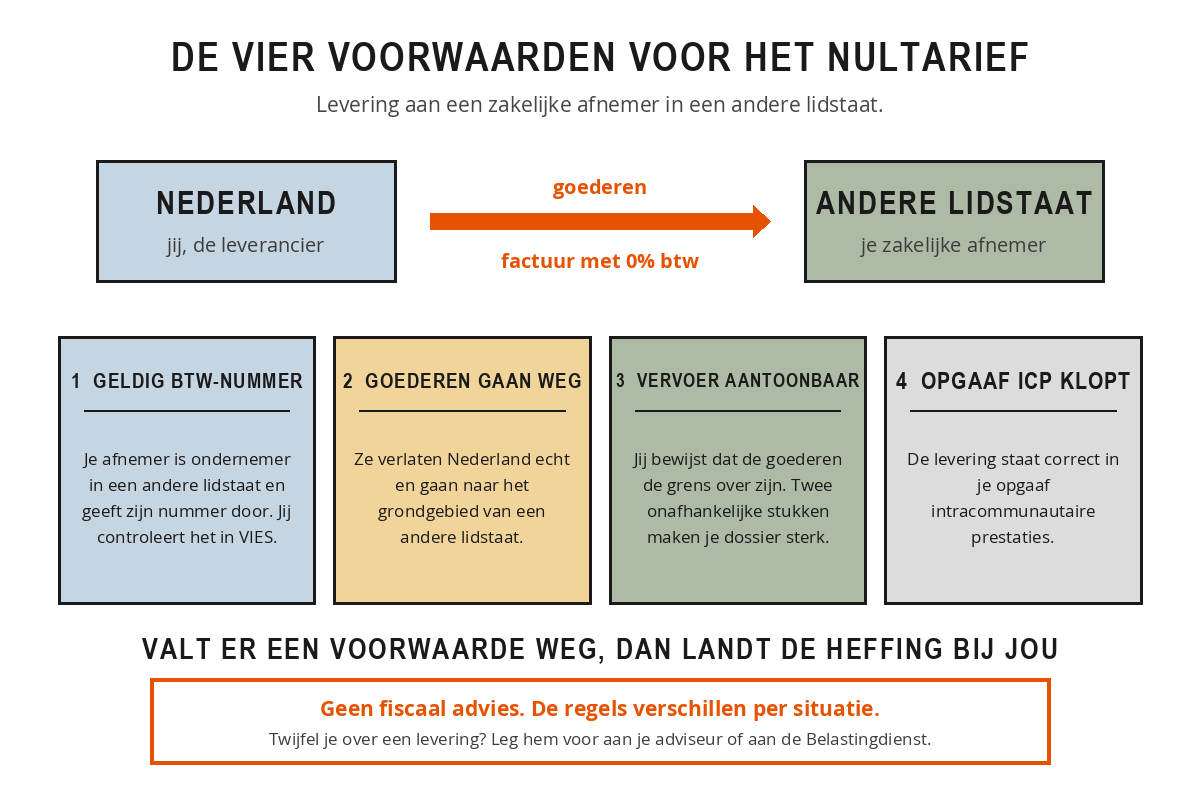
1. The customer is a business in another member state. They hold a valid VAT identification number from a country other than the Netherlands, and they provide that number to you. If you sell to a private individual or to a customer without a number, there is no intra-Community supply.
2. The goods actually leave the Netherlands. There must be a physical movement to the territory of another member state. If the goods stay in the warehouse in Venlo until the customer collects them later for the Dutch market, then it is simply a domestic supply at 21%.
3. The transport can be demonstrated. You are the one who has to prove that the goods crossed the border. Not your customer, not your carrier: you.
4. You correctly report the supply in the ICP return. The statement of intra-Community supplies must match your VAT return and your general ledger.
Conditions 1 and 4 were formal requirements until 2020. If the number was missing or the recapitulative statement was incorrect, you could still save the zero rate with other evidence. Since the quick fixes, that is a thing of the past.
What the quick fixes have changed
The quick fixes are a package of four EU measures that have applied in all member states since 1 January 2020. The aim is to make the VAT system for cross-border trade more consistent, pending a definitive system. For your own practice, these are the consequences.
The VAT identification number has become a substantive condition. Without a valid, verified number from your customer there is no entitlement to the zero rate. A VIES check at the time of the transaction is therefore no longer extra diligence, but a requirement.
Also the ICP return is a substantive condition. An incorrect or missing declaration can cost you the zero rate, unless you can explain the error and correct it. Differences between your ledger and your declaration should therefore be corrected within the same quarter, not at the year-end close.
There is also a harmonised presumption of proof for the transport arrived. There is now a European list of documents with which you can demonstrate the transport. If you supply two independent pieces of evidence from that list, the transport is presumed to have taken place. That is precisely why one single piece of paper is usually not enough.
Finally, the quick fixes deal with the call-off stock. If you store goods in a warehouse at your customer's premises in another member state, where that customer only calls them off later, then under certain conditions you do not have to register there. That arrangement is worked out in the full course.
A Dutch wholesaler in packaging materials supplies EUR 18,400 worth of goods to a Belgian customer. The seller asks for the VAT number, is given "BE0123.456.789" and puts it on the invoice with 0% VAT. During an audit it emerges that the number was withdrawn a month before the supply because of a bankruptcy. The seller has not kept a VIES consultation and therefore has no consultation number. The inspector refuses the zero rate. Additional assessment: EUR 3,194 in VAT, plus interest. The Belgian liquidator pays nothing back.
Build the VIES check into your sales process as a fixed step, not as a one-off action by a single member of staff. For every check, record the date, the number checked and the consultation number in the customer file. For customers you trade with on an ongoing basis, repeat the check at least every quarter. A number that was valid last year says nothing about today.
When the customer collects the goods themselves
In a collection transaction, your customer arranges transport themselves. They come with their own van, send a driver or engage their own carrier. You see the goods leave your premises, but after that you have no document at all showing where they ended up. That is precisely where the risk lies.
The four conditions do not change. What does change is that the burden of proof for the transport rests entirely with you, without your having any control over the transport chain yourself. If the Dutch Tax Administration asks years later why you invoiced at 0%, you cannot point to a consignment note or a transport invoice. If it turns out the goods never crossed the border, you are the one left paying the Dutch VAT that was not remitted.
The collection declaration as evidence
The collection declaration fills that gap. It is a written statement from the person collecting the goods confirming that they are transporting the goods to another member state. You record the declaration at the moment of collection, not weeks later. A usable collection declaration contains at least these five elements.
- Name and address of the customer, including the VAT identification number you checked via VIES, with the consultation number added.
- Characteristics of the goods: description, quantity and the number of the relevant invoice or packing note.
- Member state of destination, with the specific delivery address and not just the name of the country.
- Vehicle registration number, so that you link the shipment to a physical means of transport.
- Date, signature and identity of the person collecting the goods, together with a copy of their identity document and a written power of attorney if they sign on behalf of the customer.
A collection declaration is not a blank cheque. In practice, the Tax Administration mainly accepts it for regular customers with whom you have an ongoing trading relationship and who collect from you on a regular basis. If an unknown buyer turns up who pays cash and takes the goods straight away, the declaration carries little weight. For such a one-off cash transaction it is safer to charge Dutch VAT and only credit it once you have received additional proof of transport.
For collection transactions, therefore, always ask for additional documents: a confirmation of receipt from the country of destination, a payment from a foreign business bank account, correspondence about the delivery, or a weighbridge ticket from the recipient. Two independent documents make your file considerably stronger than one signed form.
Staalhandel Van Wezel has been supplying sections to a regular Belgian customer for years. Every month the customer drives a lorry to Dordrecht to collect them, and every month the driver signs a collection declaration. During an audit it emerges that the registration number is missing from those declarations and that no copy of an identity document is attached. The seller has, however, kept the payments from the Belgian business account and the email correspondence about the deliveries. Those two independent documents save the file. Had Van Wezel only had the signed forms, an additional assessment at the general rate of 21% would have come into view for twelve consignments of EUR 40,000.
In your terms of sale you can stipulate that for collection transactions you withhold a deposit equal to the amount of the Dutch VAT. As soon as the customer supplies the transport document from the country of destination, you repay that deposit. This shifts the financial risk to the party that is able to provide the evidence.
For each of these three situations, assess whether the zero rate is in play. For each situation, note which condition is decisive and what you would still want to see before you issue the invoice.
- Situation A: a Dutch machine builder sells to a Polish factory. The factory collects the machine itself with its own lorry and provides a valid Polish VAT number. There is no written collection declaration.
- Situation B: a Dutch supplier sells to a German customer, but at that customer's request the goods go to an assembly company in Rotterdam.
- Situation C: a Dutch trader supplies a Spanish customer who only provides their VAT number after three weeks. The goods have meanwhile already been transported and the invoice has already been sent at 0%.
Then work through one transaction from your own practice in the same way: which of the four conditions can you currently substantiate with a document, and which not? Put the outcome of the doubtful cases to your adviser.
Summary
- An intra-Community supply goes from one member state to another, to a business that declares an acquisition there. You invoice at 0% and retain the right to deduct input VAT.
- Four conditions: a valid VAT identification number for your customer, goods that actually leave the Netherlands, demonstrable transport and a correct ICP declaration.
- If one condition falls away, the levy lands with you: an additional assessment of 21% on the turnover you invoiced without VAT, plus interest and possibly a fine.
- Since the quick fixes of 1 January 2020, the VAT number and the EC Sales List have been substantive conditions, there is a European list of transport documents and there is an arrangement for call-off stock.
- Two independent items of evidence from that list create a presumption of proof for the transport.
- In a collection transaction the burden of proof lies with you, while the transport is out of your hands. Use a collection declaration stating the customer, the goods, the destination, the vehicle registration and the identity of the person collecting.
- A collection declaration carries most weight with regular customers. With an unknown buyer paying cash, charging Dutch VAT and issuing a credit note later is the safer route.
What happens if it turns out afterwards that you did not meet the conditions for the zero rate?
What did the quick fixes change about the position of the VAT identification number and the ICP declaration?
An unknown buyer from another member state pays in cash and takes the goods with them immediately. According to this chapter, what is the safest course of action?