


Introduction
Someone comes to you with a problem, and within thirty seconds you already have the solution ready. You tell them what to do, they nod, and two weeks later the same issue is back on the table. That is not unwillingness. Whoever is handed an answer borrows the insight. Whoever formulates it themselves keeps it.
Coaching is about something that is harder than it sounds: helping someone move forward without spelling out the answer. The temptation to offer something quickly is strong, certainly if you have experience with the problem yourself and can clearly see the solution. This course builds the patience, the structure and the questions that allow the other person to reach insight on their own.
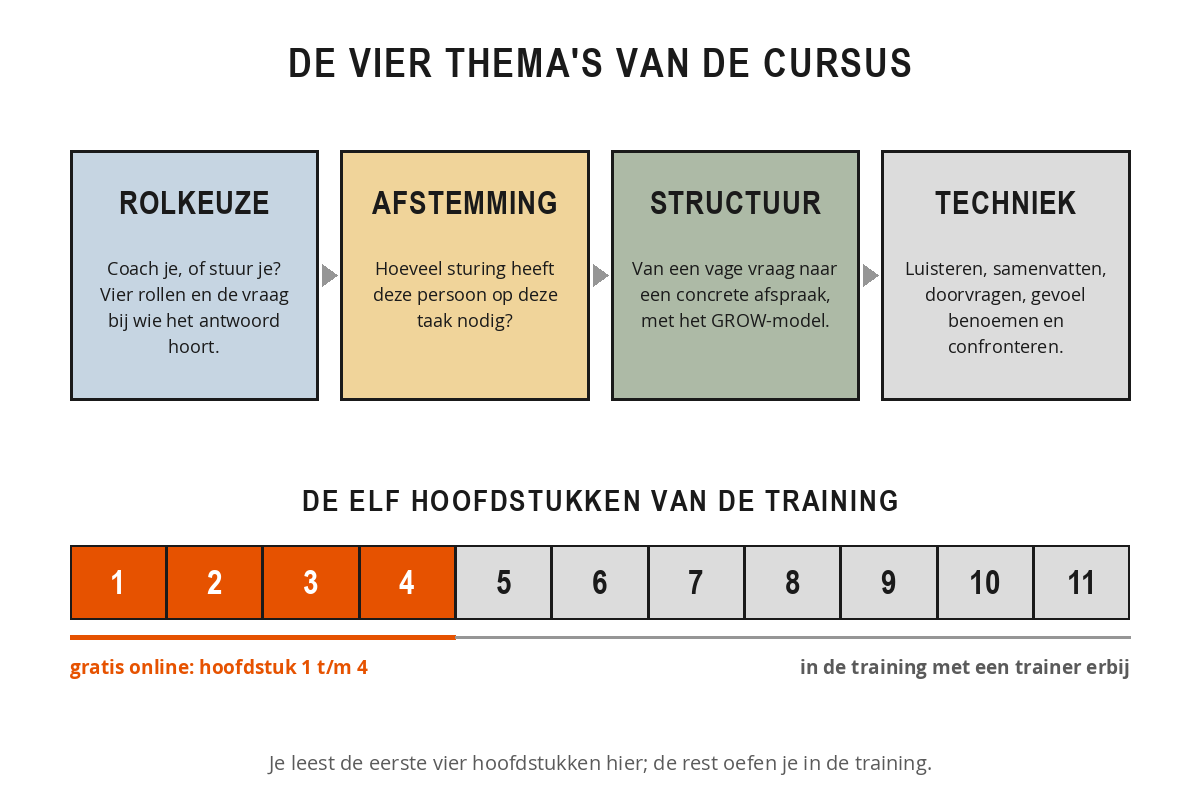
This free course contains the first four chapters: the orange part of the bar above. At the bottom of chapter 4 you will find the full course.
What you will learn
First you learn to choose. Coaching is not always the best answer, and a manager who takes a coaching approach to everything gets just as stuck as one who spells out every answer. In chapter 1 you place four roles side by side, from instructing to coaching, and you see which question tells you which role fits here. In chapter 2 that choice becomes concrete per person and per task, using the model of Hersey and Blanchard: two questions, four quadrants, four styles.
After that, the conversation itself becomes the subject. Chapter 3 gives you a backbone with the GROW model, so that a conversation arrives somewhere instead of pleasantly drifting. Chapter 4 is about what you do in that conversation: listening on three levels, summarising so that the other person hears himself, and probing at the point where it gets interesting. Plus the types of question that go with it, and the four you fall for.
The common thread: you steer the process, the other person keeps the answer. That is slower than telling them how to do it yourself, and it is the only way someone will work it out without you next time.
How the course is structured
The course follows four themes that build on one another. You start with choice of role: when do you coach, and when do you do something else? Then comes adapting: how much direction and how much space does this person need on this task? Then comes conversation structure: how does a conversation move from a vague question to a concrete agreement? And you finish with conversation technique: listening, summarising, asking follow-up questions, naming feelings, confronting and giving feedback. Each chapter contains a model, examples from practice and an exercise you apply to your own conversations.
Practical tips for use
- Keep a notepad or a blank document to hand. The exercises only work if you actually fill them in, and they work better with a conversation from last week than with a made-up example.
- Pick one technique per chapter and use it deliberately in a real conversation the following week. Trying everything at once is counterproductive, because then you're mainly occupied with yourself instead of with the other person.
- Do not read it all in one go. Between two chapters lies the time in which you try something and notice what it does.
- After a coaching conversation, take two minutes to write down what worked and what didn't. It costs almost nothing and yields more than the chapter itself.
- Find someone to practise with. A colleague who tells you afterwards at which moment the conversation became yours instead of theirs will almost always point out your pitfall.
Each chapter ends with a short knowledge check of three questions: answer them correctly to mark the chapter as completed. Your progress is saved automatically in your browser.
Enjoy the read. And if halfway through you notice that you're keeping quiet in a conversation while you have a solution at the ready: then it's working.