


1. When do you coach, and when do you direct?
A trainer knows where the conversation should go. A coach does not, and that is exactly the point. That single difference in starting point determines everything you say and leave unsaid in a conversation. And it also determines when coaching is the best thing you can do, and when it is the most roundabout way of helping someone.
After this chapter:
- You know the four roles on the line from instructing to coaching and what each role asks of you.
- Can you tell from a single question which role fits a situation: whose answer is it?
- You know in which four situations coaching within a team delivers the most.
- You recognise the three moments when coaching actually works against you.
- You know what the hierarchical relationship does to a coaching conversation and how to address it.
Four roles on one line
Instructing, advising, mentoring and coaching are often used interchangeably, while they are four different things. The difference always sits in the same place: with whom does the answer lie, and who owns the next step after the conversation? The further you move to the right along the line, the less you contribute and the more the other person has to do themselves.
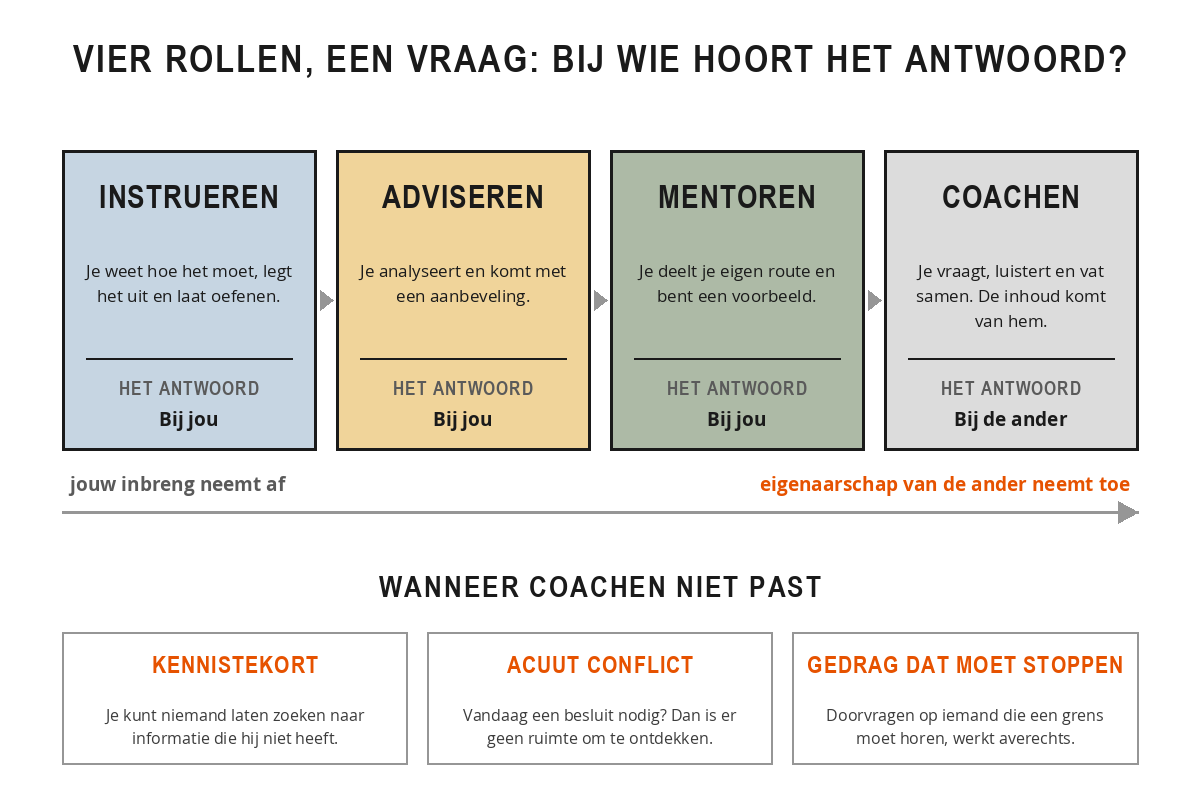
Instructing sits at the far left. You know how it should be done, you explain it and you have the person practise. The learning objective is fixed before the conversation begins, and there is a right answer. That is not a poor role, it is the only role that works when knowledge is missing. Someone who does not know how an appraisal interview is structured will not find that out through open questions. So you explain it, have them practise it, and then coach on what happens in the execution.
Advising is a step to the right. You analyse the issue and come up with a recommendation: "Based on these figures I would set the planning weekly rather than monthly." The value lies in your own judgement of the content, and that is often quick and useful. The drawback is that the insight stays borrowed. If the situation is slightly different a month later, the question comes back to you.
Mentors is the role of the experienced professional who shares his own route. You explain how you tackled it yourself, you introduce someone to the people he needs to know, you set an example. The relationship runs longer and is more loosely defined than a coaching programme. The risk is that your route becomes the norm, while that route may not suit a different character at all.
Coaching sits on the right. You ask questions, listen, summarise and challenge where necessary, but you do not supply the content. You assume that the other person has the solution within them and that your questions bring it to the surface. Four verbs sum up that attitude: encouraging (you encourage people to think for themselves, even when the answer is slow in coming), facilitating (you make sure there is time, calm and a conversation without distractions), guiding (you keep an eye on the structure and stay on topic) and analysing (you notice patterns and put them back to the other person, without attaching a conclusion to them).
An employee says: "I keep getting stuck in that meeting with purchasing."
The instructor says: "I'll show you three techniques for making your point sharper. We'll practise those now."
The adviser says: "What you need to do is email an agenda in advance. Then you're in control."
The mentor says: "When I had that role, I always dropped by the buyer a quarter of an hour beforehand. Try that."
The coach says: "When exactly did it get stuck? And what were you doing at that moment?"
All four can be useful. Only in the last does the thinking stay with the employee.
Coaching leadership is a style, not a principle
Coaching leadership means improving the performance and the learning ability of your people without telling them what to do. You work in one-to-one conversations, you bring ideas and talents to the surface, and you leave the thinking where it belongs.
That does not mean you never give direction again. A deadline is still a deadline and a safety regulation is not up for discussion. Coaching leadership is a style you consciously choose at moments when learning matters more than speed. If the fire needs putting out, you put out the fire.
Four situations where coaching does its job
Coaching delivers most when the capacity is there but the clarity is not. Ten minutes of coaching can then save hours of floundering. Four situations keep coming up.
- Learning or sharpening a skill. Someone has to chair a meeting for the first time, deliver bad news or learn to delegate. In principle he can do it, he has just never done it this way before.
- Bringing structure to new responsibilities. Someone has just moved up and is drowning in their range of tasks. The question is not what needs to be done, but where to start and what has to be finished first.
- Increasing self-knowledge and self-confidence. Someone with a clear view of their strengths and weaknesses chooses more deliberately and dares more. That insight cannot be told, only discovered.
- Being a sounding board. Someone in a solitary role has no one to push back. You do not add a solution, you reflect back what you hear: "That is the third time you have used the word loyalty." For some people that is the only place where doubt may be voiced out loud.
Sanne has been leading a project team for two months and is stuck with a team member who does not keep to agreements. Her manager feels the urge to say: "Just tackle him about it." Instead he asks: "What have you tried so far?" and then: "What is stopping you from having that conversation?"
After ten minutes it turns out Sanne is afraid the team member thinks she is too young. That is a completely different issue from the one she came in with, and it is one she can take forward herself. With "just raise it with him" the conversation would have been over in twenty seconds, and Sanne would have walked out of the door with exactly the same problem.
Where coaching breaks down
Three situations call for a different kind of conversation. In the case of an knowledge gap asking further questions is pointless: you cannot make someone search for information they do not have. In the case of a acute conflict or a situation that has to be decided today, there is no room for a journey of discovery. And with behaviour that simply has to stop, coaching is simply unclear. Asking probing questions of someone who really needs to hear a boundary is kindly meant but counterproductive: he walks away with the idea that the matter is still open.
Do you notice that you want to give a piece of advice? Then ask permission first: "I have an idea, would you like to hear it or would you rather think it through yourself first?" That way you visibly switch roles instead of slipping into one unnoticed. And if you do share the idea, say that it is yours.
The boss as coach
If you coach your own people, you have a major advantage: you know the organisation, the culture and the work from the inside. Nobody has to explain to you who that buyer is. At the same time, there is a second line between you that cannot be wished away: you appraise, you allocate the work, you sign off the promotion. The power relationship does not disappear the moment you say the conversation is confidential.
In practice you run into three things. Sharing selectively: your employee tells you what makes him look competent and leaves out the doubt, while that doubt is precisely the material coaching runs on. A hidden agenda on your side: you hear something that you, as a manager, have to act on, and suddenly the confidentiality you promised is no longer tenable. And advice that lands as an instruction: a suggestion from a manager sounds different from the same suggestion made by a neutral conversation partner. It gets carried out instead of examined.
If the topic is sensitive and touches on your own role, there are two ways round it. With cross-coaching you guide someone from another department, and a fellow manager does the same for someone from your team: the organisational knowledge remains, the appraisal role falls away. With a external coach you bring in someone from outside who has no position, interest or history within the company, which means criticism of the leadership can also be put on the table. What they do lack is the context.
If you do coach your own people, make the dual role explicit at the start: "This conversation is about your development and will not end up in your appraisal. If something comes up that I do have to act on as your manager, I will say so at that moment." Tension that is named is workable, tension that is left unnamed is not.
Take a conversation from the past two weeks in which someone brought you a problem.
- Describe in two sentences what was going on.
- Write down word for word what you said, as well as you can remember it.
- Which of the four roles was that: instructing, advising, mentoring or coaching?
- Was that the right role? Look at the four situations above and at the three in which coaching breaks down.
- Formulate one question you could have asked instead.
Then pick three people from your team with whom you regularly hold development conversations, and note down for each person which role would deliver the most at this moment. If you end up at "does not fit", write down which conversation does need to be held instead.
Summary
- Four roles on one line: instructing, advising, mentoring, coaching. Moving to the right, the person guiding contributes less and the other person takes more ownership.
- The question that determines the role: whose answer is it, and who takes the next step?
- Coaching leadership is a style you choose deliberately, not a principle that always applies.
- Coaching works when sharpening a skill, finding structure in a new role, increasing self-knowledge and acting as a sounding board.
- Coaching breaks down when there is a knowledge gap, an acute conflict, or behaviour that has to stop.
- If you coach your own people, the hierarchy is always present: selective sharing, a double agenda on your side, and advice that lands as an instruction.
- Name the dual role out loud, or opt for cross-coaching or an external coach.
According to this chapter, what is the difference between the adviser and the coach?
An employee has to hold a progress review for the first time next week and does not know how such a conversation is structured. What is the right role here?
You are coaching a member of your own team. What does this chapter say about the hierarchy that plays a part in this?