


4. Listening, summarising and asking follow-up questions
LSD stands for luisteren, samenvatten and doorvragen: listening, summarising and asking follow-up questions. Those three movements follow one another again and again in a conversation, and together they do most of the work. The GROW model from chapter 3 tells you where the conversation is heading. LSD is what you do along the way.
After this chapter:
- You know why the order of listening, summarising and probing is no coincidence.
- Listen deliberately on three levels: content, feeling and signal.
- Summarise in your own words, with a check at the end.
- You recognise the difference between an open, a closed and a leading question.
- You avoid the four pitfalls when asking questions.
The cycle
You listen first, you summarise what you heard, and only then do you probe on what stands out. After that you start again, one layer deeper. That sequence is no accident. Skip the listening and you'll be summarising your own interpretation. Skip the summarising and you'll be asking questions that land beside the story.
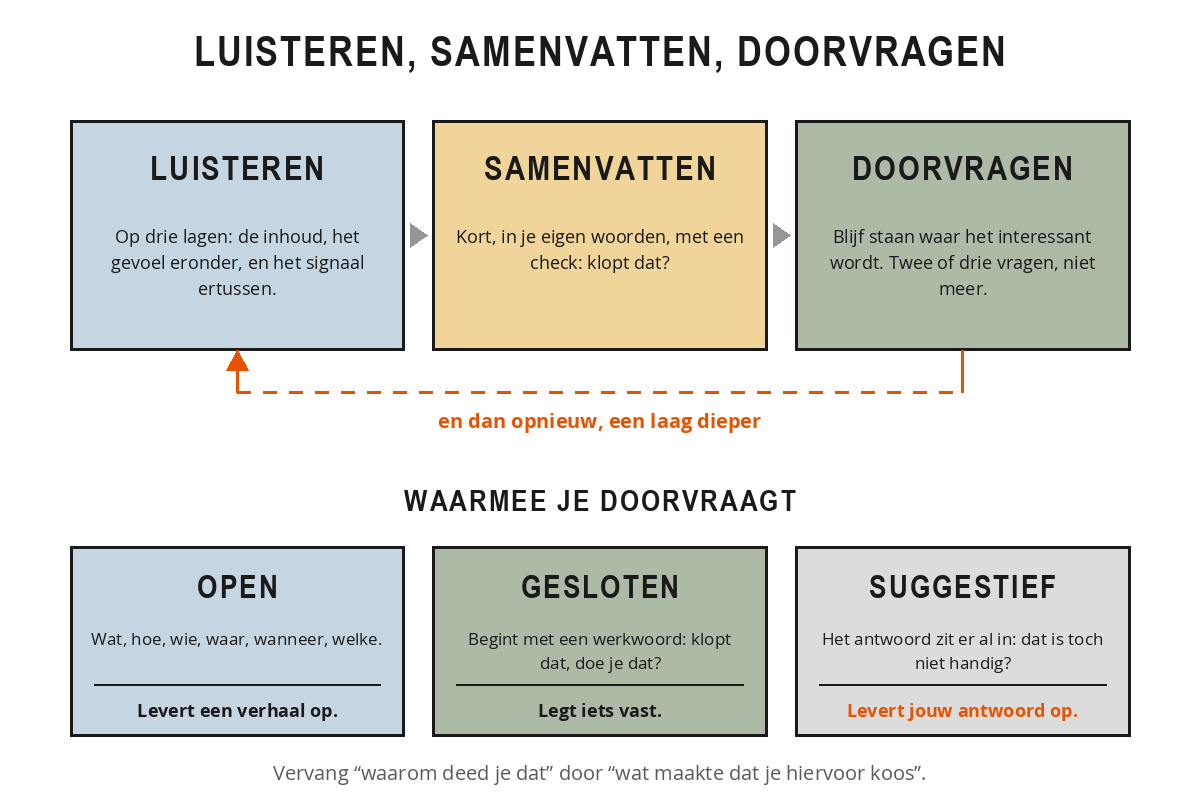
If a conversation stays flat, you are almost always skipping the middle step: you reel off a neat row of open questions without ever giving anything back. The other person supplies the answers, you tick off your list, and at the end nobody knows anything new.
Active listening
Active listening means following what the other person says with your full attention, and making that attention visible as well. The difference with simply hearing lies in two things: you interrupt your own thought process, and you show that you are following along. If you are mentally formulating your next question, you are no longer listening, however quiet you may be.
That takes energy. You suspend your judgement, keep your own experience out of the conversation and tolerate the silence that falls after someone has finished speaking. Five things in your attitude determine whether he dares to say more:
- Eye contact. You seek contact without staring. If you look away as soon as the subject becomes sensitive, he reads that as discomfort on your part, and he helps you out by changing the subject.
- Open posture. Crossed arms and a turned-away torso close you off, even if you don't mean it that way.
- A slight forward lean. Sitting slightly forward reads as engagement, leaning back as judging.
- Small acknowledgements. A nod, an "mm-hm", a brief repetition of a single word. Enough to show that you are following, short enough not to take over the story.
- Keep a calm pace. No glance at the clock, no tapping pen, no quickening of your voice. Anyone who radiates haste gets short answers.
Your phone doesn't go on silent, it goes away altogether. Put your notepad at an angle so you can look over it. Taking notes is fine, as long as the other person sees your eyes more often than the top of your head.
Three layers of listening
While someone is talking, you are gathering information on three layers at once. Those three layers provide the material for your summary and your follow-up questions.
The content layer is about the facts: what happened, when, who was there, what he did himself. This is the layer that lands most easily, and the one where most people linger too long.
The feeling layer lies beneath it: irritation, relief, embarrassment, resignation. You pick this up from the tone and pace at which someone tells his story, and from the point where he suddenly starts speaking faster or falters.
The signal layer is about the difference between what someone says and how he sits there. Such a mismatch is not proof, but it is an indication that there is more going on. What is not mentioned is information too: the colleague who features in none of the examples, or the conversation that keeps being skipped.
Summarising in your own words
Summarising means briefly giving back what you have heard, in your own wording, so the other person can confirm or correct it. You do three things at once with it: you check whether you have understood correctly, you show that you have listened, and you give him his own story back in an ordered form. That last one usually yields the most. Someone who suddenly hears their own chaos in four sentences sees for themselves where the knot is.
A summary consists of three parts. The factual core: what happened, who was there, what he did himself. The undercurrent: the mood you heard underneath it, cautiously phrased, with "I also hear some irritation in that". And the check: "Is that right?" or "What am I still missing?" Without that check it isn't a summary but a conclusion.
Use your own words, not his. Repeating him verbatim sounds like an echo and automatically produces a "yes". If you choose different words, he has to stop and think about whether it's right, and it is precisely in that thinking that sharpness arises.
Coachee: "I raised it in the team meeting, but nothing happened. And again last week, nothing. I don't know whether I'm putting it clearly enough either, because afterwards I never hear anything more about it."
Coach: "You've raised it twice, there was no response, and you're starting to wonder whether it's down to the way you're putting it. Is that right?"
Coachee: "Yes... well, actually I doubt more whether they think it's important."
The correction to the summary is what brings out the real subject here. Had the summary been skipped, the conversation would have spent the rest of the hour on presentation technique.
Summarise briefly and often. Three sentences halfway through the story work better than a two-minute monologue at the end. A summary that takes longer than the answer to it is too long.
Open, closed, leading
The form of your question determines the length of the answer. With a handful of words' difference you either open up a story or close it down, often without noticing.
A open question cannot be answered with yes or no. The other person has to find words for it, and it is precisely in that search that the thinking happens. Open questions start with what, how, who, where, when or which. "How did that meeting go?" produces a story. "Did that meeting go well?" produces a single word. The curiosity is the same, the conversation is completely different.
A closed question allows only a few answers: yes, no, a number or a choice between two. It starts with a verb. Closed questions have a bad name in coaching programmes, and undeservedly so: they are unsuitable for drawing out a story and excellent for pinning something down. In the check after a summary ("Is that right?"), in sharpening up an agreement ("Will you do that before Friday?") and in narrowing down a rambling story ("Is it mainly about that one colleague?") they do exactly the right thing.
A leading question already has the desired answer packed into it. You are not asking what the other person thinks; you are offering him what he ought to think and hoping he'll agree. You recognise them by four building blocks: the built-in assumption ("Why do you keep putting off that conversation?"), the tacked-on tag ("That's not really very sensible, is it?"), the disguised suggestion ("Have you considered just discussing it with her?") and the loaded word ("How do you deal with that difficult colleague?").
Mark is a team leader and is talking to Ilse about working with the purchasing department. He sees the solution straight away and wraps it up: "Wouldn't it make sense just to sit down with Bas?" Ilse says yes. They note it down as an action, for Friday.
Three weeks later the conversation with Bas still hasn't happened, and Mark wonders why Ilse doesn't stick to agreements. In the next conversation he puts it differently: "What have you tried so far?" It turns out Ilse has emailed Bas twice and got no reply, and that she feels he is deliberately ignoring her. Sitting down for a conversation was never her problem. That was Mark's agreement, which is why it didn't happen.
The problem with a leading question is not its politeness, but its result. You get an answer that fits your picture, not his. He goes along with it because agreeing is easier than correcting you, certainly if you are his manager. Two weeks later the agreement turns out not to have been carried out, and that is only logical: it was your idea.
Keeping why-questions separate
"Why" is grammatically an open question, but it behaves differently. "Why didn't you say so?" asks for a defence, not for an exploration. People start justifying themselves and come up with a reason afterwards that sounds tidy. You get the same information without that pressure: instead of "Why did you do that?" you ask "What made you choose this?", and instead of "Why doesn't that work?" you ask "What is getting in the way?"
Do you keep getting short answers? Then listen to your own last three questions. Chances are they all started with a verb. A question that starts with "Can you", "Have you" or "Do you think" is a closed question in disguise.
Probing: staying put where it gets interesting
Probing means exploring something that has just been said further, rather than moving on to a new subject. People compress their experience into words, and in doing so information disappears: who did something, how often, according to whom. That omitted information is often the most interesting part of the story.
"They never listen to me" is one such compression: never is rarely never, and they is rarely everyone. "Who exactly did that, and when was the last time?" brings it back to something that actually exists. "That's just not possible" is another: "What would happen if you did it anyway?" brings the brake into view. And with "it's unprofessional" you ask "What makes you say that?", because that word means something different to everyone.
Probing doesn't mean conducting an interrogation. Two or three follow-up questions on one point are enough. After that you summarise and hand the conversation back.
Four pitfalls
- The multiple question. You ask three at once and the other person answers the last one or the easiest one. One question at a time, and then wait.
- The why question. Anyone who has to justify themselves starts defending rather than exploring.
- The question that is really a piece of advice. It mainly forces its way in when you are in a hurry or think you already know the answer. Do you notice halfway through your sentence that you are packaging up a solution? Then finish the sentence as a statement and add an open question after it: "I'm thinking of a conversation with her myself. What do you think?" That way it is clear what is yours and what is his.
- The interrogation pace. Perfectly good open questions, but with no summary in between. After two or three questions, give back what you heard and check whether it's right.
Have a ten-minute conversation with a colleague about something he is currently struggling with. You ask a maximum of three questions; for the rest you only listen. Note down immediately afterwards:
- Contents: three facts he mentioned.
- Feeling: which mood you heard underneath the account, and what made you notice it.
- Signal: one moment where words and body language did not match.
- Yourself: how often you noticed that you already had a response ready in your head.
Then ask him whether he felt heard, and what made him feel that way. In a subsequent conversation, tally for each question you ask whether it was open, closed or leading, how many questions you asked in a row without summarising, and how many why-questions there were. Rewrite every leading question and every why-question into an open variant.
Summary
- Listening, summarising, probing: you repeat that sequence over and over, going one layer deeper each round.
- Active listening is visible listening: eye contact, an open posture, leaning slightly forward, small acknowledgements and a calm pace.
- You listen on three levels: the content, the feeling underneath it, and the signal between words and posture.
- A summary contains the factual core, the undercurrent and a check. Without the check it is a conclusion.
- Summarise in your own words. Repeating verbatim automatically produces a "yes".
- Open questions draw out a story, closed questions pin something down, leading questions give you your own answer back in his words.
- Replace "why" with "what made you" or "what is getting in the way".
- Four pitfalls: the multiple question, the why-question, the disguised advice and the interrogation pace.
Why do you summarise in your own words instead of repeating verbatim what someone said?
"Have you considered just having a quick word with her about it?" What kind of question is this?
You ask perfectly good open questions, but the conversation stays on the surface. Which step are you probably skipping, according to this chapter?
Ready for the next step?
You have completed the free starter of Coaching Skills. The next chapter in the full course is The communication model and the laws of communication: How a message becomes distorted along the way, where noise comes from and why two people remember the same conversation differently.
Take the 2-day course →From €1250,- excl. VAT · with an experienced trainer included