


3. Structure in your conversation with the GROW model
Four letters, four steps. The GROW model gives a coaching conversation a backbone without nailing everything down. John Whitmore made it well known, and it is still the simplest answer to the question of why so many well-intentioned conversations end in a pleasant feeling without anything changing.
After this chapter:
- You know what the four letters of GROW stand for and how they follow on from each other.
- Do you formulate a goal on two levels: the goal of the overall programme and the goal of this particular conversation?
- You map out the current situation without immediately attaching a solution to it.
- You know how to get past the first two solutions the other person already had in mind.
- You close with an agreement that is small, concrete and the other person's own.
Goal, Reality, Options, Will
The four letters stand for four phases. In Goal you determine what the conversation is working towards. With Reality you map out what is actually happening now. At Options you gather options, as many as possible, without weighing them up straight away. And at Will, the closing, the other person picks one and says out loud what he is going to do.
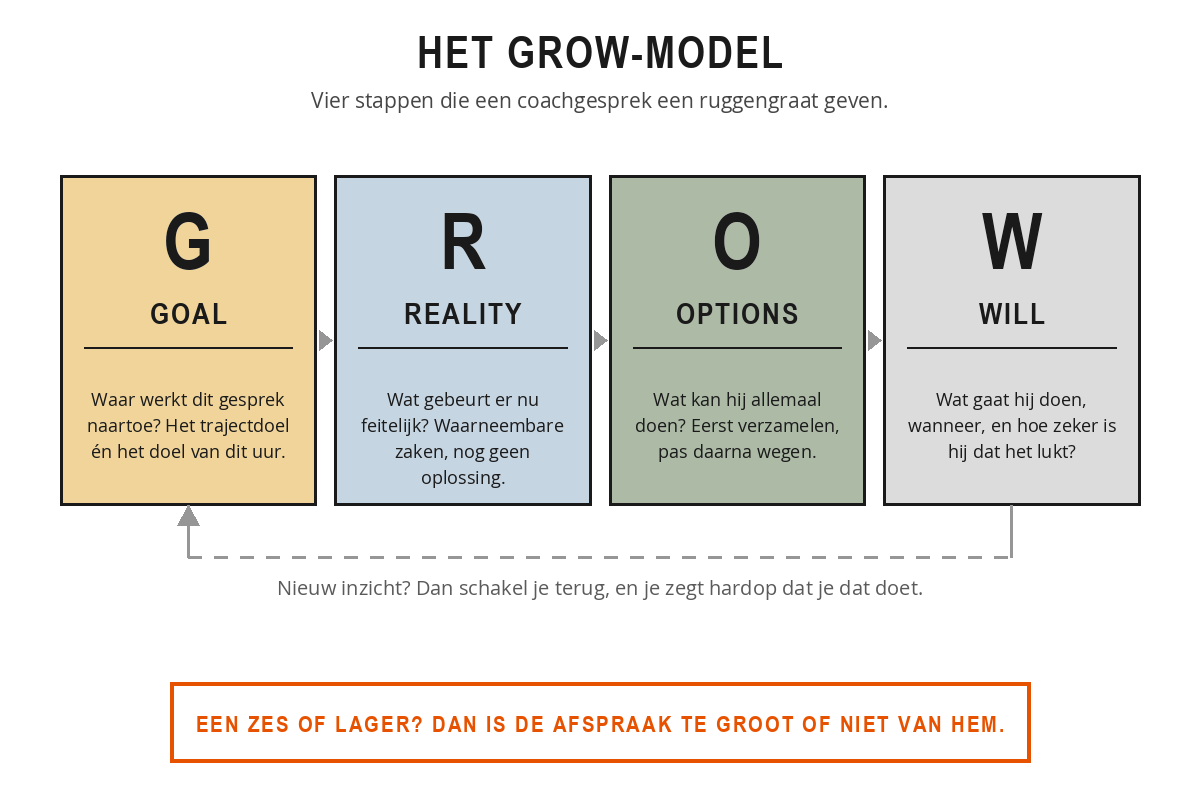
The order is not a law, but it does give you something to hold on to. In practice you regularly jump back: someone who discovers something new during Reality will sharpen up his goal. That's a gain, not a mistake.
Goal: the objective in two layers
This is almost always where it goes wrong, and always in the same way. You ask what someone wants to talk about, he names a theme, and that theme becomes the conversation. A theme is not a goal. "Dealing better with workload" is a direction you can spend six months on without ever finishing anything.
That is why you work on two levels. The overall goal is the behaviour that should be in place a few months from now. The session goal is what has to be concretely finished within this hour. Without that second layer, a conversation drifts from theme to theme and ends with "nice talk", without anyone being able to say what is now different.
Coach: "Where do you want to end up by the end of this conversation?"
Coachee: "I want to handle pressure of work better."
Coach: "That's a good goal for the whole process. What needs to be on the table fifty minutes from now for you to say: this conversation was useful?"
Coachee: "Then I'll know which three tasks I'm handing back this week, and to whom."
The second answer can be tested. At the end of the hour, it is either there or it is not.
Write the session goal down at the start in a single sentence, on a sheet of paper that is visible to both of you. If the conversation starts to wander, you simply point at it. That works more gently than a correction in words, and it is his, not yours.
Reality: look first, solve later
At Reality you ask about observable matters. What exactly happened, when, who was there, what did he do himself and what effect did that have? Opinions and explanations come later. "He never listens" is a conclusion; "I started making my point three times and was talked over three times" is the reality you can work with.
The biggest pitfall in this phase is haste. You hear the problem, you recognise it, and you move on to the solution. But as long as the situation is not clear, a solution solves something that may not be the problem. Two extra minutes at Reality saves half a conversation at Options.
Options: beyond the first two
The third phase is about quantity, not quality. Someone who comes to you with an issue usually already has two solutions in mind, and those are exactly the two that have not worked so far. Only beyond those two does room for something new appear.
So judgement stays outside the door for the moment, including yours. Impossible ideas stay on the list too, because an unworkable idea often contains a usable principle. And you yourself stay silent as long as possible: the moment you make a suggestion, the other person stops thinking and starts assessing your proposal.
- Gather first, without weighing up. Let him list whatever comes to mind and write it all down, including the things he tosses in with a laugh.
- Broaden things out if he gets stuck. "Suppose time and money were no object, what would you do then?" or "What would someone you admire try here?"
- Ask about the opposite. "What would you do to make the situation worse for certain?" Turning the question around often produces sharp insights, and it lightens the mood as well.
- Only then test it against the goal. Now judgement is allowed: which options bring him closer to what he wants?
- Keep two or three. More choice tends to slow the decision down rather than help it.
Coachee: "I only see two things: hand that task back or just grit my teeth and get on with it."
Coach: "Two is not many. What else could you come up with, even if it sounds nonsensical?"
Coachee: "I could split it up. Or ask someone to look over the difficult part with me. Or ask Anne how she did it last year."
Coach: "That's five already. Which three have the best chance of getting you finished on time?"
The third option, asking Anne, was not on his list when he walked in. He came up with it himself, and so he will act on it too.
Will: from conversation to agreement
A conversation that ends with "I'll think about it" is a conversation without a conclusion. In the closing stage, the other person states for himself what he is going to do, when he is going to do it and how he will know it has worked. You pay attention to four things: the action fits within the time until the next conversation, is described in terms of behaviour, is tied to a specific moment, and has a named obstacle with an answer attached to it. If that last element is missing, the agreement will fall apart at the first busy moment.
Finally, you ask how confident he is that it will work out, on a scale of one to ten. That number is the most useful measuring instrument in the entire model. At a six or lower, the agreement is too big, or it is not his own. In that case you scale it down together to a step that does score an eight. An eight that actually happens is worth more than a ten that you invented.
Holding on to the thread
The letters suggest a straight line, but a conversation rarely runs that way. Halfway through the exploration the goal turns out to be too broad, or while generating options a fact comes up that had not been mentioned earlier. That is not a flaw in the model, that is the model working.
What you hold on to is not the order but the goal. As long as you know where the conversation needs to end up, you can safely take a side path. You simply mark out loud that you are shifting back: "What you're telling me now puts the goal in a different light. Shall we sharpen that up again first?" That way he remains the owner of the direction and you don't lose the structure.
Three signals tell you that the thread is slipping away. The conversation turns into a story: he talks at length about others and about the history, while his own part in it disappears from view. The options are about a different problem: the solutions that come up do not match the goal set at the start. Time is up and no choice has been made: every stage has been touched on, not one has been completed.
Prepare a conversation that you will be having shortly. Work it out on paper:
- Goal for the whole process: the desired behaviour a few months from now.
- Session goal: what will be finished after this one conversation, in such a way that you can check it at the end.
- Facts: three observable events from the past two weeks.
- Difference: what stands out to you between the goal and the current situation?
Then work out the closing stage, one sentence per point: what exactly is he going to do, when precisely, how will he know it has worked, what could get in the way and what will he do then, and what confidence score does he give himself? If that score is below seven, make the step smaller until he does stand behind it.
Summary
- GROW gives you four phases: Goal, Reality (current situation), Options and Will (agreement).
- The goal has two layers: the overall goal spanning months, and the session goal that is completed by the end of this hour.
- At Reality you ask about observable facts. Moving on to solutions too quickly solves something that may not be the problem.
- At Options, quantity comes before quality. The first two solutions are the two that were already not working.
- Keep your own suggestions to yourself: the moment you propose something, the other person stops thinking.
- Close with an agreement that is described in terms of behaviour, is tied to a moment and has an obstacle with an answer to it.
- Test it with a confidence score. Six or lower means: too big, or not his.
- Going back a step is fine, as long as you say out loud that you are doing it. You hold on to the goal, not to the order.
Someone gives as their goal: "I want to communicate better with my team". According to this chapter, what do you do with that?
Why do you hold back your own solution for as long as possible during the Options stage?
At the end of the conversation, someone gives himself a five when asked how confident he is that the agreement will work out. What do you do?