


Introduction
Figures are the language of an organisation. You do not have to speak that language fluently, but you do have to be able to follow it. Because sooner or later a balance sheet will be slid across the table, your director will ask you to substantiate your budget, or the controller will explain that your department is going 12,000 euros over. At that moment it helps enormously if you know what is there, what it means and which question to ask.
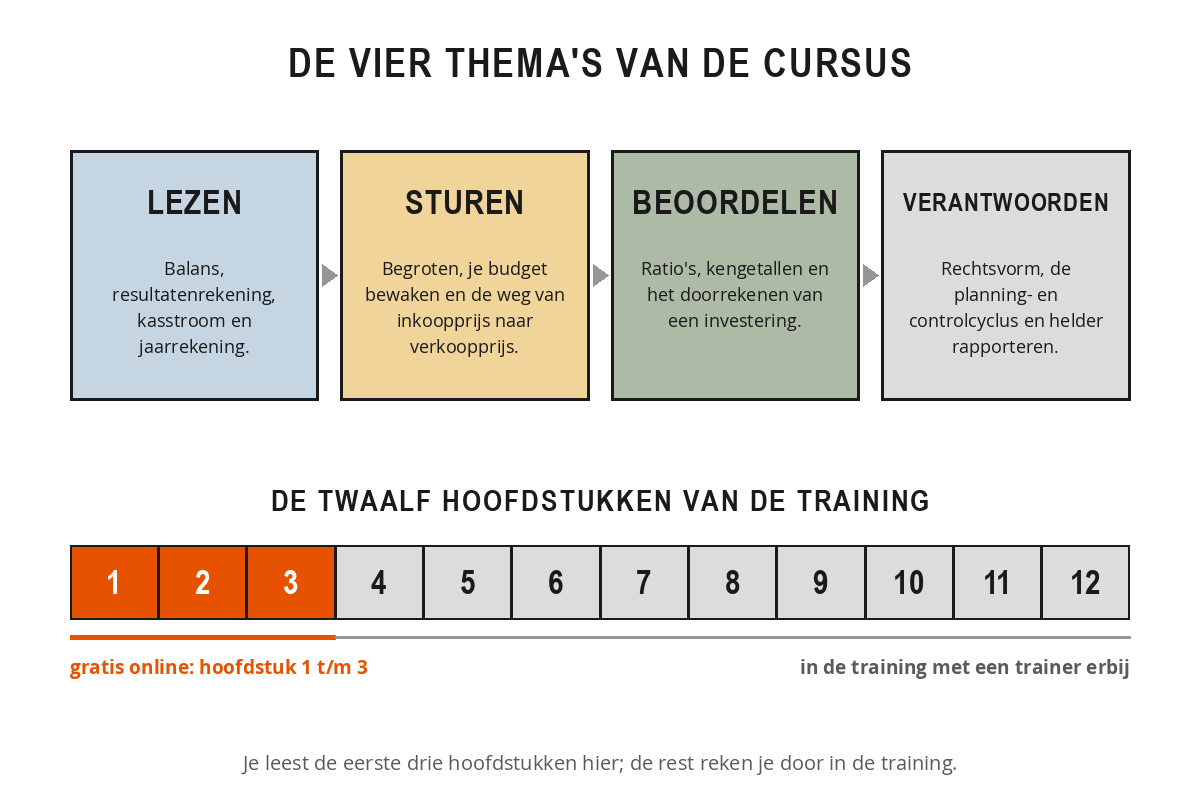
This free course contains the first three chapters: the orange part of the bar above. At the bottom of chapter 3 you will find the full course.
What you will learn
You start with the balance sheet: what an organisation owns, how that has been paid for and why those two sides are always equal. Then comes the profit and loss account, which shows what came in over the year, which costs stood against it and what was left at the bottom line. In the third chapter it gets close to home: your own budget plan and your own budget, and what you do when reality deviates from the plan. After that the course moves on to cash flow, annual accounts, ratios, investments, pricing, legal forms, the planning and control cycle and reporting.
You will not learn bookkeeping. Afterwards you do not need to be able to make a journal entry or draw up a set of annual accounts. What matters is that you can join the conversation, that you understand a report and that you ask your controller the question that counts.
How the course is structured
The course follows four themes that build on one another. You start with reading: the balance sheet, the profit and loss account, cash flow and the annual accounts. Then comes send: budgeting, keeping an eye on your budget and the route from purchase price to selling price. After that comes assessing: ratios, key figures and investment proposals. And you finish with accounting: the legal form, the planning and control cycle and a report that your management can actually use. Each chapter contains explanation, a model, examples from practice and an exercise on your own figures.
Practical tips for use
- Get out a recent set of annual accounts, from your own organisation or from a company you know. The material sinks in much faster if you apply it to real figures straight away.
- Keep a notepad to hand for terms that are new to you. By the end you will have your own glossary.
- Don't skip the exercises. You gain financial insight by doing the sums yourself, not by reading that it can be done.
- Don't read it all in one go. One chapter a week, with time to try it out, delivers more than reading through it in an afternoon.
- After each chapter, go through your own monthly report again. You will see a little more in it every time.
Each chapter ends with a short knowledge check of three questions: answer them correctly to mark the chapter as completed. Your progress is saved automatically in your browser.
The amounts in this course are deliberately small and round. Not because it is that easy in practice, but because you see a principle more quickly in whole euros than in a table with eight decimal places.