


3. Budgeting and monitoring your budget
The balance sheet and the profit and loss account are about the organisation as a whole. Your budget is about you. It is the part of the overall budget with your name on it, and the questions the controller asks you about it come back every month. This chapter is about how such a budget comes about, how you keep an eye on it throughout the year and what you do when reality deviates from the plan.
After this chapter:
- Keep your budget plan, budget and forecast separate.
- You know the five functions a budget fulfils at the same time, and why these sometimes conflict with each other.
- Whether you can assess a variance pro rata instead of being alarmed by a large number.
- You know when a variance is a problem and when it is a matter of timing.
- You know the four ways of making adjustments and what your controller expects of you.
Three words that are used interchangeably
In everyday conversation, budget, allocation and forecast mean roughly the same thing. In a conversation with your controller they do not, and that difference is precisely why those conversations sometimes talk at cross purposes.
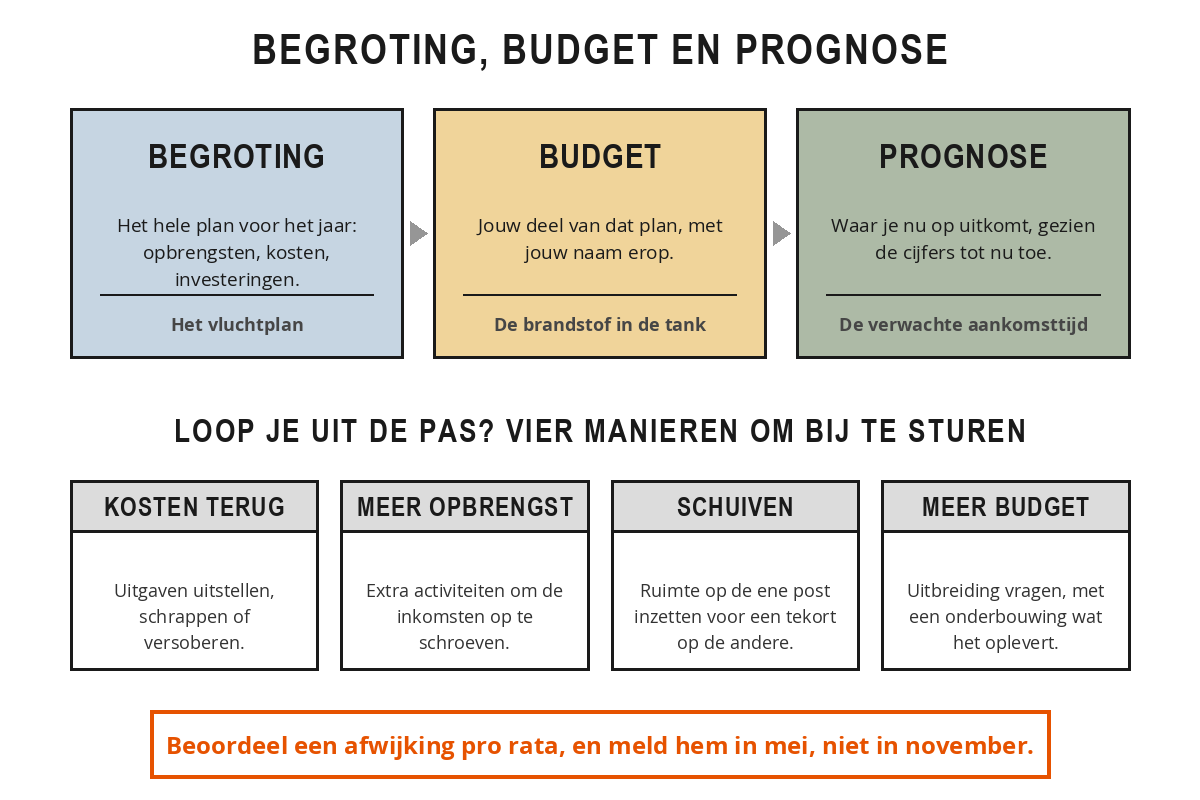
The budget is the entire financial plan for a period, usually a year: all expected income, all costs, the investments and the liquidity of the organisation or a part of it. The budget is the amount allocated within that budget plan to your department, project or cost item. That is your spending scope, and you do not simply exceed it. The forecast is a revised estimate of where you will end up at the end of the year, based on the actual figures so far. The budget stays as it is; the forecast moves with the figures.
An image that sticks: the budget plan is the flight plan, the budget is the fuel in the tank, and the forecast is what the captain announces halfway through about the expected arrival time.
Five things a budget does at the same time
A budget is not just a spreadsheet. It does five things at once, and that explains why a budget round often runs less smoothly than you would expect.
Planning. You are forced to make concrete what you want. An intention such as "we want to grow in the business market" becomes, in the budget, a revenue figure, a number of people and a marketing amount. Coordinating. If sales budgets twenty per cent more revenue, production has to make more, human resources needs to know that people will be joining and the finance department needs to know that more working capital is required. Steering. Without a budget you do not know whether an outcome is good or bad: 200.000 euro in revenue is excellent if you expected 150.000 and disastrous if you promised 400.000. Motivating. Targets only work if they are challenging and achievable. Too easy leads to complacency, unachievable to cynicism. And justifying. At the end you explain what you promised, what you achieved and how you account for the difference.
The last two functions conflict with the first three. As a budget holder you want room to manoeuvre, because then you are not held to account too quickly. As a board you want a tight budget, because that forces sharpness. That game is part of the process, but it can degenerate into a ritual in which everyone knows the first version is ten per cent too high and that it will end up somewhere in the middle. At that point nobody believes the budget any more, and its function as a control instrument is gone.
Do you notice that in your organisation it is mainly about accounting for results and hardly about planning? Then watch for two signals. Budget holders who deliberately estimate their figures low so that they are sure to meet them, and departments that quickly spend money in December so that they are not cut back next year. Both are signs of a budget that has become an instrument of reckoning.
Types of budget
Not every budget works the same way, and its form says something about how much room you have. The operating budget is what you as a manager deal with most: the day-to-day running of things, for a full year. Salaries, rent, materials, marketing, travel costs. The investment budget is for purchases that last several years, and is usually approved separately and at a higher level, because the amounts are larger and work through for longer via depreciation. The project budget has a beginning and an end: its own objective, its own duration, its own owner, and usually a contingency item of five to ten per cent.
A budget is also either fixed or flexible. A fixed budget is fixed at the start of the year: this is what you get, this is what you work with. Predictable, but rigid. A flexible budget moves with a driver variable, usually turnover or production: if you sell twenty per cent more, then selling costs are allowed to move along, because they belong to that extra turnover. That suits a production department, whereas a fixed budget makes more sense for a support department.
An operating budget is often spread over twelve months, but rarely in equal parts. Marketing costs peak around a campaign, staff costs rise because of holiday pay in May and a thirteenth month in December. A good distribution follows the rhythm of your work, not the calendar. So always ask how your budget has been spread across the year, because that is what your variance will be measured against.
Assessing the variance pro rata
Every month you receive a report with three columns: what you have spent, what was budgeted, and the difference. That difference is called the variance. Spending under budget is a positive variance, going over it a negative one.
The catch is in the comparison. You do not set your spending against the annual budget, but against what has been budgeted up to now. That is called pro rata. Without that step you either take fright at every figure or fall asleep until it is too late.
Your marketing budget is 120.000 euro for the year. After four months you have spent 50.000 euro of it. Pro rata you should have been at 40.000 euro, so you are 10.000 euro in the red. But in March a campaign was paid for that runs all year. In that case the 10.000 euro is not an overrun but a matter of timing: the money was spent earlier than budgeted, not on top of it.
That is the question you ask with every deviation: is this structural or is this timing? With timing it corrects itself, and you report it so that no one is caught off guard. With a structural deviation that does not happen, and you have to act.
Bram manages the IT department and has 60,000 euros of budget for external hires. By the end of May, 42,000 euros of that has already gone: seventy per cent of the budget, while only 42 per cent of the year has passed. His first reaction is alarm. His second reaction is to do the sums. Two large projects ran in the first quarter and have been completed. For the rest of the year there is only support of around 2,500 euros a month, so seven months times 2,500 is 17,500 euros. His forecast comes out at 59,500 euros: just within budget. No problem, then, but worth recording with the controller so that nobody raises the alarm in July after all.
Looking ahead with a forecast
Looking back at what you have spent is useful. Looking ahead at what is still to come is more important. For that you make a forecast, usually again each quarter. You take the actual figures to date, add your best estimate for the rest of the year and set the total alongside the budget. If it deviates, you know in good time.
A forecast is not a new budget plan. The budget plan simply stands, because that is what was agreed. The forecast only says: if things carry on like this, this is where we will end up.
Four ways to adjust
If you see that you are going to go over, you have roughly four options, and you usually use two at the same time.
Reduce costs. Postponing, cancelling or scaling back expenditure. The most direct intervention and often the most painful. Increase income. If you also have a revenue budget, you can deploy extra activities to bring in more. Shifting funds within your budget. Using headroom on one line item for a shortfall on another. That is often allowed, as long as the total adds up, but do ask first. Request a budget increase. Sometimes there is a good reason for that: an unexpected opportunity, a new legal requirement, a cost item that genuinely could not be foreseen. But do come with a justification of what the organisation gets in return.
Karin has a budget of 80,000 euros for her customer service team and sees in September that she is likely to overspend by around 8,000 euros, because sickness absence was higher than expected and she had to hire agency staff. She cuts nothing in staffing, because that would push up waiting times. Instead, she moves a team training course of 5,000 euros to January and postpones the purchase of new headsets worth 3,000 euros by a quarter. Two measures, both postponement rather than cancellation, and she calls the controller before he calls her.
What your controller actually wants from you
Controllers have a reputation for watching the pennies. In practice, what they mainly want is no surprises. Three things make the conversation easier.
Firstly: honest figures. A budget you deliberately set generously to stay on the safe side stands out as soon as you come in well below it three years in a row. Secondly: reporting in good time. An overrun you report in May is a conversation. The same overrun in November is a problem, because by then nothing can be done about it. And thirdly: an explanation for the number. Not just that you have 10,000 euros left over, but why, whether it is structural and what you are doing about it. Come in like that and the controller is not an opponent but someone thinking along with you about the solution.
Take the latest budget report for your own department and answer four questions:
- Which line items are you ahead of schedule on and which are you behind on, measured against what was budgeted pro rata?
- Is each variance structural or a matter of timing? Add one sentence per item.
- Make a rough forecast for the whole year. Do you come out above or below your budget?
- Which of the four adjustment options do you use if you are at risk of going ten per cent over, and what does that choice cost?
Compare your outcome with your controller's. Where your estimates differ, you will usually find the most instructive information.
Summary
- The budget plan is the whole plan, the budget is your part of it, and the forecast is the adjusted expectation for the end of the year.
- A budget plans, coordinates, steers, motivates and justifies all at the same time. The last two functions work against the first three.
- You have an operating, investment or project budget, and that budget is either fixed or moves with a control variable.
- Always assess a variance pro rata: against what has been budgeted so far, not against the annual figure.
- For every variance, ask whether it is structural or a matter of timing. That determines whether you need to do anything.
- There are four ways to make adjustments: reducing costs, increasing revenues, shifting within your budget, or requesting an increase with supporting arguments.
- Your controller wants honest figures, timely notification and an explanation with the figure. No surprises in November.
What is the difference between a budget plan and a forecast?
Your marketing budget is 120,000 euros a year and after four months you have spent 50,000 euros. How do you assess that?
You are at risk of going over budget and want to postpone the 5,000-euro team training course until next year. Which adjustment option are you using?
Ready for the next step?
You have completed the free starter of Financial Management. The next chapter in the full course is Your organisation's financial playing field: Why financial insight pays off in your role, the basic concepts and who in the organisation is responsible for what.
Take the 3-day course →From €1875,- excl. VAT · with an experienced trainer