


Introduction
You write a proposal and there is no response. You send an email of ten lines and get three questions back, all three of which were answered in it. That is rarely down to your subject. Usually you started typing before it was clear who you were writing for and what you wanted to achieve.
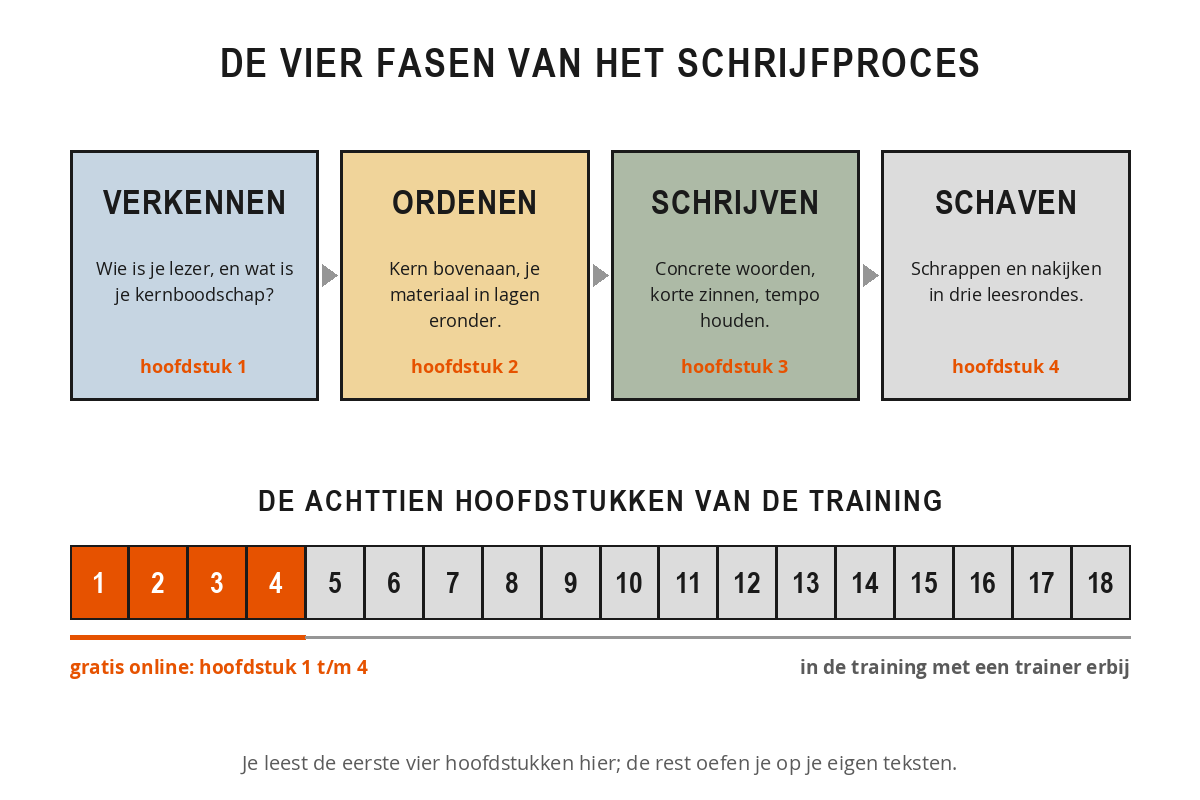
This free course consists of four chapters: the orange part of the bar above. At the bottom of chapter 4 you will find the full course.
What you will learn
Writing a text is work in four phases: exploring, ordering, writing and polishing. This course goes through all four, in that order, with one chapter per phase.
In chapter 1 you explore: you map out your reader with five questions and summarise your message in a single sentence of no more than 25 words. In chapter 2 you order: you put the core at the top according to the pyramid and choose a structure that suits your purpose. In chapter 3 you write: concrete words, verbs instead of nouns, and sentences averaging fifteen to twenty words. In chapter 4 you polish: you remove duplications, vague references and unnecessary passive forms, in three focused reading rounds.
The common thread: you do not create a clear text while typing, but while choosing. Who your reader is, what he has to do, and therefore what does not need to be in it.
How the course is structured
Each chapter begins with learning objectives and ends with a summary and a knowledge check. In between you will find the theory, a diagram, worked examples of texts that most people will recognise, and an exercise based on your own work. The examples are taken from advisory notes, emails, quotations and progress reports: the writing that takes up most of your time in the office.
Practical tips for use
- Before you start, choose one text that you actually have to write shortly. All the exercises fit that one text.
- Also keep to hand a text you sent last month. That is what you will practise cutting.
- Do not read it all in one go. One chapter a week, with time to try it out, yields more.
- Complete the exercises on paper or in a blank document. Doing them in your head feels good and changes nothing.
- Ask a colleague to read it through. You are least likely to spot your own habits in your own text.
Each chapter ends with a short knowledge check of three questions: answer them correctly to mark the chapter as completed. Your progress is saved automatically in your browser.
Enjoy the reading. And the writing, because that returns as soon as you know who you are doing it for.