


1. Writing starts with your reader
Most of the time you spend on a text goes into rewriting. That is rarely because of your sentences. It is because you started typing before it was clear who you were writing for.
After this chapter:
- You can name the four phases of the writing process and see which phase you are in.
- You create a reader profile based on five specific questions.
- You assess what information your reader needs and what you can leave out.
- You formulate the aim of your text in one testable sentence.
- You write down your core message in no more than 25 words.
Four phases: exploring, organising, writing, polishing
Writing a text is work in four phases. In the exploring you map out who your reader is, what you want to achieve with the text and what your core message will be. At this stage you do not yet write a single sentence that ends up in the text. In the organising you group your material, throw out whatever does not contribute and choose an order. The result is an outline with headings, without running sentences. During the writing you fill in that outline and keep up your pace: you do not look up synonyms, you do not agonise over commas and you do not read back. An ugly first version is exactly what this phase should produce. In the polishing you cut, check your spelling and attend to the layout.
Anyone short of time almost always skips phase 1. That looks like a saving and costs you twice as much later: halfway through you notice that half your text does not suit this reader, and you start again. The rule of thumb is that roughly a third of your time goes into exploring. If you have four hours for an advisory note, an hour and a half of thinking and sketching is not a luxury.
Turn off your spell checker while writing, so the red squiggles don't pull you out of your story. As long as you are tinkering with a sentence, you cannot think about the line of your argument.
The reader profile in five questions
A reader profile is the answer to the question of who is going to read your text and what that person needs. You do not draw it up in your head, but on paper. Together, five questions give you enough to base the rest of your choices on.
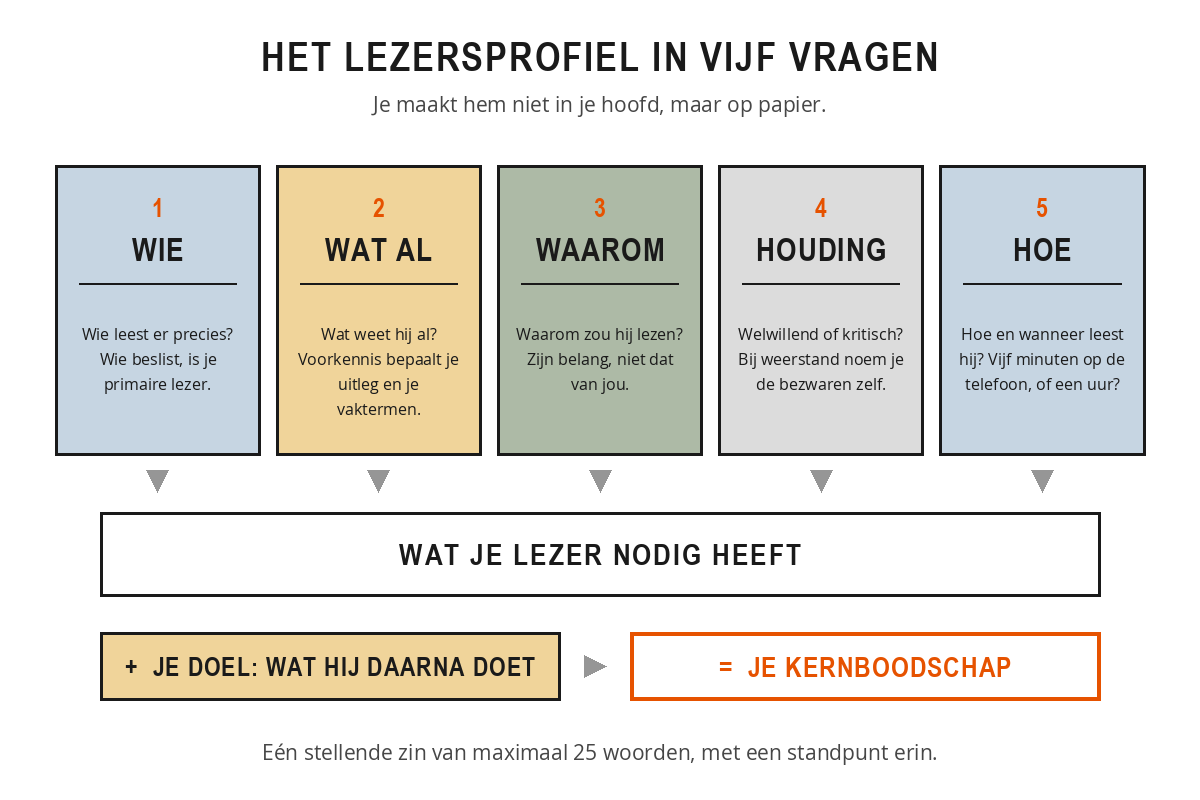
1. Who exactly is reading? Usually that is not one person. With a quotation, the buyer, the user and sometimes a lawyer read along. Whoever takes the decision is your primary reader; you serve the rest in appendices.
2. What does your reader already know? Prior knowledge determines how much explanation you need and which technical terms you can use without clarification. Underestimate his knowledge and your text comes across as patronising. Overestimate it and he drops out.
3. Why would they read this? You look for the reader's interest, not your own. A team leader reads an implementation plan because he wants to know what it will cost his people in time. So that answer belongs at the front.
4. What is their attitude towards it? A sympathetic reader needs few arguments. A critical reader first wants to see that you understand his objections. When you expect resistance, raise the counter-arguments yourself, before he thinks of them.
5. How and when do they read? Someone who opens your document on his phone five minutes before a meeting reads differently from someone who sets aside an hour for it. That determines your length, your headings and the position of your conclusion.
Marieke is a consultant and is writing a report about replacing a software package. Her first version begins with the background, then the research, then the method. The conclusion is on page 14.
Then she draws up her reader profile. Her reader is the director of operations. He knows nothing about the technology. He decides on a budget of 180,000 euros. He is sceptical, because the previous migration overran by a year. And he reads the document on the train.
Her second version opens with the recommendation and the costs, followed by three risks with the corresponding measure after each one. The research moves to the appendix. The same content, thirty pages shorter, and a different reader put first.
What a reader profile mainly produces is a list of things to cut. Everything you wrote down because it cost you a lot of effort, but which does not help your reader any further, can go. That is the hardest gain of phase 1, and the biggest.
The core message in one sentence
Your aim says what your reader should do after reading. Your reader profile says what he needs in order to be able to do that. Where those two meet lies your core message: the one sentence that remains if your reader sums up your text from memory a week later.
You write that sentence down before you start on the text. Not as an opening line, but as a compass for yourself. Every paragraph you write afterwards is tested against it: does this contribute to that one sentence, or not?
A usable core message is short, concrete and assertive. It contains a position, not a topic. "The staffing of the service desk" is a topic. "The service desk will only get through the March peak with two extra staff" is a message. Four requirements will help you formulate it.
- One sentence, no more than 25 words. If your message does not fit, you probably have two messages. In that case choose one and make the other subordinate.
- A position, not a theme. Your sentence states what you think, advise or conclude. Someone must be able to disagree with it.
- Concrete and measurable where possible. "Considerably more capacity" leaves room for discussion. "Two temporary staff for twelve weeks" does not.
- In your reader's language. You use the words he uses himself in meetings, not the jargon from your own team.
Joost is writing a report on waiting times at the service desk. His first attempt at a core message: "This report describes the results of the study into the accessibility of the service desk in the first quarter."
That is a topic with a bow around it. The reader still does not know what to do with it. After rewriting: "The service desk will only meet the service standard in March with two extra temporary staff; that requires 34.000 euro."
Now there is a position, an amount and a decision. The management team can say yes or no to this. From that point on, every figure, chart and interview in the report is there to support this one sentence.
Test your core message out loud on a colleague who knows nothing about the file. If he then asks "and what is it you actually want?", you are not there yet. If you hear "ah, and why do you think that?", you are on the right track: that is the question you answer in the rest of your text.
Why separating the phases pays off
Anyone who tries to produce a text in one go is doing four things at once: working out what he wants to say, deciding in what order, formulating and correcting. That is the main reason why writing takes so much time and so often grinds to a halt at the third paragraph. If you keep correcting while writing, you bring your own pace to a standstill and lose the overview of your story. The split between writing and polishing is therefore the most valuable of the four.
Choose a text you genuinely have to write soon and complete this reader profile with short, concrete answers.
- The name or role of your primary reader, and who else will be reading along.
- What your reader already knows, plus three technical terms you need to explain or avoid.
- Your reader's interest, in one sentence.
- Their attitude: well-disposed, neutral or critical, and why.
- How much time he realistically spends on your text, and where he reads it.
Then write down your writing goal in one sentence (what your reader does after reading) and your core message in no more than 25 words. Finally, cross out two elements of your outline that can be dropped on the basis of this profile.
Summary
- Writing happens in four phases: exploring, ordering, writing, polishing. About a third of your time belongs in phase 1.
- Your reader profile answers five questions: who is reading, what does he already know, why is he reading, what is his attitude towards it, and how and when does he read.
- Above all, the profile produces a list of things to cut: everything that cost you effort but does not help your reader can go.
- Your aim plus your reader profile give you your core message: one affirmative sentence of no more than 25 words.
- A good core message contains a position, is concrete, and is phrased in your reader's words.
- Writing and correcting at the same time costs you the overview. Keep those phases apart.
Which of these four sentences meets the requirements for a core message?
According to this chapter, what does a reader profile mainly deliver?
You have little time left for an advisory note. According to this chapter, what should you definitely not do?