


3. From incidental to proactive
Complaints are usually resolved case by case and then closed. The case is gone, the cause is not. That difference determines whether your organisation keeps receiving the same complaints year after year. The previous two chapters were about this conversation with this customer. Now you zoom out, to the stack.
After this chapter:
- You recognise by four signs that your organisation handles complaints incidentally.
- Do you know what the two levels of complaints management are and why you need both.
- You know the four requirements that proactive complaints management has to meet.
- You know why the complaints you hear are only part of the dissatisfaction.
- Can you translate a recurring complaint into an improvement point with an owner and a measurement.
Incidental complaint handling
Handling complaints incidentally means that every complaint is a separate case. A report comes in, someone picks it up, the customer gets a solution and the case is closed. What happened then disappears from view. The next customer with exactly the same problem starts from scratch, and so does the employee who helps them.
In itself nothing goes wrong in such an approach. The customer has been helped, the employee has done their job. The problem lies in what doesn't happen: nobody counts how often the same report recurs, nobody passes the cause on to the department that can do something about it, and nobody sees that fifty customers stumbled over the same thing in two months.
You can recognise it by four things. Complaints live in people's heads and not in a system: experienced colleagues know which problems come up often, but that knowledge is recorded nowhere. The feedback loop stops with the customer, so step 8 from the previous chapter is systematically skipped. There are no figures: ask how many complaints came in last month and what they were about, and you get an estimate. And everyone resolves things slightly differently, so one customer gets a voucher and the next gets their money back, depending on who they happened to reach.
An online shop receives around twenty calls a month about a parcel that is marked as delivered but has not arrived. Every member of staff duly arranges a new shipment, and every customer is satisfied. Nobody records that eighteen of those twenty reports concern the same delivery partner in the same region.
After a year, the online shop has sent a parcel twice on more than two hundred occasions. At an average order value of 45 euros, that is nine thousand euros in goods, plus the shipping costs and more than a hundred hours of call time. One conversation with that carrier could have stopped it.
Two levels, and you need both
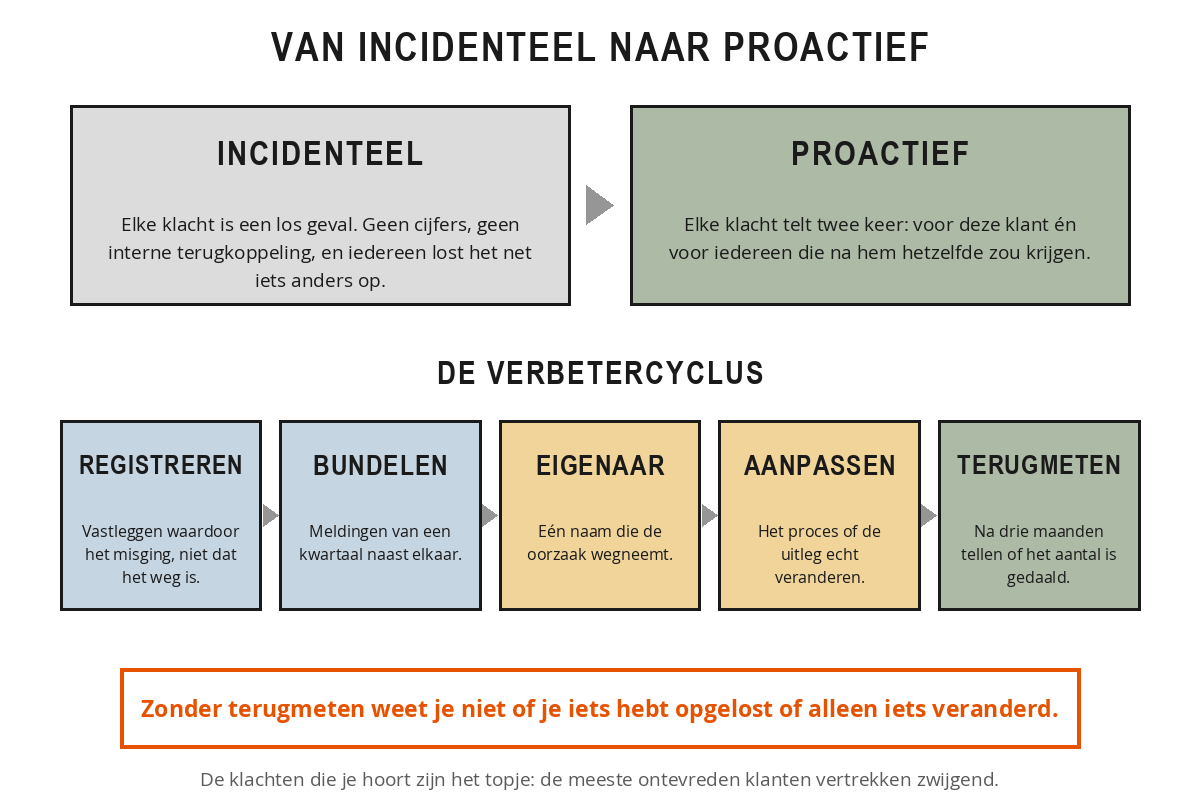
With proactive complaints management you handle every complaint twice: once for this customer, and once for all the customers after them who would otherwise get the same treatment. There are two levels to this. The first concerns the quality of each conversation: everyone works to the same method and knows how far their decision-making latitude extends. The second concerns volume and repetition: you don't look at this one customer, but at the hundred reports from this quarter.
Without the first level the second is worthless, because then you are analysing data from conversations that nobody conducted properly. Without the second you keep mopping up endlessly while the tap is left running.
Four requirements for working proactively
Proactive complaints management means setting up your complaints flow as a permanent source of information. The customer who calls is then no longer an incident, but a measurement point. That requires four things that lie outside the conversation itself.
Registering by cause, not by handling. A complaint recorded as "solved, customer satisfied" tells you nothing. Only when it also states what went wrong can you count later on.
Looking for patterns over a period. One incorrect invoice is a mistake; forty incorrect invoices in a month is a process that does not work. You can only see that difference in the stack, never in the individual conversation.
One owner per cause. As long as nobody is responsible by name for removing the source, the analysis remains a report in a folder.
Measure again. Three months after the change you check whether the number of reports on that subject has fallen. Without that check you don't know whether you have solved something or merely changed something.
In your analysis, look at both numbers and costs. Translate a recurring process complaint into the time your department spends on it each month. Within an organisation, a cause with a price tag finds an owner far more quickly than a cause with only a story attached.
The dissatisfaction you never hear about
The complaints that come in are only part of the dissatisfaction that exists. Most customers who have a bad experience never get in touch. They find it too much trouble, they expect nothing to come of it, or they have already moved to a competitor before you notice anything. Every complaint you receive therefore stands for a multiple of customers who kept quiet: the tip of a pyramid whose base remains invisible.
Anyone working proactively therefore deliberately lowers the barrier. A visible reporting point, a short question at the end of every contact, a round of calls to customers who have walked away. A rise in the number of registered complaints is then not a deterioration, but a sign that you are seeing more. That is a difficult message in an organisation that manages by complaint numbers, and it is nevertheless the right one.
The complaint as an opportunity
Seeing a complaint as an opportunity means treating the report as information you would normally pay a research agency for. The customer tells you free of charge where your process leaks, where your explanation is unclear and where your promise doesn't match your delivery. You only get that information from people who take the trouble to call.
The second benefit lies in the relationship. A customer who reports a problem gives you the opportunity to show what you are worth when things go wrong. And the sum underneath is simple: a customer who stays costs you attention, a customer who leaves costs you a complete recruitment process with marketing, sales time and usually an introductory discount.
An installation company receives eleven complaints in two months about technicians arriving late. The planner rings each customer personally to apologise. That is friendly, and it happens again every week.
When the eleven reports are bundled, the same morning route turns out to be the cause ten times over: the first appointment was structurally scheduled half an hour too early. The planning is adjusted and from now on customers are given a two-hour time slot instead of an exact time. The following quarter there are only two reports about lateness. The nine conversations the planner no longer has to have, he now uses to ring back customers who have dropped out.
Ten rules to hold up against your own work
Make complaining easy, because every barrier moves dissatisfaction to a place where you can no longer do anything with it. Thank the customer for getting in touch; they are investing time in your organisation instead of walking away. Let them finish their story first, because you win that time back twice over by not having the conversation twice. Acknowledge how they experienced it before you discuss the issue itself. Establish the core of the complaint and check it with them. Take the responsibility that is yours, because the customer is calling you, not the system. Only promise what you can deliver, because a commitment you fail to keep turns one complaint into two, and the second one is about you. Make the agreement concrete in terms of who, what and when. Act quickly and keep the customer informed, even when you have no solution. And report the cause internally, because without that last rule you help this customer while leaving the source intact for the next twenty.
This exercise is about the complaints that came your way over the past month.
- Which three reports occurred most often?
- For which of these does the cause lie outside your own department?
- What happened to that information once the customer had been helped?
- Who could have done something with it, and why were they not told?
- What does the most frequent report cost your department per month, in hours or in euros?
For each complaint, write one sentence naming the cause in terms of concrete behaviour or a process step. Then pick one, attach a name to it and a date on which you will measure again.
Summary
- Incidental complaint handling solves the case; proactive complaints management removes the cause.
- You recognise incidental working by four signs: no system, no internal feedback, no figures and no consistent solution.
- The five steps of the improvement cycle: register by cause, bundle over a period, appoint an owner, adjust, and measure again after three months.
- The complaints you hear are the tip. Below the surface lies the dissatisfaction of customers who say nothing and leave.
- More registered complaints often means that your barrier has been lowered, not that you are performing worse.
- A complaint gives you two things: free information for improvement and the chance to show what you are worth when things go wrong.
A department handles every complaint properly, but cannot say how many complaints came in last month or what they were about. According to this chapter, what is that?
After an improvement, the number of registered complaints rises, because a visible reporting point has been introduced. How do you read that?
You have found a recurring cause and adjusted the process. According to the improvement cycle, which step still needs to follow?
Ready for the next step?
You have completed the free starter of Complaints Management. The next chapter in the full course is Customer-focused behaviour: The organisation's calling card, customer focus in behavioural terms and what a departed customer costs.
Take the 2-day course →From €1250,- excl. VAT · with an experienced trainer included