


2. The complaint conversation step by step
Handling a complaint is work in a fixed order. Skip a step and the customer comes back, usually with more dissatisfaction than the first time. This chapter gives you that order, plus the two things that go wrong in practice: the moment you acknowledge a mistake, and the moment you name a solution.
After this chapter:
- You work through the eight steps of handling a complaint in the right order.
- You know what the aim of each step is and what behaviour goes with it.
- You acknowledge a mistake without running yourself or your organisation down.
- You can determine with three questions which offer fits here.
- You close with an agreement the customer can repeat back in their own words.
The eight steps
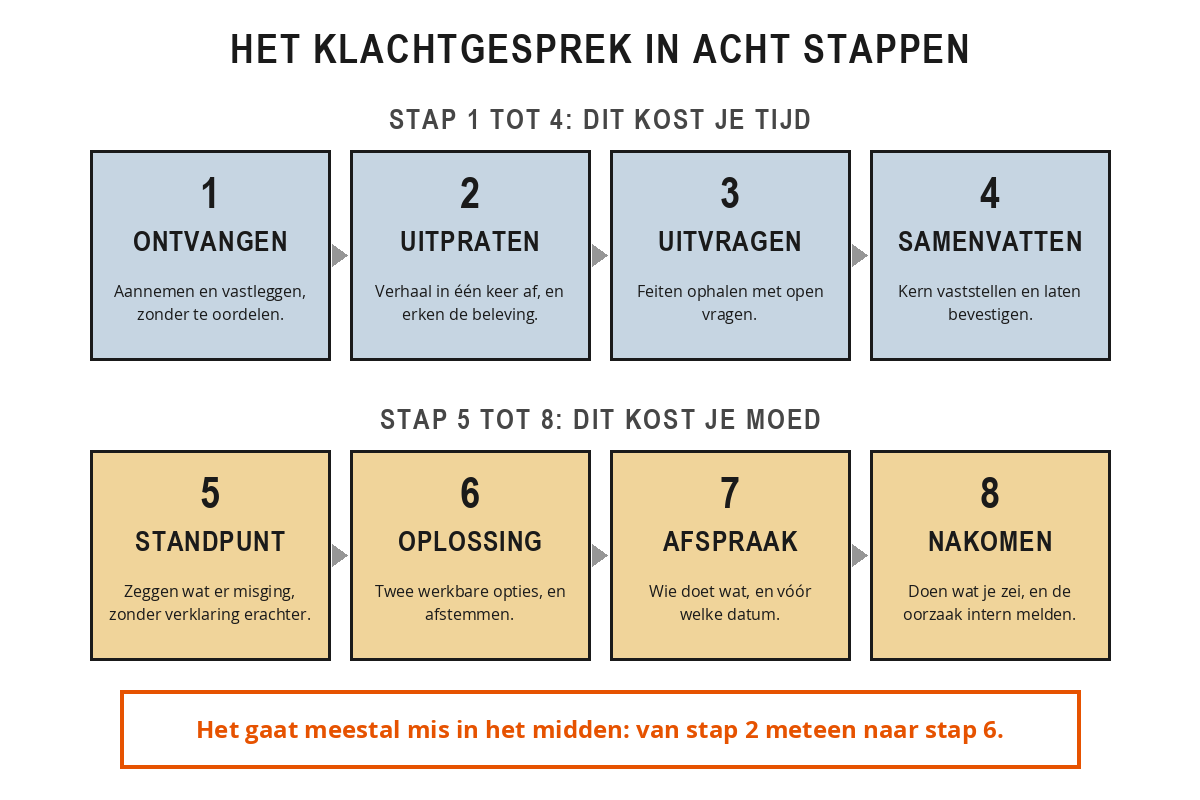
It works like this. Step 1, receiving and recording. You take the complaint without immediately judging whether it is justified. You record who is calling, what it is about and which file or order number goes with it.
Step 2, letting them finish and acknowledging. The customer tells his story in one go. You acknowledge how he experienced it before you turn to the matter itself.
Step 3, asking for the facts. With open questions you find out exactly what happened, when, and what the customer has already tried themselves.
Step 4, summarising and establishing the core issue. You summarise and ask whether that is correct. Only once the customer says yes do you know what you need to reach agreement on.
Step 5, position and responsibility. You say what went wrong on your side, or explain why something went the way it did. You never skip this step, not even when it is uncomfortable.
Step 6, proposing and agreeing a solution. You state what you are going to do and check whether that works for the customer. Aligning is more than announcing.
Step 7, recording the agreement. Who does what, and by which date? You say it out loud and you put it in the system.
Step 8, following through and reporting back internally. You do what you said you would do and you report the complaint where the cause lies. Without that last step you solve this one case and leave the source intact.
The first four steps cost you time, the last four cost you courage. That is also precisely the reason why most complaint conversations go wrong in the middle: someone jumps from step 2 to step 6 and offers a solution to a complaint that has not yet been clearly defined.
If you get stuck in a conversation and no longer know where you are, go back to step 4. A summary takes you fifteen seconds and puts you back in control.
Acknowledging mistakes
Acknowledging mistakes means saying out loud what went wrong on your side or on your organisation's side, without attaching an explanation, a reproach or a condition to it. It is step 5, and it is the step at which the conversation turns.
That feels like an admission of weakness, and it is the opposite. A customer whose problem you have put right properly is often more loyal than a customer who never had anything go wrong: they have seen what you do when things get difficult. That is known as the recovery paradox. A flawless delivery would never have given you that opportunity.
A caterer delivers the lunch for a meeting of forty people an hour late. The client, a training coordinator, phones in a fury: the whole programme has been thrown into disarray.
The branch manager does not say "the driver was stuck in traffic on the A10". He says: "We delivered your lunch an hour late and disrupted your programme as a result. That should not have happened." Only then comes the explanation, and it lands. Three months later the same coordinator books again, with the words: "At least you don't beat about the bush."
A solution that covers both sides
A complaint you resolve by giving everything away costs your organisation money. A complaint you resolve by giving nothing costs you the customer. In between lies the room in which you work. A win-win solution is not one where each side gets half; it is a solution in which the customer gets something that genuinely removes his problem and you offer something your organisation can bear and can explain.
Three questions will get you there. First: what is this customer's real interest? Someone demanding "money back" sometimes mainly wants the problem gone by tomorrow. Ask a few more questions and it turns out a replacement with express delivery is worth more than a credit note. Secondly: what is my scope for decision-making? If you know in advance what you are allowed to commit to on your own, you do not have to put the customer on hold for every step. If you do not know how much room you have, you will promise too much or too little. Thirdly: will this hold up as a precedent? Could you make this same offer to the next twenty customers in the same situation? If the answer is no, you have not devised a solution but an exception, and that will come back to you through the stories people tell.
Think of your options as a rising scale. At the far left is acknowledgement and a clear explanation. Next comes a concrete commitment with a date, then repair or replacement, then financial compensation, and at the far right the exception outside the terms. By far the majority of complaints are resolved on the left of that scale. If you start straight away on the right, you buy off the complaint without removing the dissatisfaction, and at the same time you teach the customer that complaining pays.
Two options instead of one
If you offer one solution, the customer can only say yes or no. If you offer two workable options, he chooses. And a customer who chooses is not the recipient of your decision but a participant in the solution.
A customer calls about a coffee machine costing 1,850 euros that has broken down twice in four months: "I want my money back."
The employee says: "I understand that you have lost confidence after two breakdowns. I can do two things. I can exchange the machine for a new one, which will be here tomorrow, and then I'll extend the warranty by a year. Or I can credit the full amount, in which case you're rid of it but you're also left without a machine. What helps you most?" The customer opts for the exchange. The organisation does not lose 1,850 euros in turnover, the customer has coffee tomorrow, and the offer can be explained to every subsequent customer with two breakdowns within the warranty period.
Closing positively
The customer does not judge your complaint handling on the middle of the conversation, but on the last minute. That is precisely where what was clear before becomes vague. "I'll make sure it gets picked up" leaves the customer with nothing to hold on to.
An agreement is concrete if the customer can repeat it back, and for that you need three elements in a single sentence: who takes the action, what that action is, and when. So not "you will hear from us", but "I will call you tomorrow before twelve with the delivery date". Larger or longer-running agreements you confirm in writing, using the same words you used on the phone. If your email differs from your conversation, the discussion starts all over again. And if the agreement turns out not to be feasible, you still call at the agreed time, even without a solution.
Close in a fixed order: a summary of the agreement, then the question of whether anything has been left unresolved, then the closing line. That last line does more work than it appears to.
Mind your last words. If you end with "Apologies again for the inconvenience", the problem is the last thing the customer hears. If you end with "I'm glad you reported it, now we can put it right for others too", they hang up thinking their call had an effect.
Eight points to check yourself against
Thank the customer for raising it, because nine out of ten dissatisfied customers do not complain but simply leave. Resolve it at first contact, because every handover increases the irritation. Respond quickly, even without a solution, because the customer will fill in the silence themselves and never positively. Talk about the problem and not about the blame, because as soon as you start working out who got it wrong, everyone goes on the defensive and the solution grinds to a halt. Do not promise anything you cannot deliver, because a broken commitment turns a product complaint into a complaint about the way the customer was treated. Stick to the facts and avoid reproaches. Address the pattern and not just the individual case, because if the same complaint comes up three times, the problem does not lie with those three customers. And record the complaint: it costs you a minute and gives your organisation the insight with which you prevent the next one.
Take a complaint you handled over the past month and work through the eight steps:
- Which step did you complete fastest, and which did you skip?
- What did skipping that cost: an extra contact, extra time, extra dissatisfaction?
- What was the customer's real interest, as opposed to their demand?
- Where on the scale from acknowledgement to exception did your solution sit, and what second option could you have offered?
- Write down your closing agreement, including who, what and when.
Discuss it with a colleague who has done the same exercise. There is a good chance you both skip the same step.
Summary
- The eight steps: receive, let them finish, ask for the facts, summarise, state your position, agree a solution, record the agreement and follow through with internal feedback.
- The first four cost time, the last four take courage. It usually goes wrong in the middle.
- Acknowledging is step 5 and not a sign of weakness: a well-remedied mistake often results in a stronger customer relationship than a flawless delivery.
- Three questions before you make an offer: what is the real interest, how much room do I have to decide, and does this hold up as a precedent?
- Start on the left of the scale, with acknowledgement and repair, and where possible offer two workable options.
- An agreement is only concrete once it contains who, what and when, and the customer can repeat it back.
Where do most complaint conversations go wrong according to this chapter?
A customer demands a credit note. According to this chapter, which question comes first when determining your offer?
Why does offering two solutions work better than offering one?