


4. Closing with an agreement
Most phone calls don't go wrong in the middle, but at the end. The contact was pleasant, the customer felt heard, and then you close with "we'll look into it" and a friendly goodbye. A week later the same customer calls again, now irritated, because nothing has happened. This chapter is about that final minute.
After this chapter:
- You can recognise the four phases of a telephone call and you know roughly how much time each phase is given.
- You know why uncertainty is more unpleasant for a customer than bad news.
- You make an agreement concrete with who, what and when.
- You know the difference between a commitment and an impression.
- You know what to do after hanging up, and who hangs up first.
The four phases of the conversation
Every telephone call follows the same underlying pattern, even when the customer moves back and forth across the subject. If you consciously follow that rhythm, you keep a grip on time, content and atmosphere.
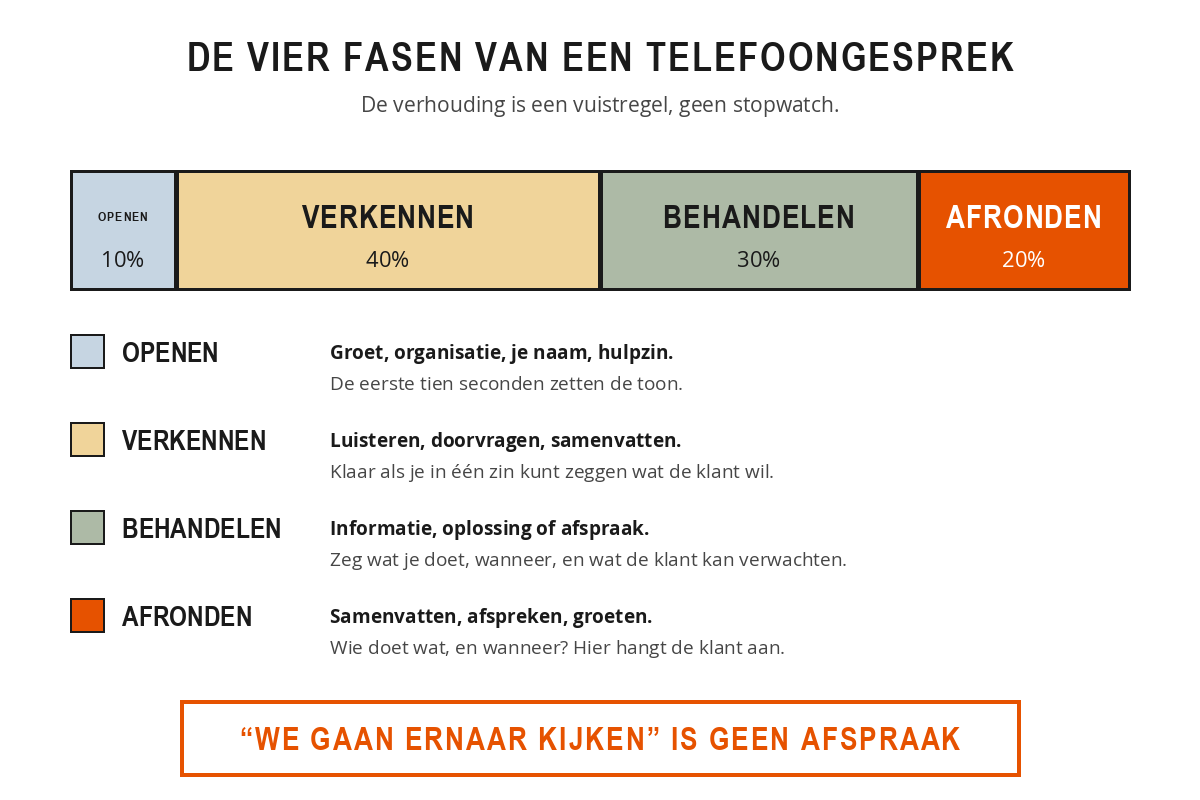
Open takes up about a tenth of the conversation: your greeting, your name, your organisation and the invitation to explain. Exploring is by far the largest phase, around forty per cent: listening, asking follow-up questions and summarising until you can say in one sentence what the customer wants to achieve. If you can't, you still know too little. Handling is roughly thirty per cent: you give information, offer a solution or make an arrangement. And Closing is the final twenty per cent. Short, but it is the part the customer remembers and it determines whether they call again tomorrow.
The biggest pitfall lies between exploring and handling: as soon as you hear a word you recognise, your answer is already lined up while the customer is still talking. Understand first, then act. The second pitfall is in the closing: it gets skipped because the call is "basically finished" anyway.
Uncertainty is worse than bad news
You won't be able to solve everything while the customer is on the line. That is no problem, as long as they know where they stand. "We'll look into it" leaves them empty-handed: they don't know who is looking into it, when, or what they will hear if nothing comes of it. "I'm passing your request on to the planning department now. You'll hear from us by twelve o'clock tomorrow at the latest" gives them something to count on. If you can't do something, say what you can't do, why, and what the next step is. Someone who knows where they stand can move on.
As you do so, translate your internal jargon into plain language. "I'll escalate your case to the back office and you'll get a response within the SLA" means nothing to the customer. "I'll pass your question on to a colleague who can sort this out, and they will call you back today" says exactly the same thing, but comprehensibly.
Who does what, and when
An agreement is only an agreement if it contains those three things. Who: a name, not a department. "Administration will be in touch" is not an agreement; "Karin from administration will call you" is. What: the specific action, not "chasing it up". When: a time you can keep, with some margin built in. Don't promise "within the hour" if you know your colleague is in a meeting until three.
You bring those three together at the end in the closing summary, and you give the customer the chance to correct or add something. "Just to summarise: I have changed your address and you will receive a confirmation by email this afternoon. Is that correct?" Then comes the question many people skip: "Is there anything else I can help you with?" That is precisely where the real reason for the call sometimes finally comes out.
When giving important information, don't ask "do you understand?" and don't ask "do you have any questions?" either. The first sounds patronising, the second almost always produces "no". "Have I explained that clearly enough?" and "what questions do you still have about this?" are genuinely inviting.
Mr Hendriks calls about an installation that has been postponed twice. Youssef, the employee, cannot schedule the new date himself; the planning department does that. Weak closing: "I'll pass it on to planning, they'll pick it up." Hendriks hangs up without a name, without a date and without any idea what "pick it up" means. Strong closing: "I'm passing your file to Marloes in planning right now, with a note that it has already been moved twice. She will call you tomorrow between nine and twelve with a date. If you haven't heard anything by twelve, call me, I'm here all morning. Does that work for you?" The same powerlessness, the same waiting time, a very different customer.
A commitment or an impression
There is a difference between what you say and what the customer hears. "I think that will be all right" is an estimate to you; to the customer it is a promise. "I'll see whether I can manage it today" is heard as: it will be done today. On the telephone that gap is dangerous, because there is no email in which you can later check what was actually said.
So stick to what you have control over yourself. You can promise to pass something on, to call back, to look into something. You cannot promise that a colleague will call when you haven't spoken to them, or that something will be approved by someone else. If you doubt whether the customer has understood correctly, ask them to summarise it themselves: "Just to be sure I've explained it properly: what happens now?" That sounds odd on paper, but on the phone it is the only way to find out.
A customer asks whether the 15 per cent discount also applies to a second order. Daniëlle, the employee, isn't sure and says: "That should be possible, I'll just check with sales." She forgets, the customer places an order for 2,400 euros and sees no discount on the invoice. Now there is a complaint and an expectation that someone has to reverse. Had she said: "I'm not sure and I don't want to promise you anything I can't deliver. I'll check with sales and call you back today before five with a yes or a no" — then there would have been no problem at all, not even if the answer was no.
The last ten seconds, and what comes after
Thank the customer for calling and end with a polite goodbye. Let them hang up first when you can: there is nothing more annoying than wanting to add something and hearing a dead line. And don't let your voice trail off. The final sentence is the part that sticks, and that is precisely where many people swallow their words.
Then comes the part nobody hears. Write up your note straight away, not after the next three calls; by then you no longer know exactly what was said, and details get lost that come back later as confusion or a complaint. Put the agreement in your diary or in the system, not in your head. And call back at the agreed time, even if you don't have an answer yet. "I don't have it yet, I'll call you again tomorrow" is a kept agreement. Saying nothing is not, however good your reason.
Take three conversations you had this week in which you promised something. For each conversation, write down:
- Who would do something, what exactly, and when? Could you fill in all three?
- Was it a commitment or an impression? Would the customer describe it the same way you do?
- Has the agreement been kept, and has the customer noticed?
Then formulate one standard closing sentence that you will use from tomorrow onwards, containing who, what and when, with a check at the end.
Summary
- A telephone call has four phases: opening (10%), exploring (40%), handling (30%) and closing (20%).
- You have finished exploring when you can say in one sentence what the client wants to achieve; if you can't, you ask another open question.
- Uncertainty is more unpleasant for a customer than bad news. Say what will happen, by whom and when.
- An agreement contains who, what and when. A department is not a who, and "chasing it up" is not a what.
- Summarise at the end, check whether it is correct and ask whether there is anything else going on.
- Only promise what is within your own control. What you mean as an estimate, the customer hears as a promise.
- Let the customer hang up first, write up your note straight away and call back at the agreed time, even if you don't know anything yet.
Which phase of the telephone call normally takes up the most time?
Which closing counts as a real agreement?
You promised to call back today, but you still don't know the answer. What do you do?
Ready for the next step?
You have completed the free starter of Customer-focused telephone skills. The next chapter in the full course is Your role in customer contact: The organisation's calling card, customer-focused thinking and the cost-benefit consideration behind every conversation.
Take the 2-day course →From €1250,- excl. VAT · with an experienced trainer included