


3. Steering through listening and questioning
You pick up the phone and out comes a story you hadn't bargained for. A customer who starts on three things at once, or on one thing he can't quite put into words. You can go two ways: drift along until the conversation ends somewhere of its own accord, or steer it. You steer not by talking louder, but by listening and asking the right question at the right moment.
After this chapter:
- You know the difference between hearing, passive listening and active listening.
- You know how to make it audible over the phone that you are listening.
- You recognise the five blockages that get in the way of your own listening.
- You can apply the questioning funnel: from open via leading to closed.
- You probe the reason behind the call and find the question behind the question.
- You use a summary as a way of steering, not just as a way of closing.
Hearing, passive listening, active listening
There are three levels of listening. Hearing is registering that someone is talking, without processing the content; that happens when you are already working on your answer in your head. Passive listening is following the content without showing that you are listening. To the customer that feels like talking to a wall, and over the phone he notices it in what doesn't happen: no response, no summary, a silence at an odd moment. Active listening is following the content and making it audible that you are there.
On the phone, making that audible is no minor detail. You can't nod. Without short acknowledgements ("yes", "mm-hm", "I see", "go on") the caller becomes uncertain and within twenty seconds asks: "Are you still there?" Do vary those acknowledgements, though. Ten "yes"es in a row sounds like processing noise, not like attention.
Five things get in the way of active listening, and they are all recognisable. Jumping to conclusions: after three sentences you think you know what it is about. Selective listening: you mainly hear what fits what you were expecting. Judging while listening: you form an opinion ("there goes another moaner") that colours the rest of the story. Being distracted: an incoming email, a colleague asking something. And wanting to solve things too quickly: you hear a problem and switch into solution mode, which means you miss the real question.
Want to know whether you were listening actively? Afterwards, count how often you summarised and how often you asked follow-up questions. Fewer than two of each in a conversation of a few minutes almost always means you were in passive mode.
The questioning funnel
Questions are your steering wheel. Not every question steers in the same direction, and the order in which you ask them makes the difference between a conversation and an interrogation. So build your conversation like a funnel: start broad, then narrow down, then pin it down.
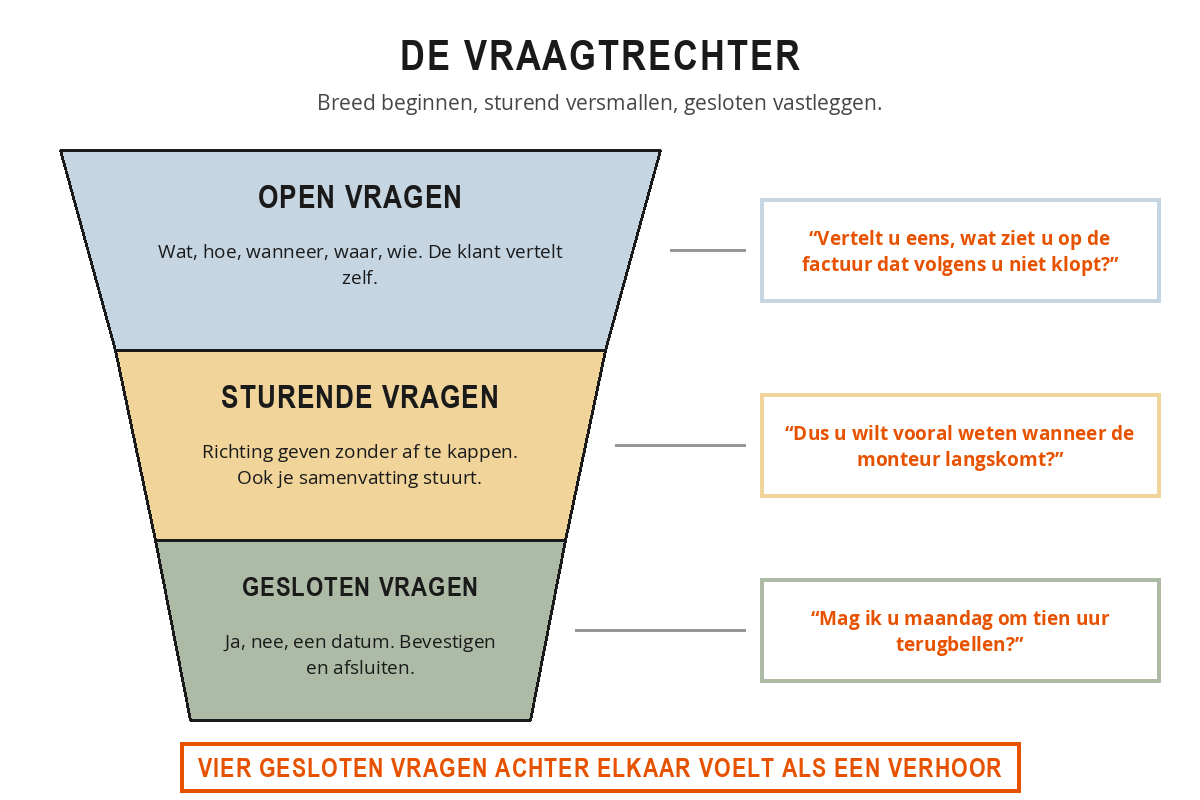
At the top are the open questions. These begin with what, how, when, where or who, and the customer can't answer them with yes or no. "Tell me, what do you see on that invoice that isn't right?" gets you the whole story in one go, including the details you would otherwise have needed six follow-up questions for. Use them at the start, and again at any moment when you notice you know too little.
In the middle are the leading questions and summaries. These give direction: "So if I understand correctly, what you mainly want to know is when the engineer will call round?" or "Would it help if I booked a new appointment straight away?" This brings a rambling conversation back to the heart of the matter without cutting the customer off. Be careful with the manipulative variant ("Surely you would agree that..."); that backs the other person into a corner. A good steering question feels like a relief to the customer.
At the bottom are the closed questions. These produce a short answer: yes, no, a date, a number. "Do you have the order number to hand?" or "May I call you back on Monday at ten?" They are ideal for checking facts and confirming arrangements, and therefore for closing. Ask too many in a row, however, and it feels like a form, and the customer clams up.
The question behind the question
The question someone asks is almost never the whole question. Someone asking "what are your opening hours?" may want to know whether he can still drop by today. Someone asking whether he can cancel his subscription may just be angry about a single invoice. If you only answer the literal question, you give a correct answer to the wrong question. The customer hangs up and calls again a week later. Or he doesn't call at all.
Three things take you below the surface. Asking about what prompted the call: "May I ask what prompted this?" People almost always tell you the whole story if you make a bit of room for it. Listening to what is not being said: hesitation, a sigh, a tone that doesn't match the words. If someone says "it's not really a problem" in an irritated tone, then it is a problem, and you may name it: "I can hear some doubt, is there something else going on?" And summarising with an open invitation: end your summary with "is that right, or am I missing something?" That last sentence is worth its weight in gold, because customers almost always add something at that point.
A customer rings: "I want to know whether you can speed up my order." The literal answer is short: yes, that's possible, it costs 12,50 euro extra, would you like that? Femke, the agent, first asks: "May I ask why you need it sooner?" Answer: "It's my daughter's birthday on Saturday and I thought it would arrive in time." Now the real question emerges: how do I make sure she has something on Saturday. Express delivery won't make Saturday, but a digital gift voucher will, and that costs nothing extra. Without that one question the customer would have paid 12,50 euro for a parcel arriving on Monday.
Summarising as a steering tool
Summarising is not a trick you pull at the end. It is the hinge on which you turn a conversation. You check whether you have understood correctly, the customer hears that someone is listening, you bring order to a story that went in all directions, and you have a natural moment to move on to a proposal. Four moments call for it: after a long story, before you switch to a solution, when the conversation jumps from one subject to another, and at the end.
There are four ways. Summarising verbatim you use for facts: "You said order number 4471, delivered on 12 March. Is that correct?" Paraphrasing is reflecting back in your own words: "If I understand you correctly..." Don't fill in what the customer didn't say, because then you are putting words in his mouth. Reflecting feelings doesn't summarise facts but the emotion: "I can hear that it really bothers you that this is now happening for the third time." With an angry or disappointed caller this often works better than any factual summary: people want to be heard first, and only then helped. And structuring summary brings order to a rambling story: "There are three things going on: first the faulty product, second the return that didn't work, and third the money you are still owed."
Mrs Aydin rings up irritated. She talks non-stop for two minutes: an order, a confirmation, a phone call yesterday, a colleague who was supposed to ring back. Bas, the agent, says: "Let me check whether I've got this right. You placed your order last Tuesday, you received confirmation that it would arrive on Wednesday, and now a week has gone by with no parcel and no news. On top of that, you rang yesterday and got no follow-up. Is that correct?" With that one summary he checks three facts, acknowledges the frustration and opens the door to a solution. Mrs Aydin replies: "Yes. And to be honest, that last bit bothers me most." Now Bas knows what the conversation is really about.
Take three customer questions from your own work that you get often. For each question, write down:
- The customer's literal question.
- Three possible questions that may lie behind it.
- The single follow-up question that tells you which of those three it is.
Then, in your next conversation, choose one technique to apply deliberately: summarise three times, or ask two follow-up questions about something that wasn't entirely clear. Afterwards, write down what you noticed in the other person's response.
Summary
- Hearing is perceiving, passive listening is following without showing it, active listening is following and responding audibly.
- On the phone you can't nod: short, varied acknowledgements are your only way of letting the caller hear that you're there.
- Five blockages: jumping to conclusions, selective listening, judging, being distracted and wanting to solve things too quickly.
- The questioning funnel runs from open questions (information and space) via leading questions and summaries (direction) to closed questions (confirming and closing).
- Ask about what prompted the call, listen for what isn't said, and end a summary with "is that right, or am I missing something?".
- Summarising can be literal (facts), paraphrasing (content), reflective (emotion) or structuring (a rambling story).
- With an angry caller, reflecting feelings works better than listing facts.
In what order does the questioning funnel place the types of question?
A customer says in an irritated tone: "It's not really a problem." What do you do?
Which summary best suits a customer who rings up angry about the third outage in a month?