


4. Active listening
Listening is work that the other person has to be able to notice. As long as a customer hears or sees nothing, your attention for him does not exist. That is not a matter of making more effort, but of shifting your attention from your own answer to the other person's story, and showing that you are doing so.
After this chapter:
- You identify the difference between passive and active listening and recognise it in your own conversations.
- You use minimal encouragers to keep a customer talking.
- You know when silence does your work for you and when it costs you information.
- You distinguish what a customer says from what he means, and you check this without filling in the gaps yourself.
- You use the ten commandments as a checklist after a conversation.
Passive and active listening
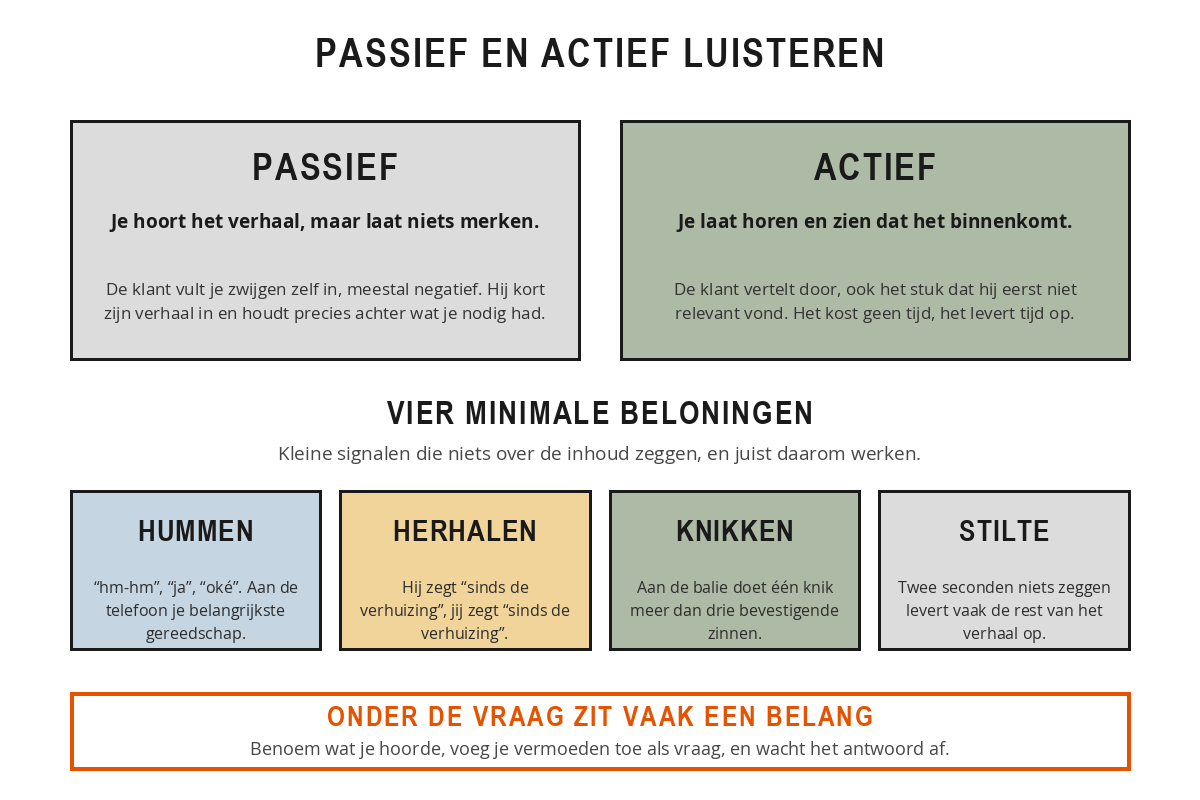
Passive listening is listening without showing it. You hear the story, you do not interrupt and you wait until the customer has finished. That is hard for the customer to read: on the phone he hears nothing, at the desk he sees someone looking at a screen. It is most noticeable on the phone, because there he has only your voice to go on.
Active listening is listening that the other person can notice. You give short signals that the story is getting through, you ask follow-up questions about what you hear, and you let the customer steer where the conversation goes. It doesn't take any extra time. It usually saves time, because you hear the whole story in one go instead of half of it.
Even so, passive listening is not the same as listening badly. You can think along perfectly well in your head without showing it, and there are moments when that is exactly right. A customer who is building up his story needs space; if you interrupt him with a question, you lose the key point that was coming right after it. Silence also works with someone who is working himself up: he runs out of steam and you keep a cool head.
Passive listening only becomes a problem once it becomes your default setting. The client fills in your silence himself, and usually negatively. He thinks you aren't engaging, that you don't find it interesting or that you already have an answer ready. He then cuts his story short and holds back precisely the information you needed.
Not sure whether silence is appropriate here? The customer gives you the answer themselves. If they keep talking, let them go on. If they stop and wait, that is a request for a sign of life.
Minimal encouragers
Minimal encouragers are the small signals with which you let someone know: carry on, I'm following you. They consist of one or two words, a sound or a movement, and they say nothing about the content. That is exactly why they work: you don't take over the conversation and you keep the customer talking. There are four of them.
Humming and short sounds. You say "mm-hm", "yes" or "okay". On the phone this is your most important tool, because the customer cannot see you. Repeating a key word. The customer says "things have been going wrong since the move" and you say "since the move". He fills in the rest himself, and usually with exactly the part you needed. Nodding and eye contact. At the front desk, a single nod does more than three sentences of confirmation. Allowing a silence to fall. Saying nothing for two seconds often yields the information you couldn't get at with a question.
A customer rings about a delivery that isn't right. Two versions of the same moment. Passive: the customer talks for two minutes, Nienke says nothing and closes with "I'll look into it." The customer asks: "Are you still there?" Active: after his first sentence he hears "mm-hm", halfway through "that second box, yes", and at the end "so you were left without the parts you needed". At that point he mentions something Nienke didn't yet know: he reported it last week as well. That one sentence turns the matter from an isolated error into a pattern, and so changes the solution too.
What the customer says and what they mean
A customer rarely says straight away what really matters to them. They ask a question about a delivery time while their own customer is breathing down their neck. Anyone who only answers the literal question solves half the problem. Beneath the question there is often an interest, a concern or an assumption. That isn't a hidden agenda, but the most normal thing in the world: the customer tells you what they think is relevant.
There are a few signals you pick up fairly reliably once you start paying attention. The customer mentions something twice, even though the conversation has long since moved on. Their voice changes on one particular word. They start a sentence and don't finish it. Or their question is so precise that there must be a concrete situation behind it.
If you have a hunch, put it back to the customer carefully rather than acting on it. You do this in three steps. First name what you heard, in the customer's own words: "you said it went wrong last week as well". Then add your hunch as a question and not as a conclusion: "is it bothering you that this is now the third time?" And then wait for the answer, so that you can adjust your picture if they meant something else.
Customer: "Could that repair be done on Friday instead?" The literal answer is "Friday is fully booked, Tuesday is possible". The probing answer is: "Friday is fully booked. Are you tied to that day?" It then turns out that he is moving house on Monday. Tuesday is therefore not an alternative but a problem, and with that information you can come up with something else: a temporary replacement appliance, or an engineer who fits him in at the end of Friday. Without that one question you would have given a correct answer and had a dissatisfied customer.
The ten commandments of good listening
Good listening is largely a matter of not doing things. These ten points are a checklist you can use after a conversation to work out where you dropped out.
- Let the customer finish. Even if you think you know what it's about after ten seconds, wait for the final sentence. That's often where the real point is.
- Do not prepare your answer while you are listening. The moment you start formulating your response, you stop hearing the rest. Do your thinking once the customer has finished.
- Separate the issue from the person. A customer with an awkward tone may still have a legitimate problem. You respond to the problem, not to the delivery.
- Let them hear that you are there. A short acknowledgement costs nothing and keeps the story moving.
- Pay attention to what isn't being said. Hesitations, half-finished sentences and a change in tone of voice often point to the question the customer doesn't yet dare to ask.
- Ask further questions when something is unclear. An assumption you don't check becomes your mistake later on.
- Tolerate silences. Three seconds feels long to you and short to the customer. Whoever keeps the silence going gets the addition.
- Don't share your own experience unless asked. With "that happened to me too" you pull the conversation towards yourself.
- Write down facts, not full sentences. Write down numbers, dates and names; keep your attention on the customer.
- Check your understanding before you solve anything. Briefly summarise what you have understood, and let the customer correct you.
Choose three questions that customers regularly ask you and that you normally deal with in one sentence.
- For each question, note down the exact wording the customer uses.
- Note down two interests or concerns that may lie behind them.
- Formulate the checking question that brings this to the surface, using the three steps from this chapter.
Then, after your next three customer conversations, go through the ten commandments and score yourself from 1 to 5 on each point. Note down two commandments on which you score highly and how that shows in the conversation, the commandment with your lowest score and the situation in which it goes wrong, and one change you will try out tomorrow in your first conversation.
Summary
- Active listening can be heard and seen; passive listening stays inside your head. What the customer doesn't notice doesn't exist as far as they are concerned.
- Silence is useful as long as the customer keeps talking or is working themselves up, but as a default setting it costs you information.
- The four minimal encouragers are making sounds of acknowledgement, repeating a key word, nodding and allowing a silence. They keep the customer talking without you taking over the conversation.
- Behind the literal question there is often an interest or a concern. Name what you heard, add your assumption as a question and wait for the answer.
- The ten commandments are a checklist for working out where you dropped out during a conversation.
According to this chapter, what is the difference between passive and active listening?
A customer mentions for the second time that it also went wrong last month, while the conversation has long since moved on to something else. What do you do?
Why do minimal encouragers work precisely because they say nothing about the content?
Ready for the next step?
You have completed the free starter of Customer-focused working. The next chapter in the full course is Summarising: Summarising as a third technique alongside questioning and listening, formulating with linking words and what a good summary gains you.
Take the 2-day course →From €1250,- excl. VAT · with an experienced trainer included