


3. Asking questions
Whoever asks the right question has less guessing to do. In customer contact, the way you ask questions determines how much you find out, how quickly you get to the heart of the matter and whether the customer notices that someone is thinking along with them. A question is therefore not a stepping stone on the way to your answer: your question does work in the conversation in its own right.
After this chapter:
- You know what a well-put question gets you in terms of information, direction, trust and time.
- You formulate open questions and know where in the conversation to use them.
- You understand why the why question is risky and which alternative gets you the same information.
- You recognise the four types of closed question and know which one to leave out.
- You build your questions up like a funnel, from exploring to confirming.
What a good question gets you
Your question delivers four things at once. Information: you hear what the customer needs instead of what you assume. Direction: whoever asks the questions decides what the conversation is about; if you don't ask any questions, you follow the customer's story and the conversation takes longer than necessary. Trust: a customer who notices that you want to understand their situation becomes calmer, because your question is the proof that you have not finished listening. Time saved: two good questions at the start prevent a second phone call at the end.
Questions also help you find out the customer's frame of reference, the idea from chapter 2. You don't know exactly what is in it, so you ask.
Open questions
An open question is a question the customer cannot answer with yes or no. It starts with a question word: what, who, where, when, how, which, to what extent. The customer decides how much they tell you, and it is precisely that freedom that gives you information you had not thought of.
Compare two openings for the same fault. "Have you tried the manual yet?" gets you one word. "What have you tried so far?" gets you the whole run-up, including the detail you hadn't asked about. You use open questions at the start of a conversation, with a complaint, with a vague query, and at any moment you notice you are filling in the blanks yourself.
Be careful with the why question. "Why did you fill it in like that?" sounds to most ears like an accusation, even if you mean it neutrally. You then get a defence instead of information. Two alternatives get you the same thing without the baggage: "What made you choose that option?" and "How did you arrive at that?"
Ask one question at a time and then keep quiet. Two questions in one sentence let the customer choose, and he almost always picks the easier of the two.
Closed questions in four forms
A closed question is a question the customer can answer with yes, no or a single piece of information. That doesn't make it any less valuable than an open question, just usable in a different way: you use it to confirm, to let someone choose and to check, not to explore.
The yes/no question pins down a single fact. "Is the address on the invoice still correct?" The answer is short, and that is exactly what the question is for. The multiple-choice question offers two or three possibilities. "Would you like the replacement tomorrow or on Friday?" The customer doesn't have to think anything up, only choose; that way you get a conversation moving without opening it up again. The leading question already has the answer you want to hear hidden inside it: "You agree that is the best solution, don't you?" or "That is not really a problem, is it?" The customer often says yes, but that yes is worth nothing. You have talked them into it and they notice that later, usually when the bill arrives. Leave this form alone. The checking question checks whether your picture matches the customer's: "So if I have it right: the fault is only on the upper floor and not in the shop itself?" The customer can confirm or correct. Five seconds of work, and it stops you spending half an hour on the wrong solution.
The questioning funnel
In almost every customer conversation you make the same movement: first open things up, then narrow them down. That is the question funnel, and it has four layers.
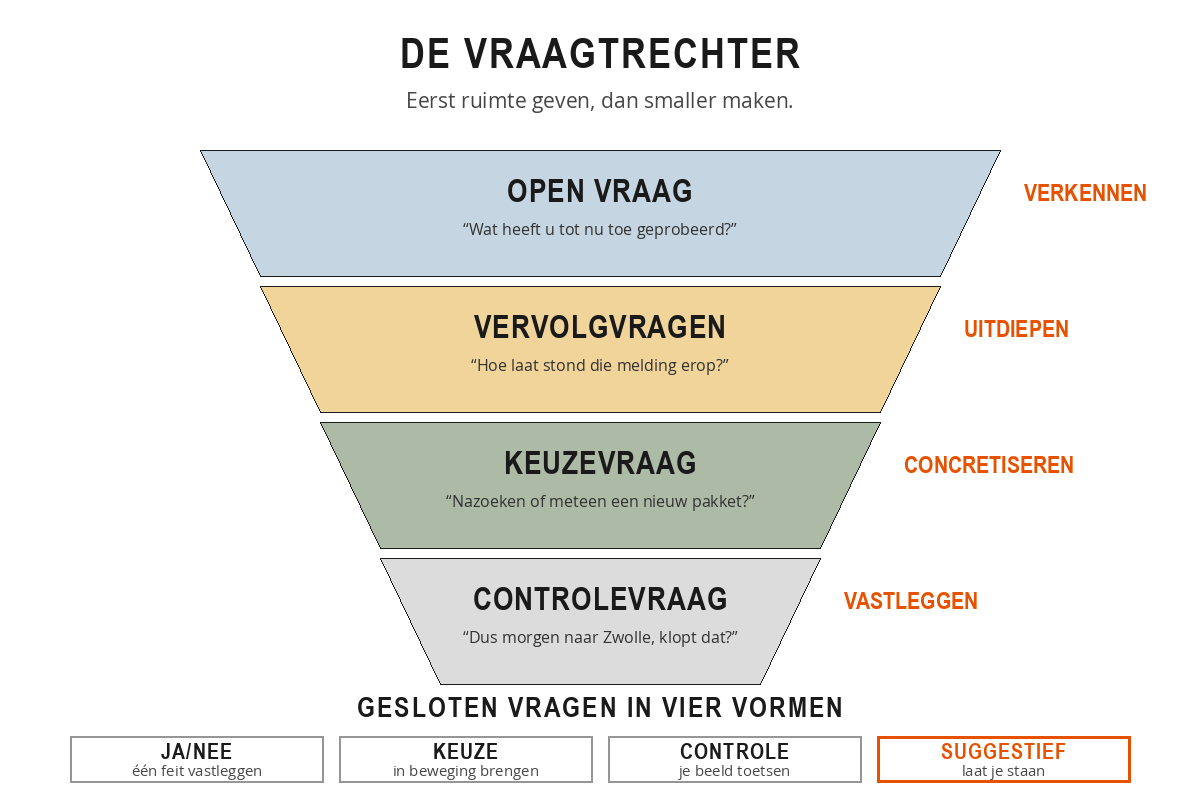
At the top is the open question: you give the customer room to tell his story in his own words. Below that come the follow-up questions: you go deeper into exactly what he is noticing and what it is costing him. Then the choice question: once the picture is clear, you set the feasible options out side by side. And at the bottom, the checking question: you close so that you both have the same picture of the agreement. If you turn the funnel around and start with detailed questions, you miss the reason behind the call and have to go back to the beginning halfway through anyway.
A customer calls about a parcel that has not arrived. Open question: "What have you seen in track and trace so far?" Follow-up question: "What time was that last update?" Choice question: "Would you like me to start a trace request with the carrier, or shall I send a replacement parcel straight away?" Checking question: "So I will arrange a replacement parcel to the address in Zwolle, for delivery tomorrow?" Four questions, four different forms, and by the end there is no room left for misunderstandings.
Alongside the movement from broad to narrow there is a second line: from easy to personal. Save the sensitive questions for the middle of the conversation. Questions about budget, about what has gone wrong internally or about earlier complaints land badly in the first thirty seconds. As soon as the customer notices that you are thinking along with them, they usually give that information without hesitation.
Flag a sensitive question before you ask it: "To see what's feasible, I'd like to ask you something about the budget." The customer then knows why you're asking and doesn't have to look for a hidden motive.
Four pitfalls
Most questioning mistakes come not from unwillingness but from haste. You think you already know the question and steer the conversation towards your own answer.
Filling in the answer yourself. "You'll want it delivered as quickly as possible, I imagine?" Perhaps the customer actually wants certainty rather than speed, but you'll never find out, because you've put the answer in their mouth. Overdoing closed questions. You fire off ten yes/no questions and tick off your own checklist as you go; the customer feels interrogated and offers nothing extra. Jumping to the solution too soon. At the first recognisable word you start explaining, so half the story never comes to light. Forgetting to check. You have probed well, but do not check whether your conclusion is correct; one checking question would have made the difference.
Bas gets a customer on the line who asks whether she can switch to the larger package. Bas hears "larger package", quotes the price, and sends the offer. Two weeks later she cancels. What he did not ask: why now? Her team had grown from four to eleven people, she mainly needed help with the setup, and price was the least of her concerns. One open question at the start, "what has changed that means you now need more?", would have told him that. As it was, he gained three minutes and lost a customer.
Start by rewriting these three closed questions as open questions, and note for each one what you hope to hear in addition: "Do you want the standard package?", "Did the fault start today?" and "Are you satisfied with the solution?"
Then take a conversation from yesterday or today and work through it on paper.
- What did the customer ask first?
- Which open question could you have asked?
- Which two follow-up questions would have taken the story deeper?
- Which two feasible options could you have put forward in a choice question?
- How would you have confirmed the agreement with a checking question?
Finally, cross out every leading question you come across in your own version and rewrite it neutrally. Which of the four pitfalls do you see most often in yourself?
Summary
- A question gets you four things: information, direction, trust and time.
- Open questions start with a question word and give the customer room. You use them at the beginning, with complaints and as soon as you notice you are filling in the answer yourself.
- The why question sounds like an accusation. "What made you choose that?" gets the same information without putting people on the defensive.
- Closed questions come in four forms: yes/no, choice, leading and checking. Leave the leading one out; the other three are useful.
- The question funnel runs from exploring to going deeper to making things concrete to confirming.
- Sensitive questions belong in the middle of the conversation, not in the first thirty seconds, and you announce them in advance.
Which question form does this chapter say you should keep, and why?
A customer sounds irritated about a form he has filled in incorrectly. Which question do you ask?
In what order does the questioning funnel run?