


Introduction
The financial statements contain two profit figures for the same financial year. One follows from financial reporting law, the other from tax law. Where the two diverge, a tax claim arises that is already fixed at the balance sheet date but is only settled in a later year. That is a deferred tax, and it is the item that most often goes wrong in files.
You probably know the concepts. What causes friction in practice is the application: which difference does and does not give rise to a deferred tax, which way does it go, what amount belongs to it and what does the entry look like. That is what this free course is about.
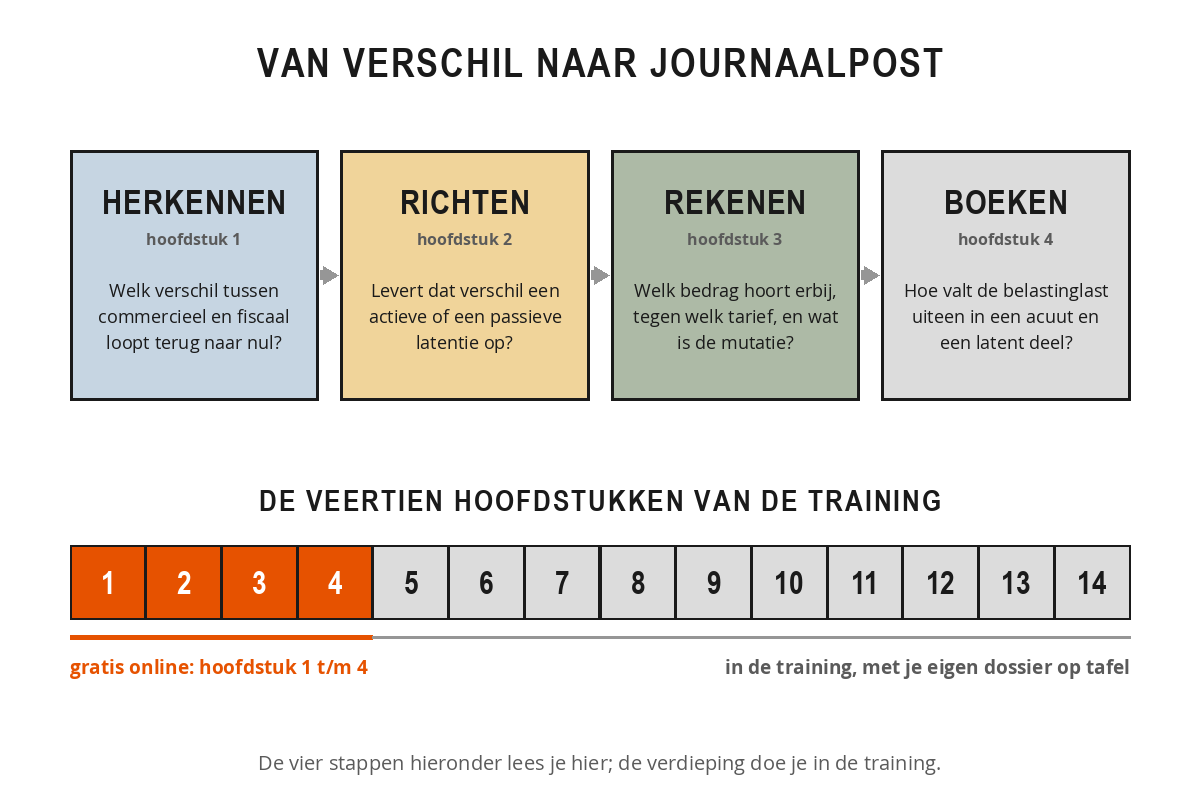
The four steps in the diagram are the four chapters of this course. In chapter 1 you separate temporary from permanent differences using the balance sheet approach: only a difference that eventually reverses to zero gives rise to deferred tax. In chapter 2 you derive from the nature of the item and the two carrying amounts whether a deferred tax asset or a deferred tax liability arises. In chapter 3 you build the differences matrix, choose the applicable rate and reconcile the opening balance to the closing balance. In chapter 4 the tax charge is split into a current and a deferred part and you prepare the journal entries.
This course explains the methodology using the examples from our syllabus. It is not tax advice and not reporting advice. Rates, terms and rules change, and what is correct in a specific case depends on the facts, on the framework under which reporting takes place and on the wording of the law and the guidelines at that time. The calculation examples below use a rate of 25.8 per cent, because the syllabus applies that percentage. In your own case, calculate with the rate that applies there, and test your workings against the applicable regulations.
Who this course is for
For accountants, controllers, financial statement preparers and finance staff who know the concepts but want to sharpen up the practical application. You do not need prior knowledge of specific regulations, but you do need to be able to read a balance sheet and prepare a journal entry. If your background is in tax returns, you will recognise the tax side and your focus will mainly be on translating it into the financial statements; if your background is in preparing financial statements, it is the other way round.
How best to read the course
- Keep a set of accounts to hand. With almost every subject you can ask yourself how it has been dealt with in that particular set of financial statements, and whether that solution is tenable.
- Work through the examples yourself. The arithmetic logic of deferred tax only becomes second nature once you have calculated and posted the difference a few times yourself.
- Read the chapters in order. Chapter 2 builds on the balance sheet approach from chapter 1, and chapter 4 takes its figures from the movement schedule in chapter 3.
- Do the exercise at the end of each chapter on paper. You will use the solution to chapter 1 again in the later chapters.
What the full course covers further
The course comprises fourteen chapters. After the four you are reading here, it covers the tax position in the balance sheet, the sources of differences per balance sheet item, deferred taxes within the fiscal unity, revaluation, losses available for offset, accounting treatment under RJ 272 and IAS 12, measurement and discounting, presentation and the movement schedule in the notes, and the pitfalls from audit practice. That calls for a trainer and your own file on the table.
Each chapter ends with a short knowledge check of three questions: answer them correctly to mark the chapter as completed. Your progress is saved automatically in your browser.