


1. Temporary and permanent differences
Not every difference between commercial and taxable profit leads to a deferred tax position. The dividing line runs between differences that cancel themselves out over time and differences that never do. That distinction determines your entire treatment: put a difference on the wrong side of that line and you will end up with a deferred tax position on the balance sheet that does not belong there, or a claim will be missing that should have been recognised.
After this chapter you can:
- Explaining what a temporary difference is and why it leads to a deferred tax.
- Determining the tax carrying amount of a balance sheet item and comparing it with the commercial carrying amount.
- Applying the balance sheet approach to identify differences.
- Recognising permanent differences and explaining why these precisely do not give rise to a deferred tax position.
- You can argue, for a specific item, whether the difference is temporary or permanent.
This course explains the system using the examples from our syllabus, and is not tax or financial reporting advice. The worked examples use a rate of 25.8 per cent because that is the percentage used in the syllabus. In your own file, calculate with the rate that applies there, and check your work against the legislation and the guidelines as they stand at that time.
Two profit concepts side by side
Commercial profit is the result as you present it in the financial statements. That profit follows the rules of Title 9 Book 2 of the Dutch Civil Code, supplemented by the Dutch Accounting Standards or by IFRS. The aim is a true and fair view: someone reading the financial statements must be able to form a realistic judgement about equity and results.
Taxable profit is the result on which the company pays corporation tax. That profit follows the Corporation Tax Act, the Income Tax Act and the principle of sound business practice. Here it is not about a true and fair view, but about a tax base that the legislator considers defensible and workable.
In practice, the amounts differ for three main reasons. The valuation and depreciation rules differ: the tax authorities tie depreciation on buildings to the floor value and apply maximum percentages, whereas for commercial purposes you depreciate over the expected economic life and residual value. The moment of profit recognition differs: sound business practice allows you to defer profit and take losses immediately, whereas financial reporting law links profit recognition to the moment performance has been delivered. And there are items that remain out of view for tax purposes: costs that are fully charged commercially but are not, or only partly, deductible for tax purposes, and income that remains untaxed.
The first two causes produce differences that cancel themselves out later. The third never does. That is exactly where the dividing line of this chapter runs.
What a temporary difference is
A temporary difference is a difference between the commercial carrying amount of an asset or a liability and the tax carrying amount of that same item, which disappears again in the future. It is a matter of timing. Commercially and for tax purposes you eventually arrive at the same total amount, just not in the same year. That difference in rhythm means a tax claim or a tax credit is already present in the figures today.
The tax carrying amount, referred to internationally as the tax base, is the value a item has in the tax balance sheet. For an asset, it is the amount you may still charge against the result for tax purposes in the future. For a liability, it is the carrying amount less the amount that is still deductible for tax purposes. That tax carrying amount stands apart from what appears in the financial statements; it follows sound business practice and corporate income tax legislation.
A manufacturing company buys a machine for 100.000 euro. For financial reporting purposes it is depreciated on a straight-line basis over five years, so 20.000 euro per year. For tax purposes the company makes use of a scheme that allows depreciation over three years, so just over 33.000 euro per year.
After year 1 the commercial book value is 80.000 euro and the tax book value is 66.667 euro. The temporary difference is 13.333 euro. Taxable profit is lower than commercial profit that year, so you pay less tax now. In years 4 and 5 there is nothing left to depreciate for tax purposes, while the commercial charge simply continues: that is when the difference reverses. After year 5 the book value is nil in both columns and the difference has fully unwound.
Note what in that example does not happens. Over the whole term the company depreciates 100,000 euros under both systems. No deduction disappears and no deduction is added. Only the year in which the deduction falls differs, and with it the year in which the tax is paid. That is the essence: a temporary difference shifts the tax claim between years, but nets off to nil over the term.
You recognise a temporary difference by a simple check question: is there a point in the future at which the commercial and tax figures are equal again? For a machine that is the end of the depreciation period. For a provision it is the moment of payment. If you cannot point to that moment, you are probably dealing with a permanent difference.
Temporary differences come in two directions. If the commercial carrying amount of an asset is higher than the tax base, you will pay more tax later and a taxable temporary difference arises. If the commercial carrying amount is lower, you still have deductible potential for tax purposes and a deductible temporary difference arises. For liabilities it works exactly the other way round. In chapter 2 you link these two directions to the deferred tax liability and the deferred tax asset.
What a permanent difference is
A permanent difference arises when income is never brought into taxation or an expense is never deductible. There is no year in which the accounting and tax treatments catch up with each other, so the difference never returns to zero. That is why no deferred tax position belongs with it.
The best-known examples are the participation result that falls under the participation exemption, a non-deductible fine and the non-deductible portion of mixed costs such as entertainment. In all three cases the taxable profit differs permanently from the commercial profit, without any future settlement to offset it.
Such a difference also does not sit in a balance sheet item. A fine that has been paid leaves the balance sheet and leaves behind no item whose commercial and tax carrying amounts diverge. The effect stays in the result: the tax charge for the year differs from the amount you would expect if the nominal rate were applied to the commercial profit.
That does not mean a permanent difference may remain invisible. It helps determine the effective tax rate and appears in the notes, in the reconciliation between the nominal rate and the actual tax charge. So you do record permanent differences, but in a separate overview, outside the deferred tax calculation.
The balance sheet approach
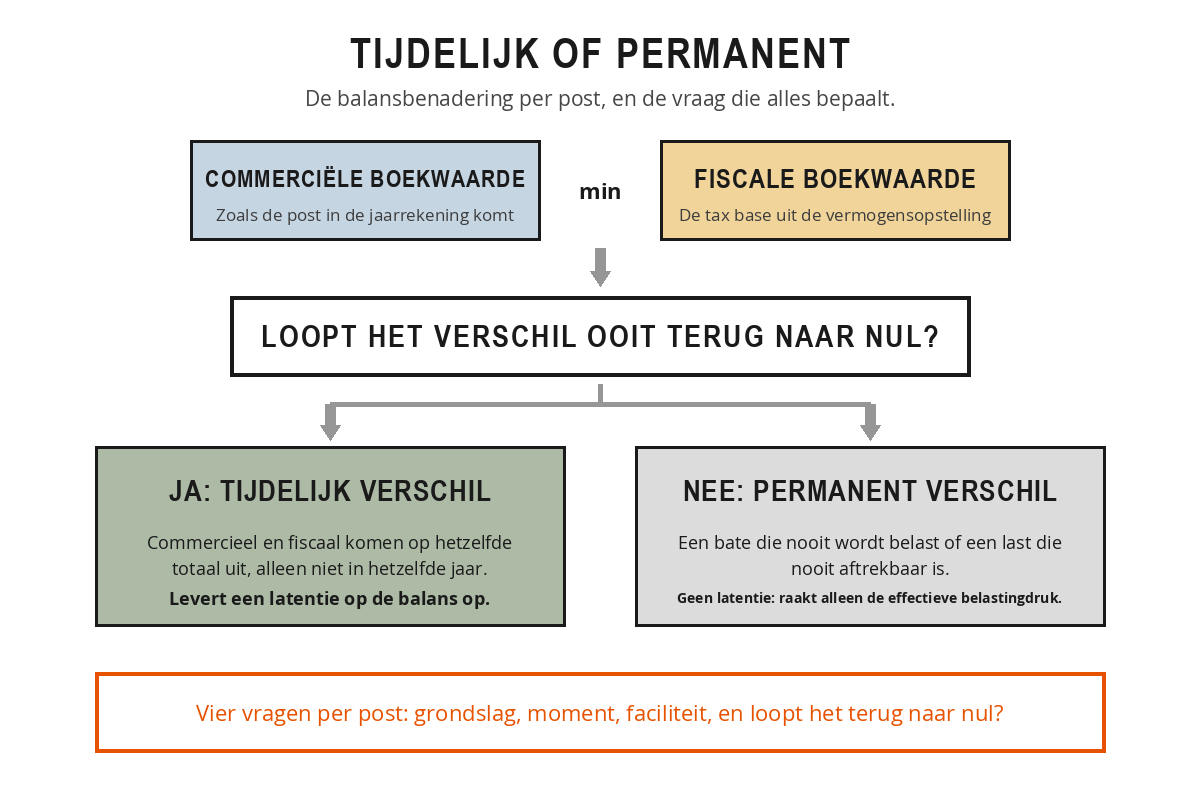
There are two ways of tracing differences between commercial and tax figures. The first looks at the profit and loss account: you compare the commercial expense with the tax expense per year and record the difference. The second looks at the balance sheet: you compare, item by item, the commercial carrying amount with the tax carrying amount. That second route is called the balance sheet approach, and it is the route prescribed by both RJ 272 and IAS 12.
The diagram above sets out that route in its simplest form. You put the commercial carrying amount next to the tax base, subtract one from the other, and ask one question about the difference that remains: will this ever reverse to nil? If the answer is yes, you have a temporary difference and a deferred tax position appears on the balance sheet; the commercial and tax figures then arrive at the same total, just not in the same year. If the answer is no, it is a permanent difference: income that is never taxed or an expense that is never deductible, which only affects the effective tax rate. An item where both values coincide drops out automatically. A receivable of 40,000 euro that is valued identically for commercial and tax purposes has a tax base of 40,000 euro and therefore produces no difference.
For each item you work this out in six steps. First take stock you list the items: you work down the commercial balance sheet line by line, including the items that do not exist for tax purposes. Then you note the commercial carrying amount at the balance sheet date, as it will appear in the financial statements. Alongside it you put the tax carrying amount, from the tax balance sheet or from the last tax return, supplemented with the movements for the current year. Next you calculate the difference: commercial minus tax, and you keep the sign. Then you assess the reversal: will the difference return to nil in later years through depreciation, release, sale or settlement? And finally you exclude the permanent differences: you leave those out of the deferred tax calculation and record them separately.
The outcome of step five determines everything. If the difference reverses, you have a temporary difference and you move on to the deferred tax position. If it does not reverse, the trail stops there.
Why the balance sheet and not the profit
The balance sheet approach captures more than the profit and loss approach. A revaluation of a building that you recognise directly in equity never passes through the profit and loss account. Even so, the accounting carrying amount shifts while the tax carrying amount stays put, so a difference arises that you have to account for. The same applies to an acquisition in which you recognise assets at fair value while the tax carrying amount continues unchanged.
Another advantage: the balance sheet approach is verifiable. You can trace every difference back to two amounts, both of which are recorded somewhere. That makes your file traceable for the accountant and for yourself, a year later.
Build a single worksheet with fixed columns: item, commercial carrying amount, tax carrying amount, difference, temporary or permanent, expected moment of reversal. You pick up that worksheet again every year. The comparison with last year shows immediately which differences have reversed and which have newly arisen.
Identifying differences by balance sheet item
Not every balance sheet item is equally suspect. Cash, trade receivables at nominal value and ordinary trade payables rarely produce a difference, because the commercial and the tax valuation coincide. The attention goes to items where the valuation rules diverge or where a tax facility comes into play.
For each item you ask the same four questions, the four that also appear at the bottom of the schedule. Does the basis differ, so the valuation rule? Does the timing of profit recognition or cost allocation differ? Is there a tax facility applicable? And does the difference ever back to zero? Those four questions will bring you to a reasoned conclusion for virtually every item.
When scanning, look out for items that exist commercially but not for tax purposes, or the other way round. Development costs capitalised in the commercial accounts with a tax book value of nil produce a difference equal to the full book value. You see the same pattern with a provision that is only deductible for tax purposes when it is paid.
Bouwbedrijf Kastanje BV buys a machine costing 400.000 euro. For financial reporting purposes the company depreciates the machine over five years, because that is how long it lasts in practice. That comes to 80.000 euro per year. For tax purposes depreciation is limited to 40.000 euro per year.
The effect in year 1: the commercial charge is 40.000 euros higher than the tax charge, so the commercial profit is 40.000 euros lower than the taxable profit. Kastanje BV pays relatively a lot of tax now and relatively little later. Over the machine's full life, the company depreciates 400.000 euros under both systems; the difference lies only in the timing. Run through the four questions and the answer to the basis question is yes, to the timing question yes, and to the last question yes as well: the difference reverses to nil as soon as the machine has been fully depreciated in both columns. A temporary difference, and therefore a deferred tax.
If that same BV pays a fine of 60,000 euros in the same year that is not deductible for tax purposes, the answer to the last question is no. The fine has been paid, leaves no balance sheet item behind, and there will never be a year in which those 60,000 euros are deducted after all. A permanent difference, so no deferred tax, but a line in your schedule of permanent differences.
Take the balance sheet of a company you know and scan five items. For each item, note:
- The name of the balance sheet item and the commercial carrying amount at the balance sheet date.
- The tax book value according to the tax balance sheet.
- The difference: commercial minus tax, including the sign.
- The basis question, the timing question and the facility question: yes or no.
- The reversal moment: when is the difference back to zero?
- Your judgement: no difference, temporary difference or permanent difference, with one sentence of reasoning.
Mark the items you are unsure about and note what information you still lack to reach a decision. Keep this worked-out version: in chapter 3 you will use it to build the differences matrix.
Summary
- Commercial profit follows financial reporting law and aims at a true and fair view; taxable profit follows tax law and sound business practice and aims at a basis for taxation.
- A temporary difference reverses to nil in the future and leads to a deferred tax position. Commercially and for tax purposes you end up at the same total, just not in the same year.
- A permanent difference remains in place, is not part of a balance sheet item and affects only the effective tax rate. You record it in a separate schedule, outside the deferred tax calculation.
- The tax book value of an asset is what you may still depreciate for tax purposes; for a liability it is the carrying amount less what is still deductible for tax purposes.
- You identify differences using the balance sheet approach, in six steps: take stock, accounting carrying amount, tax carrying amount, difference, assess the reversal, exclude permanent differences.
- For each item you ask four questions: does the basis of valuation differ, does the timing differ, is a facility involved, and does it run back to zero?
- A taxable temporary difference arises with an asset whose commercial book value is higher; a deductible difference arises if it is lower. With liabilities that logic is reversed.
Why does a temporary difference give rise to a deferred tax position and a permanent difference not?
A BV capitalises development costs of 250.000 euro for financial reporting purposes; for tax purposes those costs were charged in full to the result in the year they were incurred. What is the tax carrying amount of that item and what follows from it?
Why do RJ 272 and IAS 12 prescribe the balance sheet approach instead of the profit and loss approach?