


4. Setting goals with BE SMARTIE
A goal you cannot check remains an intention. BE SMARTIE turns a vague plan into an agreement with yourself that you can, three months from now, establish whether you have kept. And it solves the problem that most goals founder on: that the result actually lies with someone else.
After this chapter:
- You know the nine letters of BE SMARTIE and what each letter adds to a goal.
- You test one of your own goals against all nine criteria and rewrite it wherever it does not hold up.
- You divide a goal across three time horizons: the year, the quarter and the week.
- You recognise a goal that leans on someone else's behaviour and rewrite it in terms of your own actions.
- You describe an ideal end result from which you can derive your assessment criteria directly.
The nine letters
The familiar SMART list makes a goal verifiable, but says nothing about whether you actually want the goal. That is what the extra letters are for. BE SMARTIE starts with direction, then moves to precision and ends with the fuel you need to keep going when things get difficult.
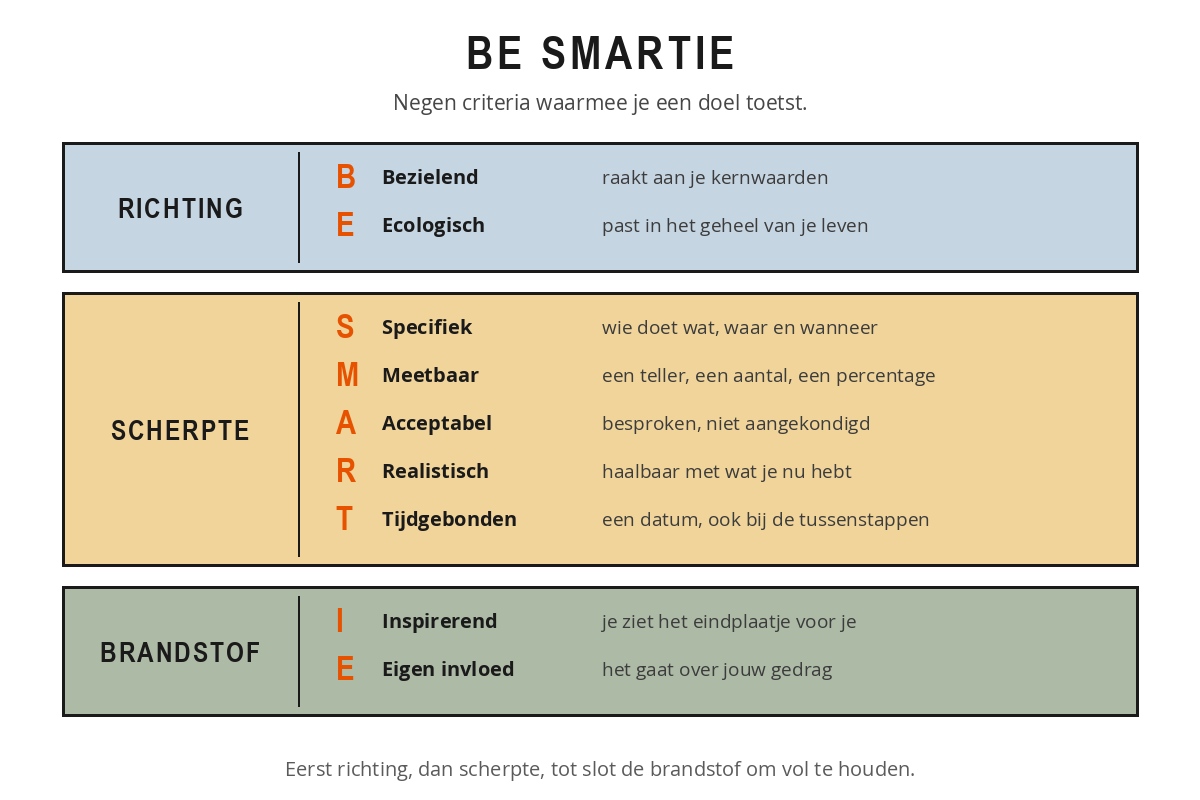
Direction. The B stands for inspiring: the goal touches on something that is of lasting importance to you. Your core values from chapter 3 are the test. Do you recognise at least one of them in it? If not, the goal will quietly die within six weeks. The E stands for ecological: the goal fits into your life and your work as a whole. You look at the price. What will get less attention, and do you accept that? A goal that damages your health, your home situation or your team will not last.
Precision. Specific: you describe who does what, where, when and with whom. "Communicate better" is not a goal. "In every team meeting I summarise at least once before giving my own opinion" is. Measurable: there is a counter, a percentage, a number or observable behaviour, so that at the end you can answer yes or no. Acceptable: the people around you can live with it, and so can you. For goals that affect others, this means you have discussed them rather than announced them. Realistic: the goal is achievable with the time, knowledge and resources you have now or can arrange within the period. A goal that is too easy, incidentally, is just as demotivating as an unachievable one. Time-boundthere is a date attached, and not only at the end; the intermediate steps have a moment too.
Fuel. Inspiring: you can picture the end result. You can describe in thirty seconds what it looks like once it has worked, and you notice that you're looking forward to it. Own influence: the goal is about your own behaviour. "My manager gives me more room" is beyond your reach. "Before 1 June I will put forward a well-founded proposal about my range of tasks" is within it.
Els wants to become more assertive. She tests this against BE SMARTIE and sees that it only scores on the B: it does touch on her values, but beyond that there is nothing to work with. She rewrites it as: "Before 1 July I will have voiced my dissenting opinion within the first ten minutes in at least six meetings, and I will keep track of that in my diary." Her quarterly goal becomes six times, her weekly goal once, in the Monday meeting. That makes the goal measurable and time-bound, and it is entirely about her own behaviour.
If you trip over the R for realistic when testing your goal, it's a shame to scale down your ambition straight away. First extend the timeframe, or make the weekly action smaller. An annual goal that stays intact at a calmer pace is more motivating than a watered-down version of what you actually wanted.
From year to week
A goal that only ends in a year's time gives you no signal for eleven months as to whether you are on course. That is why you cut every goal into three horizons. You plan from year to week, but you execute the other way round: the longest horizon gives meaning to the shortest, the shortest gives proof to the longest.
The annual goal provides direction. At year level you formulate in one sentence where you want to go. Numbers matter less here than clarity. "This year I want to be known as someone who puts problems on the agenda before they escalate" is workable, because it gives direction to a hundred small choices. You reread the yearly goal at the start of each quarter with one question: is this direction still right, given what has happened over the past three months?
The quarterly goal delivers an interim result. Three months is long enough to build something and short enough to keep in view. This is where the number belongs. From the yearly goal above follows, for example: by the end of March I will have put a risk on the agenda in four team meetings that was not yet urgent. Choose one interim result and not three, because a quarter with three goals usually produces three half results. Add a number and a date. And name what you are letting go of: every quarterly goal costs time that has to come from somewhere else, and if you do not name that, it comes out of your evenings.
The weekly action provides the proof. At weekly level your goal consists of actions with a day and a time. "Thursday nine o'clock: submit agenda item to Karin for next week's meeting." That is small enough to do on a busy day, and it is immediately visible whether it has happened. The link also runs upwards: if after four weeks it turns out there are no agenda items at all, you know that in week five and not at the end of March.
Plan your weekly actions at the moment you write down your quarterly goal, not later. Put twelve lines in your diary, each with a day and a time. It takes half an hour and it saves you having to decide twelve times whether you feel like it today.
Testing against your own influence
Many goals fail not because they are too big, but because the result lies with someone else. "I want my manager to give me more responsibility" is a wish about someone else's behaviour. You rewrite such a goal into something where your own actions make the difference: "Before 1 April I will submit a proposal naming one project that I want to run independently, and I will ask for a decision on it in my appraisal interview." The wording shifts from outcome to behaviour. The outcome remains uncertain, because the other person decides. Your own part, however, is entirely plannable.
There are three questions you apply to every goal you write down. Who carries out the action? If someone else appears in the sentence as the one acting, you rephrase it from your side. Can I start tomorrow? If the answer is no because you are waiting for something, you name that waiting as a separate step with a name and a date attached. And: what if the other person says no? A goal that collapses completely at a single refusal was in reality a hope.
The ideal end result
The ideal end result describes the situation as it will look at the moment your goal has been achieved. You write it in the present tense, as if you were looking at it now, and in terms concrete enough for an outsider to recognise it. So not "having more control", but: it is four o'clock on Friday afternoon, I am going through my weekly overview and there is nothing left outstanding that I should have done today, and on Monday I start with an agenda item I put forward myself.
That concreteness does two things. You notice immediately whether you really want it, because a lukewarm end picture gives itself away. And you extract from it the criteria you'll test against later: a weekly overview, an empty list of outstanding matters and an agenda item of your own. Those are three things you can count or point to.
Youssef's goal is to work better with the purchasing department. He writes down his ideal end result: "It is June. I know how their working week looks for three people in purchasing. When there is an urgent request, I ring the right person directly instead of emailing the general address, and I get an answer within a day." From this he derives his quarterly goal: three half-hour introductory meetings before 1 June. And his first weekly action: send an invitation to the first person on Tuesday at eleven o'clock.
Take a goal you have been carrying around for some time and put it down on paper literally, in the words you use for it yourself.
- Go through the nine letters and give each letter a score from 1 to 5. For every score below 3, note in one sentence what is missing.
- Rewrite the goal in no more than two sentences, so that it scores a 4 or 5 on at least seven letters.
- Divide the rewritten goal across the three horizons: the year in one sentence, the quarter with a number in it, and the first weekly action with a day and a time.
- Write the ideal end result in five to eight sentences, in the present tense, and underline three things you can count or point to.
- Go through the three test questions and cross out every sentence that is about someone else's behaviour.
Put that first weekly action in your diary straight away before you go on. If you don't, this was an interesting conversation with yourself.
Summary
- BE SMARTIE tests a goal in three groups: direction (inspiring in purpose, ecological), sharpness (specific, measurable, acceptable, realistic, time-bound) and fuel (inspiring, within your own influence).
- The B you test against your core values. If there is nothing there, the goal will quietly die within six weeks.
- The three horizons: the year gives direction, the quarter delivers a measurable interim result, the week delivers actions with a day and a time.
- Planning runs from year to week; feedback runs from week to year.
- Choose one quarterly goal, add a number and a date, and name what you'll let go of for it.
- A goal only holds up if the result depends on your own actions and not on someone else's consent.
- You describe the ideal end result in the present tense, and it immediately gives you the criteria to test against.
What does the final E of BE SMARTIE stand for, and what does that letter do to your goal?
Someone writes down as a goal: "My team will deliver the report on time from now on." What is the problem here?
Why does this chapter break an annual goal down into a quarterly goal and weekly actions?
Ready for the next step?
You have completed the free starter of Proactive action. The next chapter in the full course is The communication model: The sender-receiver model, the difference between observing and interpreting, your frame of reference and the three channels of your message.
Take the 2-day course →From €1250,- excl. VAT · with an experienced trainer included