


3. Core values as a compass
Values are not fine words for a poster. They determine where your energy goes at the moment two things cannot both happen. That is why they come before all the techniques that follow in this course: without direction, a technique is merely a faster way of getting somewhere you did not want to be.
After this chapter:
- You know what core values are and how they differ from goals, rules and traits.
- Using a funnel of four rounds, you reduce a broad list of values to a top three.
- You translate a value word into behaviour that a colleague can see or hear.
- You set decision rules in advance for moments when you have no time to weigh things up.
- You know what to do when two of your values get in each other's way.
Values, goals, rules and traits
A core value is a guiding principle that indicates what is of lasting importance to you. It describes not what you want to achieve, but how you want to act on the way there. Autonomy, reliability, fairness, connection, craftsmanship, calm: those words only acquire meaning once you link them to behaviour. Three delimitations help with this.
- A value is not a goal. A goal is something you reach once and then it is done. "Three new clients this quarter" is a goal. Entrepreneurship still applies once the quarter is over.
- A value is not a rule. Rules come from outside and apply to everyone. Values come from within and differ from person to person. Two colleagues follow the same house rules and still act differently.
- A value is not a trait. A trait describes how you are, a value what you aim for. Someone can be impatient by nature and still hold patience as a value, precisely because it does not come naturally.
Anyone who wants to act proactively needs such an internal compass. Otherwise whoever shouts loudest determines your direction, and that is usually the person with the shortest deadline.
From a long list to your top three
Almost everyone presented with a list of values ticks too many boxes. After all, there is little on such a list that you would object to. The distinguishing power only emerges once you start cutting, and cutting hurts a little. That is precisely where the information lies.
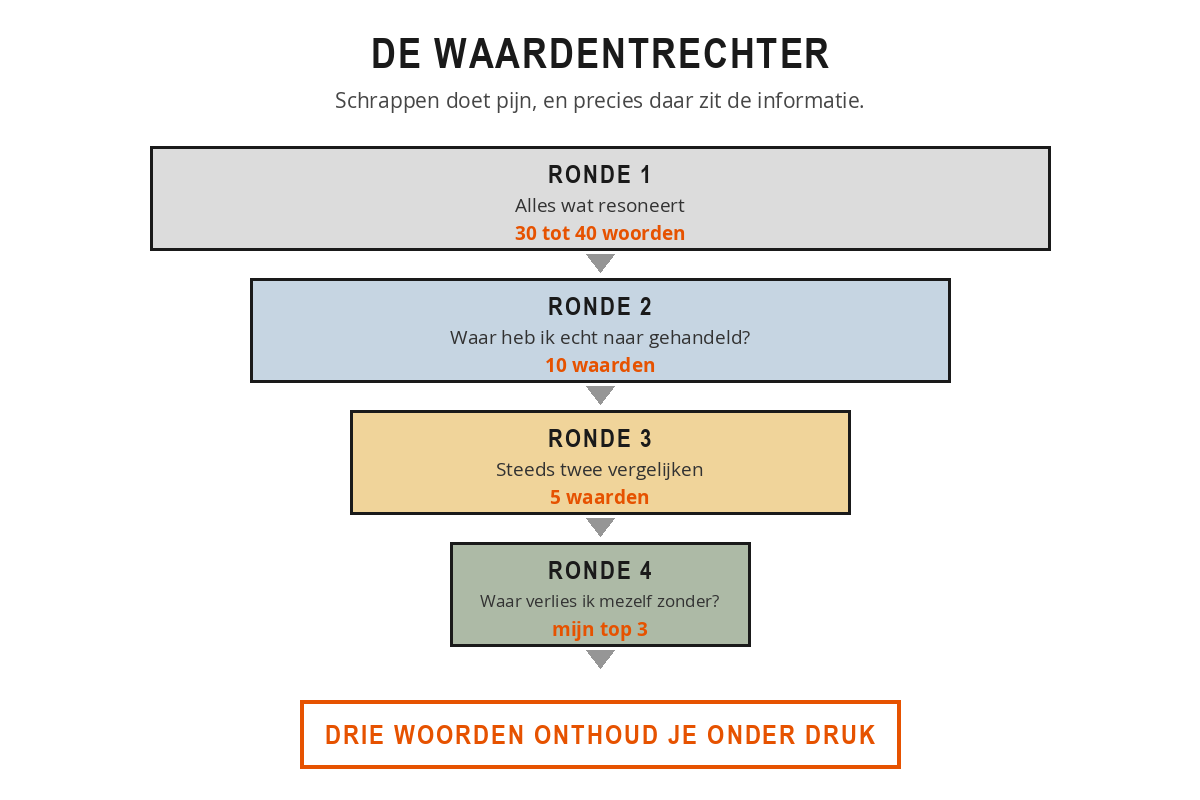
Round 1, everything that resonates. You work through a broad list of values and mark whatever appeals to you, without yet thinking about priority. Often thirty to forty words remain. That is exactly the intention; you are not selecting yet.
Round 2, back to ten. For each word you ask: have I acted on this over the past two months, or do I mainly just like the sound of it? What remains, you will recognise in your diary. This is the round in which most fine-sounding words fall away.
Round 3, back to five. You place two values side by side each time and ask: if I could keep only one, which would it be? You repeat that until five remain. Comparing works better than weighing up, because here you do not have to give a score but only have to choose.
Round 4, back to three. The final step is the hardest. Your top three are the values of which you say: if I have to act against this on a structural basis, I lose myself in this work. Why three? A top ten makes no choices. When values clash, you want to know which one takes precedence, and that is only possible if the list is short. Three words are also easy to remember at a busy moment.
If you keep hesitating between two values, the regret question helps: which of the two would you regret most if you had done nothing with it for a year? Regret is a more reliable gauge than enthusiasm.
Meike, a team leader at a care organisation, is left with five values after round 3: diligence, autonomy, connection, recognition and growth. While comparing them she notices that recognition keeps losing out. "I like to hear it when something goes well, but I'm not going to change the way I work for it." Growth falls against autonomy: if she gets to decide how she works, growth follows of its own accord. Her top three becomes diligence, autonomy and connection. When she is asked a week later to just quickly sign off a file, she knows straight away why she won't.
From value word to visible behaviour
A top three on paper changes nothing yet. Values only start to work when they are visible in what you do on a Tuesday afternoon with a full diary. You cannot do reliability, but you can confirm every commitment within 24 hours. That is why you translate every core value into at least two behaviours that a colleague can see or hear without looking inside your head. You do that in four stages.
- Choose one core value. Start with the value that is under the most pressure right now, not with the easiest one.
- Write the behaviour in verbs. Write down what someone would literally see you doing. "I keep asking questions until I have the question behind the question" is usable, "I am committed" is not.
- Add a fixed moment in your week to go with it. Behaviour without a place in the diary disappears. Note down which meeting or time slot this behaviour belongs to.
- Name the price you pay. Every value costs something: time, discomfort or a conversation you would rather avoid. If you know that price in advance, you will not surprise yourself at the moment of paying.
The ladder only works in one direction. If you get stuck on step one or two, you are left with a fine-sounding word that nobody notices.
Decision rules for busy moments
Under pressure you do not choose carefully, you choose quickly. A decision rule is a short agreement with yourself in the form "if this happens, then I do that", which you set down in advance so that you do not have to weigh things up in the moment itself. Three examples:
- If someone asks whether something can be done quickly, I say I will come back to it this afternoon.
- If I notice that I have made a mistake, I report it the same day to the person affected by it.
- If a decision is outside my influence, I give it five minutes at most and then move on.
Rachid has openness as his first core value. He notices that in meetings with his director he almost always stays silent when he disagrees with something. His decision rule becomes: if I disagree in a meeting and I have arguments, I say so before the break. Not afterwards, because by then the decision has usually already been made. The first two times it visibly costs him an effort. The third time, the director asks him unprompted what he thinks.
When two values clash
Loyalty to your team clashes with honesty towards your client. Care clashes with speed. Such a clash does not mean you have chosen your values wrongly; it comes with the territory as soon as values really provide direction. If you never feel a clash, you have probably chosen words that ask nothing of you.
The order of your top three is then your tool. That order is not a ranking for all time, but a rule of precedence for the moment when you cannot serve both. If you know your order, you hesitate for less time and explain afterwards more clearly why you did what you did.
Test your order against real situations from your past, not against how you would like to be. Recall three moments when you had to choose and look at which value actually won out at the time. That is the order you are working with now. If you want to change it, that is a learning objective and not an observation.
Make your own selection in four rounds. Set aside twenty minutes for it and work on paper.
- Round 1: note down at least fifteen value words that appeal to you.
- Round 2: delete every word for which you cannot name concrete behaviour from the past two months, until ten remain.
- Round 3: compare two values at a time and cross out the loser, until five remain.
- Round 4: choose your top three and write one sentence for each value beginning with: you can see this value in my work because I ...
Then note which value was the hardest to drop and why that grates. Finally, choose the value that is under the most pressure right now and write one decision rule to go with it, in the form if this happens, then I do that.
Summary
- A core value says how you want to act, not what you want to achieve. It is not a goal, not a rule and not a personality trait.
- The funnel runs in four rounds: everything that resonates, back to ten based on evidence from your diary, back to five by comparing, and back to three.
- Three values, because a longer list makes no choice and you won't remember it at a busy moment.
- A value only starts to work once you translate it into visible behaviour, with a fixed moment in your week and a price you know in advance.
- Decision rules in the form of "if this, then that" ensure that under pressure you choose the way you wanted to choose beforehand.
- Clashing values are part of the deal. The order of your top three is your priority rule, and you test that order against what you actually did in the past.
A colleague says: "My core value this year is to obtain three certificates." What is wrong here according to this chapter?
What is the question you ask about each value word in round 2 of the funnel?
Why does this chapter set decision rules in advance instead of weighing things up in the moment?