


1. What makes a project a project
Not everything that is busy, complicated and important is a project. And the other way round: plenty of jobs that do call for a project approach are not treated as such. They simply run along in the diary as ordinary work, until they go off the rails. This chapter is about that distinction, because the approach you choose determines everything that follows.
After this chapter:
- Can you explain in your own words what a project is?
- You recognise the difference between routine work, project work and improvising.
- Can you name the five characteristics that make a job a project?
- You know why organisations accept the extra organisation a project brings.
- Do you understand how time, money and quality are tied together in the golden triangle?
Three ways of working
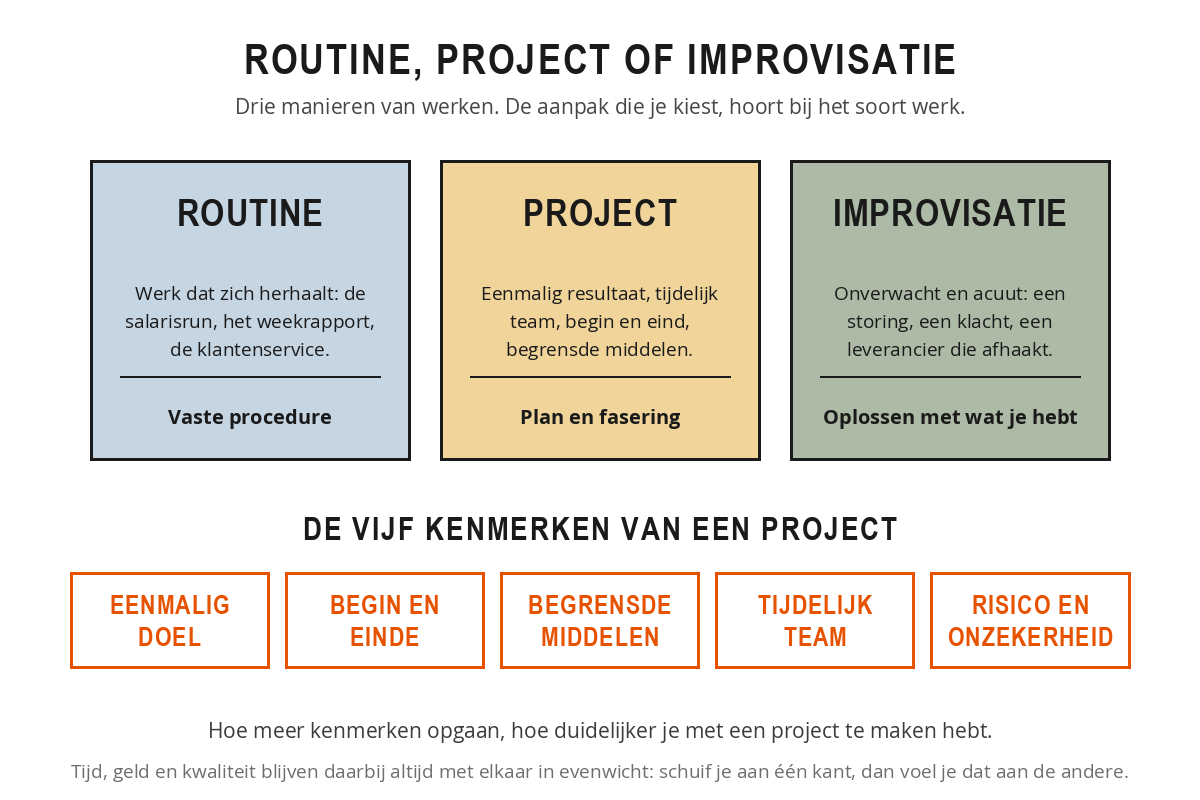
Work in organisations falls broadly into three categories, and each category calls for a different approach.
Routine work is everything that repeats. The monthly payroll run, the weekly stock report, the daily customer service. You know what has to happen, how it should be done and who does it. The approach is set out in procedures, and that is precisely its strength: nobody has to think it through again. Writing a project plan for routine work is wasted effort.
Improvising is what you do when something unexpected happens and you have to act straight away. A server goes down, a complaint gets out of hand, a supplier drops out on the day of delivery. You have no time for a plan and solve it with what you have. That is legitimate work too. It only becomes a problem when an organisation starts running on it, because then everyone puts out the same fire again and again.
Project-based working sits in between. You know what you want to achieve, you have time to prepare it, but there is no ready-made procedure to fall back on. You make a plan, work it out in phases and adjust along the way where necessary. It takes more organisation than routine work and more patience than improvising, and that is exactly what you get back for it: control.
The five characteristics of a project
To determine whether project-based work is the right approach, you look at five characteristics. The more of them apply, the clearer it is that you are dealing with a project.
A clear, one-off objective. You are working towards a result that does not yet exist: a new product, a refurbished building, an implemented system. Once delivered it is finished, and you do not do it all over again next month.
A beginning and an end. A project does not run on indefinitely. There is a start date and a planned end date, and the work happens in between. Without an end you do not have a project but a department.
Limited resources. You have an agreed budget, a set number of hours and an agreed set of people. Not unlimited, and usually less than you would like.
A temporary team. The people involved often come from different departments or even different organisations. After the project they go back to their regular work, and during the project they usually have that work to do as well.
Risk and uncertainty. Because the result is unique, you never know in advance exactly how it will go. There are always uncertainties, and you have to manage them rather than hope they turn out all right.
Not sure whether a job is a project? Ask yourself three questions. Is the result one-off? Is there a clear end date? Are there people working on it who do not normally do this alongside their own work? Three times yes, and you are in project territory.
At a secondary school there are two jobs on the deputy head's list. The first is the open day in November: a fixed date, a budget of 4,800 euros, a working group of seven people from four subject departments and a concrete result, namely a day on which two hundred parents see the school. All five characteristics apply, so that is a project. The second job is printing and sending out the grade lists at the end of each semester: the same every time, laid down in a procedure, carried out by the administration. That is routine work and it would be nonsense to write a project plan for it. When the deputy head treated the open day as routine work two years ago, it turned out three weeks beforehand that no one felt responsible for the catering.
Why organisations that go the extra mile
A project takes more organisation than simply carrying on working. There are meetings, a plan, a client who has to form a view now and then. Even so, organisations choose it deliberately, and there are good reasons for that. With a project approach you keep control over time, money and quality. You know who is responsible for what, instead of the work getting stuck between two departments. You spot risks before they become problems. And you build in moments at which you look back and adjust, so that you do not spend months working on something that stopped fitting long ago. It makes complex work manageable, and manageable work produces better results.
The golden triangle: time, money and quality
Every project has three dials that have to stay in balance with each other: time, money and quality. Move one and you feel it immediately in the other two. Want to finish sooner? Then you need more people or more money, or you deliver less. Want more quality? That costs time or money. That trade-off lies underneath almost every discussion you will have in a project, including the discussions that at first sight do not seem to be about it at all.
The awkward part is that clients rarely choose of their own accord. They want it fast, good and within budget, and as long as no one asks further, that stays in place. Your job is to put that choice on the table at the start, not halfway through when things get tight.
An insurer wants a customer portal live before the start of the new policy year on 1 January. Budget: 180,000 euros. In October it turns out that the link with the claims system is three weeks more work than expected. The project manager presents three options: move the date to February, add two external developers for 26,000 euros, or go live without customers being able to view their claim file and add that in March. The board chooses the third option, because the date was hard and the budget was spent. That is not a failure, that is the triangle doing its work. Had that choice not been made in October, the project would have hit January with all three problems at once.
Six phases at a glance
Every project goes through the same life cycle: initiation, definition, design, preparation, realisation and aftercare. In chapter 3 each phase is opened up separately, with what is delivered per phase and which decision sits behind it. For now it is enough to know that there are six of them, that they follow on from one another, and that between every two phases there is a moment at which someone decides whether you carry on.
Take a job you have done or seen in the past few months.
- Was it routine, a project or improvisation? And was the job actually tackled that way?
- Go through the five characteristics. How many apply?
- Which of the three dials, time, money or quality, mattered most to the client? Was that ever said out loud?
- If it went wrong: was that down to the approach or to the execution?
Write down your answers in no more than ten sentences. You will use them in the following chapters as a point of reference.
Summary
- Routine work repeats itself and is fixed in procedures; you improvise when something unexpected happens; project-based work sits in between, with a plan and phases.
- The five characteristics of a project: a one-off goal, a beginning and an end, limited resources, a temporary team, and risk and uncertainty.
- The more characteristics apply, the clearer it is that you are dealing with a project.
- Organisations accept the extra organisation a project brings because it gives control over time, money and quality, and because it names responsibilities.
- Time, money and quality form the golden triangle: turning one dial always means another one moves with it.
- Ask your client at the start which of the three weighs heaviest. That answer prevents most of the discussions later on.
The Purchasing department carries out the same supplier assessment every quarter: fixed questionnaire, fixed people, documented procedure. What do you call that work?
Which description belongs to the characteristic "temporary team"?
Your client wants delivery two weeks earlier than planned. What does the golden triangle say about that?