


Introduction
Almost nobody becomes a project manager. You end up being one. A job comes along that does not fit into any department, someone looks in your direction, and before you know it you are the one who has to sort it out. Rolling out a new system, moving an office, putting on a conference, launching a service. Without ever having been taught anything about it, and usually on top of your regular work.
And then things go wrong in places where you don't expect it. Not because too little work is being done, but because things were left unspoken in the first few weeks. The client had a different result in mind. All sorts of things were added along the way without anyone asking what that cost. The schedule was a sum of optimism. And the risk that eventually wrecked the project was on nobody's list.
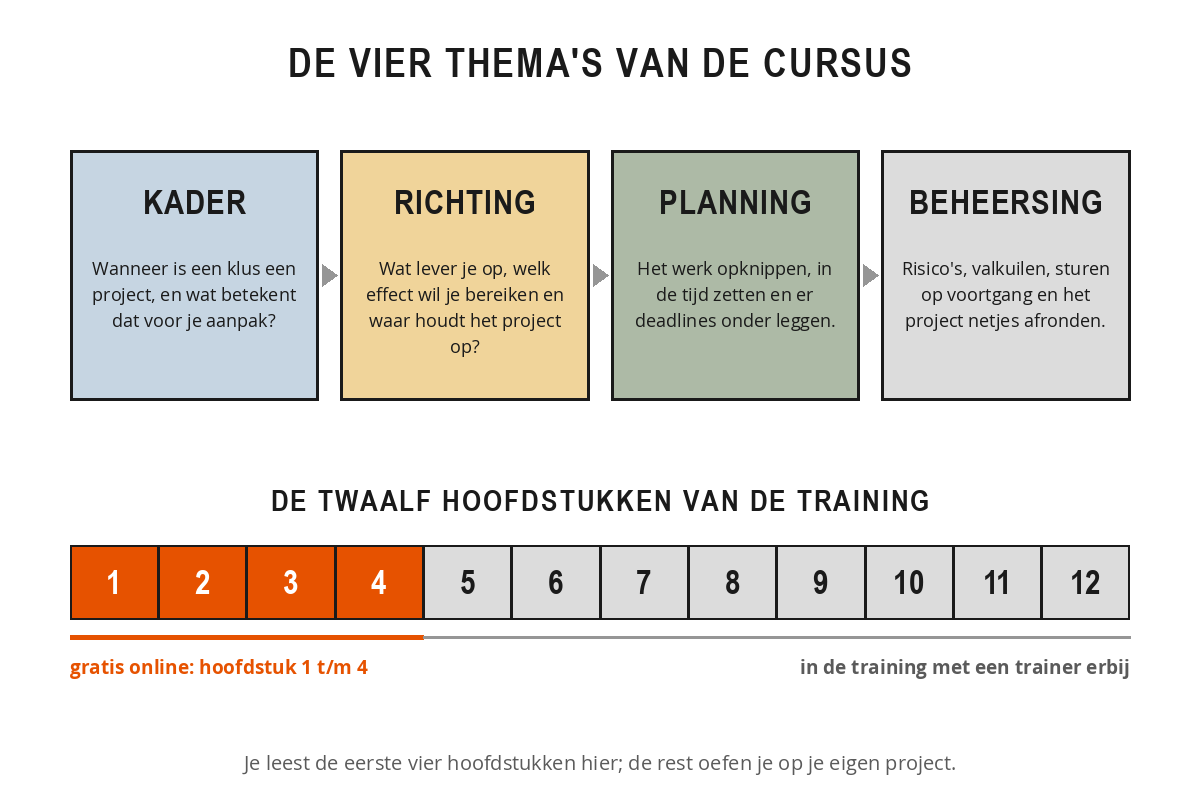
This free course contains the first four chapters: the orange part of the bar above. At the bottom of chapter 4 you will find the full course.
What you will learn
You first learn to distinguish between work that calls for a project and work that does not, because applying a project approach to a routine job only costs time. Next you turn a vague wish into an assignment you can read aloud to someone who has never heard of it, with an objective behind it and a scope around it. You then cut the work into phases and work packages and put a schedule under it that you can actually deliver, with a critical path and milestones. And you finish with risks: how to write them down before they happen, how to weigh them on likelihood and impact, and which five pitfalls come back in almost every project.
The common thread: project management is less about tools than you think and more about agreements. A Gantt chart is not difficult. Getting a client to choose up front between the deadline and the quality, that is the work.
How the course is structured
The course follows four themes that build on one another. You start with the scope: when is something a project, and what does that mean for your approach? Then comes direction: what are you delivering, what effect do you want to achieve and where does the project end? Then comes planning: breaking the work into pieces, setting it out in time and putting deadlines under it. And you finish with control: risks, pitfalls, steering on progress and finishing off properly. Each chapter contains theory, a model, examples from practice and an exercise that you apply to your own project.
Practical tips for use
- Choose one project you are currently involved in and keep it alongside you throughout the course. The material only lands once you have something to apply it to.
- Don't read it all in one go. One chapter a week, with time to try it out, delivers more than reading through it in an afternoon.
- Do the exercises on paper. What you write down you can show to someone else, and that is precisely where the surprises come out.
- Put the outcome of chapter 2 to your client. That conversation will yield more than the rest of the course put together.
- Do you work in an environment with Scrum or Agile? The terms differ, the questions don't. What are we delivering, for whom, within which limits, and what can go wrong.
Each chapter ends with a short knowledge check of three questions: answer them correctly to mark the chapter as completed. Your progress is saved automatically in your browser.
Enjoy the reading, and above all: good luck with your own project.