


2. Understanding the client
Many account managers know their client through one contact person and the last three orders. That is a narrow basis for a conversation about next year. A client analysis forces you to organise your picture and to separate what you know from what you assume. Only then do you know what this client is worth to you and how much attention they deserve.
After this chapter:
- Whether you know which information belongs in a client analysis and where to get it.
- You can draw up a SWOT for one specific account, from your position with that client.
- Determine your customer value using four building blocks instead of turnover alone.
- Do you divide your accounts into A, B and C, with a contact frequency and an objective per segment?
- You turn your analysis into information gaps, opportunities and risks.
The four layers of a customer analysis
A customer analysis peels back four layers, from hard figures to the people behind the decision.
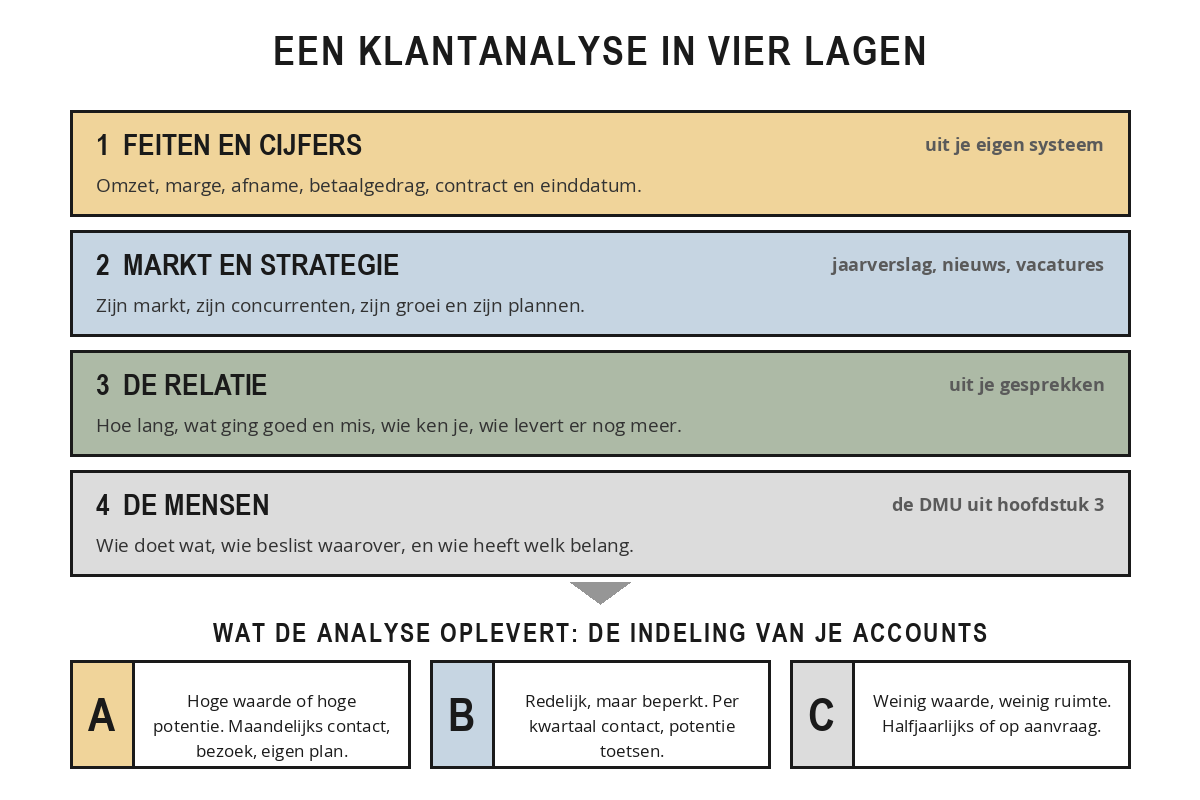
Layer 1, facts and figures. Turnover and margin over the past three years, which products or services the customer buys, their payment behaviour, the type of contract and its end date, and the costs you incur to serve this customer. This is the layer that shows your current value, and it is simply there in your own system.
Layer 2, the customer's market and strategy. Which market are they in, who are their competitors, is their sector growing or shrinking, and what plans have they stated themselves? Annual reports, news items, job vacancies and their own website will tell you a great deal here. A customer looking for three buyers is clearly building something up.
Layer 3, the relationship. Since when have you been working together, what went well and what went wrong, how many contacts do you know, and how deep are you embedded in the organisation? Also: which competitors also supply them, and with what exactly?
Layer 4, the people. Who does what, who decides on what, and who has which interest? You work out that layer in chapter 3.
The difference between a good and a poor customer analysis rarely lies in layer 1. You already have those figures. The difference lies in layers 2 and 3, and you fill those mainly with what you pick up in conversations. Asking good follow-up questions is therefore not a separate topic: it is your most important source.
A customer analysis is not a one-off document. Put a date on it and update it after every customer conversation, even if it is only one line. An analysis that is fifteen months old is a historical document, not a working tool.
A SWOT at account level
You may know the SWOT as a tool for an entire organisation, but it works just as well for a single client. You complete it from your position with this specific client, not from your company as a whole.
At strengths you put down what you have better organised with this client than your competitor: you know the production manager personally, you always deliver within 48 hours, your system links up with theirs. Under weaknesses shows you where you are vulnerable: a single contact person, an outstanding complaint, a price that is ten per cent above the market. Opportunities are developments at the customer or in their market that you can respond to: a new branch, an expiring contract with a competitor, new legislation in their industry. Threats are developments that undermine your position: a purchasing department about to centralise, a competitor that has just run a trial, your contact person retiring.
The value lies in the combination. An opportunity plus a strength is where you can act straight away. An opportunity plus a weakness is where you first have to arrange something internally.
What a customer is really worth
Customer value is the total return on a relationship over several years, in money and in other things that help your organisation move forward. Four building blocks together determine that value.
- Current value: the margin over the past period, minus the cost of serving this customer. A customer with a lot of turnover and a lot of complaint handling may end up at the bottom of the list.
- Potential: the part of the purchasing budget that currently goes to a competitor. A customer with 40,000 euros of turnover with you and 300,000 euros elsewhere is more interesting than a customer who already buys everything from you.
- Reference value: what this name does for you with other prospects. A well-known client in your field opens doors that an advertisement never will.
- Collaboration value: does he pay on time, does he think along with you, does he share his plans? Clients who involve you in their development sharpen up what you offer.
Put those four side by side and a different ranking often emerges from the one the revenue list in your system shows.
An account manager in technical wholesale has 46 clients. By revenue, Vermeer Installaties is in 3rd place, with 210,000 euros. On completing the four building blocks it turns out that Vermeer already buys everything from him, chases up every delivery by phone and pays in 68 days on average. Potential nil, cost to serve high. In 19th place is Dorsman Techniek with 38,000 euros. Dorsman has just opened a second site, still buys its core range from a competitor and is a name in the region that everyone watches. Vermeer becomes a B with the emphasis on retention, Dorsman an A with the emphasis on growth. On the revenue list that conclusion would have been impossible.
A-, B- and C-accounts
With current value on one axis and potential on the other, three workable groups emerge, and each group calls for a different way of serving it. That is exactly what the categorisation is for.
A A-account has high value, high potential or both. Here you schedule fixed contact moments, know several people at the client and work from a written plan: roughly monthly contact, preferably a visit, with deepening and growing the relationship as the aim. A B account currently delivers reasonable returns with limited room to grow, or the other way round: little revenue with plenty of room. Here you maintain the relationship and check specifically whether that potential really exists, with roughly one conversation per quarter. A C-account brings in little and offers little room. You serve these clients twice a year or on request, largely by email and through the service department. That isn't a punishment, it's a choice not to spread your time too thinly.
The ratio between those groups is skewed, and that is the whole point. In the classic split, the A group, roughly 20 per cent of your customers, accounts for around 80 per cent of your margin. The B group, at 30 per cent of customers, is good for some 15 per cent, and the C group, with half of your customer base, represents only 5 per cent. An extra hour of attention for an A customer therefore counts for something entirely different from an extra hour with a C customer.
Put a date next to each letter. A classification without a review moment is out of date within a year, because clients grow, shrink and change buyers. Reviewing your list twice a year is enough.
From analysis to conclusions
An analysis that stays in your folder has no value. The step that counts is translating it into three types of conclusion. Information gaps: what you do not yet know but do need. Every gap becomes an open question for your next conversation, or a name you still have to get to know. Opportunities: a development your organisation can do something about, phrased in the client's language. So not "we can supply X", but "they need to solve Y". Risks: a contract coming to an end, an ambassador leaving, a competitor who has got a foot in the door at a sister company. Each calls for an action you don't put off.
Your conclusions are interpretations, and interpretations aren't always right. The quickest check is the client themselves. In four steps: you summarise what you have understood about their situation and their market, you name the development you see and ask whether they experience it the same way, you ask what consequences that development has for them in the coming year, and you ask who within their organisation decides on that subject. Clients generally respond well to such a summary, because you show that you have got to grips with their world. And in steps three and four you get information you would never have heard from a question about your offering.
At an office supplier, Hanne handles an account of 95,000 euros that has been stable for three years. In layer 2 she reads that the customer has two vacancies open for a site in Zwolle that didn't exist last year. Her strength is that the facilities manager trusts her; her weakness is that she doesn't know anyone at the new location. That is an opportunity plus a weakness, so she first arranges an internal delivery commitment for the Zwolle region and then asks the facilities manager who is handling the fit-out there. Two months later there is a quotation of 30,000 euros on the table. Without layer 2 she would never have spotted those vacancies.
Choose one account that you think you know well.
- Fill in the four layers. Put a question mark after everything you are actually assuming.
- Complete the SWOT with at least two points per quadrant, from your position with this customer.
- Record two combinations: one strength plus opportunity that you act on straight away, and one weakness plus opportunity that requires you to arrange something internally first.
- Give each of the four building blocks of client value a score from 1 to 5 and determine the letter A, B or C.
- Compare that letter with the number of contact moments over the past six months and note the difference.
Finally, write down the opening sentence you will use to test your picture in the next conversation.
Summary
- A client analysis works in four layers: facts and figures, the client's market and strategy, the relationship with you, and the people behind the decision. For each layer, separate what you know from what you assume.
- Layer 1 is in your system; the difference is made in layers 2 and 3, and you fill those with what you pick up in conversations.
- The SWOT at account level is about your position with this one customer. Strength plus opportunity means acting straight away; weakness plus opportunity means arranging something internally first.
- Client value consists of current value, potential, reference value and collaboration value. Revenue alone gives the wrong ranking.
- A-accounts get monthly contact, a visit and a plan; B-accounts one conversation per quarter to test their potential; C-accounts every six months or on request, served efficiently.
- Around 20 per cent of your customers deliver about 80 per cent of your margin, 30 per cent account for some 15 per cent and the remaining half for about 5 per cent.
- Every analysis ends in information gaps, opportunities and risks, and you test these with the client in four steps before you build a plan on them.
Why does the difference between a good and a bad customer analysis rarely lie in the first layer?
You see an opportunity in a customer's market, but you only know one person there and you still have a complaint outstanding. According to this chapter, what is the right order?
A client generates a lot of revenue, but already buys everything from you, chases up every delivery by phone and pays late. How does the client value work out?