


1. The account manager and the customer pyramid
An account manager is caught between two fires. The customer wants maximum attention and speed, while your own organisation guards margins, capacity and agreements. The profession lies in the space between the two. Anyone who only follows the customer burns up their credit with colleagues. Anyone who only follows their own organisation loses their credibility with the customer.
After this chapter:
- You know what an account is and how a key account differs from it.
- You know the five core tasks that come up in virtually every account management role.
- Can you sort your own customers into a customer pyramid, by value and by potential.
- You recognise the three movements of retaining, deepening and growing in your own accounts.
- You know why internal customer focus determines whether your promise to the customer is delivered on.
What exactly is an account?
An account is a customer who has been assigned to you and for whom you carry commercial responsibility. Not every order is an account. An account is about a relationship that you manage over a longer period: you know the organisation, the people and the plans, and you know what there is to be gained in the years ahead.
A key account is a customer with strategic weight. That may be a customer who provides a large share of your turnover, who opens the door to a new market, or who brings so much knowledge and reference value that you do not want to lose them. Key accounts get their own approach, more consultation and often a team around them rather than a single contact person.
Five core tasks in the role
The specifics differ from sector to sector, but you will come across these five tasks everywhere. Maintaining relationships: you make sure the customer knows you, trusts you and calls you when something is going on, even when there is nothing to sell. Spotting and capitalising on opportunities: you hear what the customer is struggling with and connect that to what your organisation can deliver. Gathering and passing on information: what happens at the customer is only known within your own company if you tell it. Monitoring agreements: you keep an eye on whether what was promised is actually delivered, in quality, time and price. And accounting for the result: you steer on turnover, margin and customer retention, and you account for that.
Two account managers receive the same urgent request. Karim immediately emails the customer a commitment for Wednesday and puts his own production department on the spot. The delivery slips to Friday, the customer is disappointed and the planner is irritated. Marloes calls the planner first, hears that Thursday is possible with a small rescheduling, and explains that to the customer. The customer accepts Thursday, the planner feels taken seriously. The same request, two days' difference, and two very different relationships.
The customer pyramid
You have more customers than hours. The customer pyramid helps you divide up that scarce time: it makes visible which customers carry the most weight and how much attention they warrant.
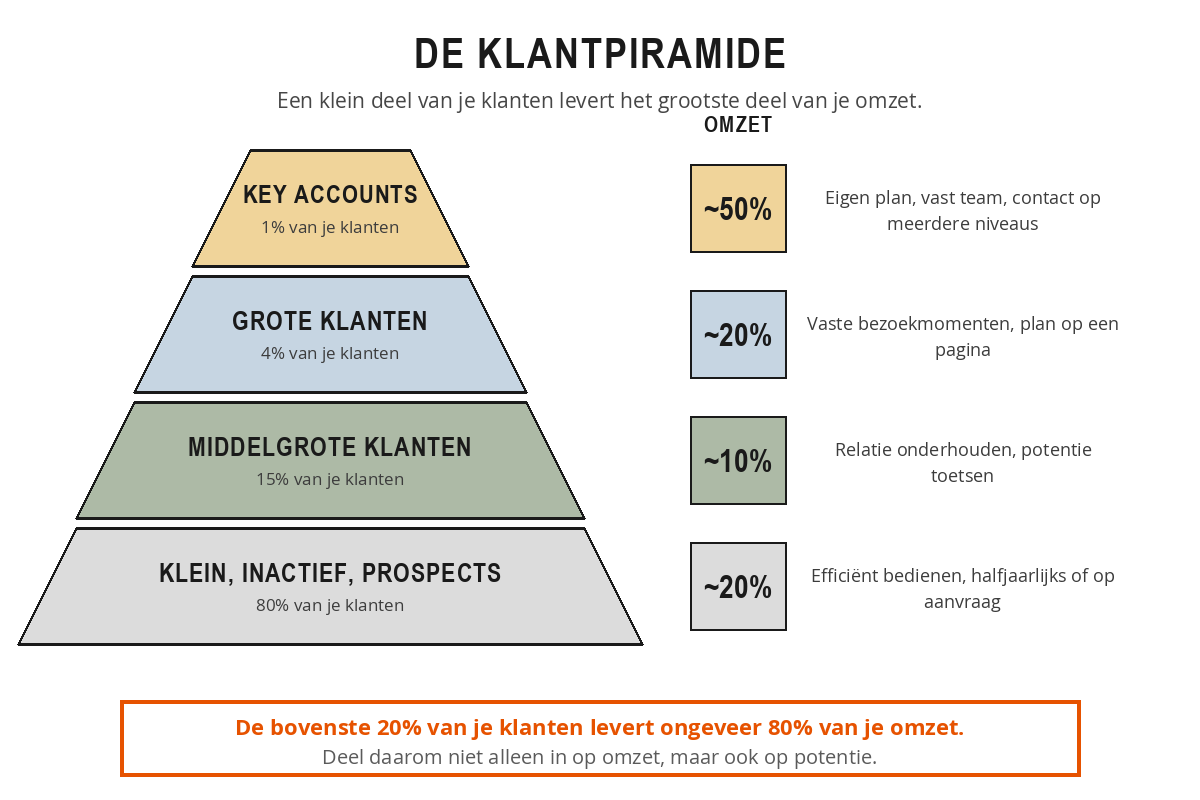
The distribution differs from one organisation to the next, but the pattern is familiar. In Jay Curry's classic pyramid, the top 20 per cent of your customers account for around 80 per cent of revenue. Within that top group there is a layer of key accounts of roughly 1 per cent of your customers, and that single layer alone accounts for about half of your turnover. Below it are the large customers, around 4 per cent of your customer base, accounting for roughly 20 per cent of your turnover, and the medium-sized customers, around 15 per cent, accounting for roughly 10 per cent. And then there is the broad base: 80 per cent of your customers, consisting of small and inactive customers, prospects and suspects, together accounting for the last fifth of your turnover.
Work it out and the point becomes clear. Of every hundred customers, twenty deliver four fifths of your turnover, and that single top customer within that group accounts for half on his own. That skewed ratio is not a problem, but it is a question of steering. If you give every customer the same amount of time, you automatically give the top layer too little.
Segmenting by value and by potential
A pyramid based on turnover alone looks backwards. You see what a customer bought last year, not what is still in it. That is why you weigh up two things against each other. The current value is the revenue and margin of the past period, minus the costs you incur to serve this customer; high revenue with a thin margin and a lot of service is less attractive than it looks. The potential is the share of the customer's purchasing budget that currently goes to others; a customer who buys 10 per cent of their needs from you offers more scope than a customer who already takes 90 per cent.
Put those two side by side and you get four types of customers. High value and high potential: that is where you invest. High value and low potential: those you defend. Low value and high potential: those you develop. Low value and low potential: those you serve as efficiently as possible.
A small account with a large purchasing need belongs in the upper layers in terms of attention, even though it sits at the bottom in terms of turnover. Anyone who builds their pyramid purely on historical turnover keeps investing in customers who are already at capacity.
From transaction to partnership
The profession has shifted over the past few decades. Discounts and quick deals are still part of it, but they are no longer the core. Customers compare prices and specifications online themselves, so the account manager who only comes to deliver product information adds little. Three shifts determine what your working day looks like. From product to issue: the client is not buying a service but a solution to something that is costing them money or time, so your conversation starts with that problem and not with your product range. From a single contact to a network: decisions are shared across several people and departments, so you maintain contact at several levels. From hunting to growing: winning a new client costs many times more than growing an existing one.
Retain, deepen, grow
That last shift calls for a different view of your portfolio. An account is not a completed sale but a relationship with a course, and it contains three movements.
Retaining is making sure the customer stays. You keep to your agreements, you are available, and you solve problems before the customer has to complain about them. This does not generate extra revenue; it prevents existing revenue from walking away. Deepening is to broaden the relationship within the same volume of business. You get to know more people, you get to the table earlier in the process, you hear the plans for next year. The revenue stays the same, your position becomes stronger. Growing is turning that position into more work: an extra site, an additional service, a multi-year contract.
Many account managers skip the middle move. They keep the customer nicely satisfied and then ask for more work. To the customer that feels like a sales attempt without cause. Growth almost always comes after deepening, rarely before it.
Your diary for the past month gives an honest picture. If virtually all your customer contact falls into the retention category, in other words adjusting, solving and delivering on promises, then no room for depth has been created. A workable rule of thumb: at least one conversation per quarter with each large customer in which no ongoing matter is on the agenda.
Customer focus works in two directions
External customer focus is about the customer who pays: you put yourself in their situation and make their objective central instead of your own offering. Internal customer focus is about your colleagues. Everything you promise the customer is carried out by the planner, the engineer, the service desk or the administration team. If they see your request as an awkward interruption, your promise will struggle to come to life. If they see it as a shared interest, you will get more done than you could expect on paper.
In concrete terms that means: you explain why something is needed, instead of only when. You ask about their situation before you commit to a date. You report back what the customer thought of the result. And you share the credit, internally too.
Iris promises a client a report for Monday's management meeting. Rather than emailing the data department with "please deliver by Monday", she drops by with a question: this client's board decides on Monday whether to renew a contract worth 180.000 euro, what do you need from me to have the figures ready by Friday? The analyst says he needs two missing fields. Iris collects them from the client that same afternoon. The report is ready on Thursday, a day before the deadline.
Build your own customer pyramid. Take last year's revenue list.
- Divide your customers across four tiers: key accounts, large customers, medium-sized customers and the base.
- Add up the revenue of your top three tiers and see whether together they come to around 80 per cent.
- Give every client in the top two layers an estimate of their potential: low, medium or high.
- Mark the customers in the bottom two layers with high potential. Those are your candidates for development.
- Note down which two accounts your time spent does not match their position in the pyramid.
Then look at your last month of contact per account and note whether it was about retaining, deepening or growing.
Summary
- An account is a client with a longer-term relationship and its own commercial owner. A key account also carries strategic weight through revenue, market position or reference value.
- The five core tasks are maintaining relationships, converting opportunities, passing on information, monitoring agreements and accounting for results.
- In the customer pyramid, the top 20 per cent of your customers deliver roughly 80 per cent of your turnover, with the key accounts (1 per cent) alone accounting for about half. The base of 80 per cent of your customers delivers the final fifth.
- Don't only segment by current value, but by potential as well: the share of the purchasing budget that currently goes to someone else.
- The profession is shifting from transaction to partnership: from product to problem, from a single contact to a network, from hunting to growing.
- Retaining prevents loss, deepening strengthens your position, growing brings in revenue. Growth comes after deepening, not before.
- External customer focus determines what you promise, internal customer focus determines whether that promise is kept.
A customer is third on your revenue list and now buys almost everything they need from you. What does this chapter say about the attention they deserve?
Why does an account manager who keeps his customers nicely satisfied and then asks for extra work get stuck?
According to this chapter, what is the difference between internal and external customer focus?