


3. The four phases of the advisory conversation
An advisory conversation has a fixed structure: four phases, each with its own purpose and its own pitfall. Anyone who skips a phase often gives perfectly sound advice on the wrong question. And you only notice that when the advice is not acted upon.
After this chapter:
- You can name the four phases of an advisory conversation and the purpose of each phase.
- you open a conversation in such a way that the purpose, agenda and expectations are clear to both parties.
- You use listening, summarising and probing to get the question behind the question out into the open.
- You recognise in yourself the moment when you jump to a solution too soon.
- you close with agreements that survive the meeting room.
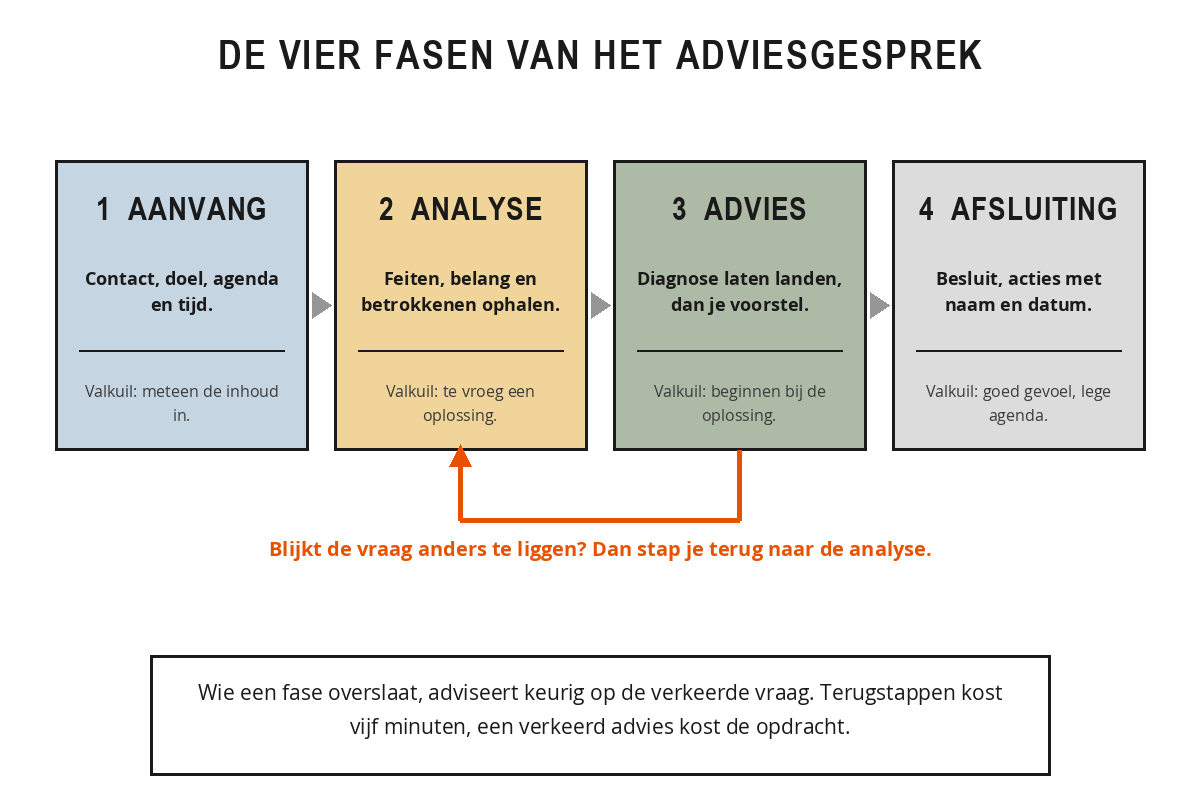
The four phases are opening (making contact and setting the frame), analysis (gathering the facts, the interest and those involved), advice (turning your diagnosis into a proposal) and closing (recording what happens and by whom). The arrow back in the diagram is not a mistake. As soon as it emerges during the advice phase that the question is different from what you thought, you step back to the analysis. That costs five minutes. Advice on the wrong question costs you the assignment.
Phase 1: opening
The first few minutes determine how much you find out in the rest of the conversation. You establish two things here: the tone in which the conversation takes place, and the agreements about what the conversation is about. If you don't, you will still be negotiating the agenda halfway through.
An opening consists of five steps. You begin with making contact: greeting, a few personal words, and paying attention to what you see. Someone who comes in rushed needs a different opening from someone who settles in with plenty of time. Then you name the trigger: "You called me last week about the lead time of the applications." Next you check the aim with the other person: you place your own picture alongside that of your conversation partner and ask whether it is correct. This is the most important step of this phase, and the most frequently skipped. Then you ask the agenda in three steps and ask whether anything needs to be added. And finally you agree time and role at the start: how much time is there, what does the other person expect of you, thinking along, deciding or carrying out, and what happens after this conversation?
One question yields more in the opening phase than all the others: "What would you be satisfied about at the end of this hour?" The answer gives you the aim, the level of expectation and often the real theme, all at once.
An adviser sits down with a team leader who asks for "a course on giving feedback". Instead of talking about the course straight away, she opens like this: "Before we talk about the course, I'm curious. What is happening in the team at the moment that makes you think of this?" The team leader talks about two employees who systematically avoid each other and about a project that has consequently overrun by two months. It turns out not to be a training question at all. That insight takes three minutes at the start, instead of a failed course costing 4.800 euro two months later.
Phase 2: analysis
In the analysis phase you gather information and sharpen the question. You collect facts, but interests, perceptions and feelings belong there just as much. The pitfall is familiar and persistent: you hear something recognisable and within two seconds your mind supplies a solution. From that moment on you are no longer listening, you are collecting evidence for what you already think.
The engine of this phase is the combination of listening, summarising and probing. Those three only work together. If you listen without summarising, it remains unclear whether you have understood correctly. If you summarise without probing, you stay on the surface. And if you probe without listening first, you are interrogating someone.
Three types of follow-up question will usually get you furthest. Clarifying: "What exactly do you mean by 'it isn't working'?" You remove vague words and replace them with behaviour and figures. Deepening: "What makes this urgent now?" You are looking for the interest and the trigger behind the question. Broadening: "Who else notices anything of this?" You bring the other parties involved and their interests into view.
After the conversation you have a mountain of information: statements, figures, observations and contradictions. That mountain is not yet a diagnosis. Force yourself to write down at least eight possible causes before you start weighing them up, because the first plausible explanation crowds out the rest. As soon as you think "it's down to communication", you stop looking. Then bring in structure: put the problem in the middle of a blank sheet, draw branches for people, processes, systems and management, and attach each cause to the branch where it belongs. The heaviest branch gives you your diagnosis.
A diagnosis is a shared formulation of the problem that the client recognises. Put it to them first and ask whether it is correct. Only once the client nods does a piece of advice have solid ground under its feet.
Phase 3: advice
The temptation to open with your solution is strong. It works the other way round: only when the client recognises your diagnosis are they willing to hear your advice. That is why you begin by reflecting back what you have gathered, in the client's own words. Then you keep quiet for a moment. That silence serves a purpose: it gives the other person room to say "yes, that's it" or "no, that's not the core of it". If you build on a diagnosis that is not shared, you lose the other person for the rest of the conversation.
Four rules apply when presenting your proposal. One main line, no more than three arguments: more arguments do not make your story stronger, they make it vaguer. Concrete in terms of behaviour, time and money: "more ownership with the team leaders" says nothing; "from 1 May the team leaders run the weekly start themselves, twenty minutes, to a fixed format" is something someone can say yes or no to. Naming the consequences, including the unpleasant ones: if your advice costs three months of extra lead time or a difficult conversation, you say so yourself. If the client hears it later from someone else, your advice loses its authority. And two routes, not a menu: with two alternatives that differ clearly, a client makes a choice; with five options, they postpone the decision.
Fatima is investigating why complaint handling at an insurer is grinding to a halt. She reports back: "You called it a staffing problem. What I see is that three out of four complaints are handed over twice before anyone picks them up. That costs four days on average. Does that picture match?" The manager nods and says: "I hadn't looked at it that way." From that moment on, the conversation is about handover points and no longer about extra people. She puts forward two routes: the first employee remains the owner of the complaint, or there is a daily triage of fifteen minutes. The manager chooses the second, because it asks less of the individual employee. Had Fatima opened with "you need to work differently", it would have stayed with extra people.
Test acceptance with a question that makes the client calculate rather than judge. "What do you think of it?" produces a socially acceptable answer. "Who here would be the first to object to this?" produces information about the resistance you still have to resolve.
Phase 4: closing
Many advisory conversations end in a good feeling and an empty diary. The closing phase exists to prevent that. Four questions take you five minutes and determine whether your advice will actually lead to anything.
What have we decided? You summarise, the client confirms. Not the other way round, because you are responsible for the precision. Who does what, and when? Every action is given a name and a date; "the team will pick this up" is not an agreement. Who else needs to hear this? This is how you build support outside the room, and it is often here that the most important action of the entire conversation arises. When will we review? Putting a follow-up moment in the diary turns a piece of advice into a process.
Close with a short process question: "Did you get what you needed today?" The answer is free feedback on your own way of advising. Sometimes you will hear that you went too fast, sometimes that the client would have liked more direction. You use that information in the next conversation with the same person.
Take an advisory question you have received in recent weeks and work it out in writing.
- Write down the question exactly as the client put it, word for word.
- Underneath, note down: which facts you have heard, which interest lies beneath them and what you do not yet know.
- Formulate three probing questions you would still ask: one clarifying, one deepening and one broadening.
- Look back: at what point in this conversation did you first jump to a solution, and what signal in yourself could you have noticed?
- Finally, go through the four closing questions. Which agreements had no name or no date attached?
Summary
- An advisory conversation runs through four phases: opening, analysis, advice and closing.
- In the opening phase you make contact and explicitly establish the objective, agenda, time and roles. The most important step is checking the objective with the other person.
- In the analysis phase you gather facts, interests and those involved by listening, summarising and probing, and you do not yet give advice.
- Clarifying, deepening and broadening are the three types of probing question that take you furthest.
- A diagnosis is only usable once the client recognises themselves in it. Put it to them and ask whether it is right.
- In the advisory phase you stick to one main line with no more than three arguments, you make it concrete in terms of behaviour, time and money, you name the consequences and you offer two routes.
- In the closing phase you record what has been decided, who does what and when, who else needs to hear about it and when you will review.
- If it emerges during the advice phase that the question is different, you step back to the analysis.
Which step in the opening phase is, according to this chapter, skipped most often, even though it is the most important one?
In the advisory phase, your client's reaction shows that the question is different from what you thought. What do you do?
Why, according to this chapter, do you offer two routes rather than five options?
Ready for the next step?
You have completed the free starter of Advisory Skills. The next chapter in the full course is Communication as a foundation: The communication model, the three channels through which your message comes across, and the other person's frame of reference.
Take the 3-day course →From €1875,- excl. VAT · with an experienced trainer