


2. The four advisory styles
Where your role is about your position in relation to the client, your style is about how you conduct the conversation. Not what you are, but how you move. And almost everyone moves in one fixed way, without ever having chosen it.
After this chapter:
- Recognise the four advisory styles by concrete behaviour.
- You know which style suits you naturally and which one you rarely use.
- You can assess which style suits this client, this issue and this moment.
- You know which signals tell you that you need to switch.
- You understand why a conversation that has got stuck is usually a style problem.
Two dials, four styles
Advisory styles differ on two things: how much you steer the content, and how much space the client gets in the conversation. Those two move in opposite directions. The more firmly you determine the content, the less space is left, and vice versa. Put them on a scale and you get four recognisable styles: telling, selling, exploring together and moving with the client. From left to right your steering decreases and the space for the client increases.
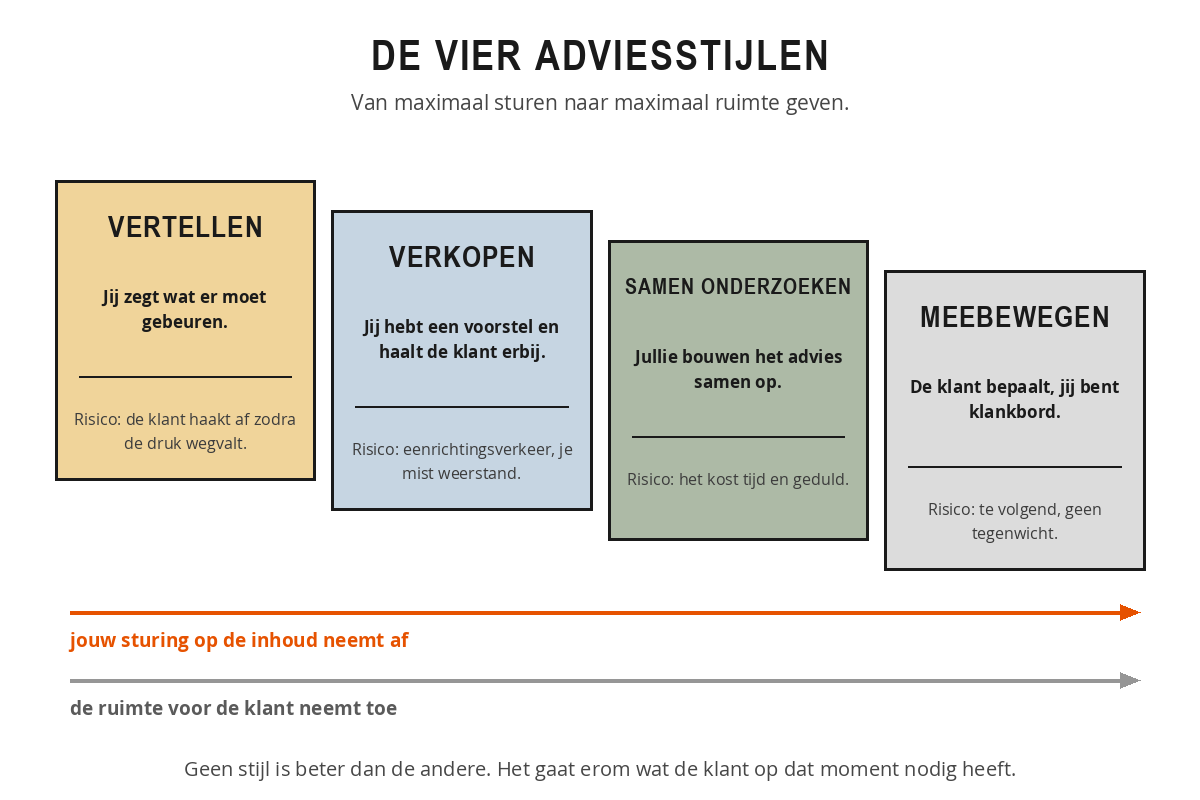
Telling. You make a clear statement about what needs to happen. You base it on your expertise and you leave little room for discussion. "I would not sign this contract until clause 7 has been amended." This style suits urgent situations, technical matters with a known answer, and clients who come to you for a clear answer. The risk: the client does not feel heard and goes along with it for as long as you are there. As soon as the pressure is off, implementation stalls.
Selling. You have a proposal and you try to win the client over with arguments, examples and enthusiasm. You explain why your approach works and you address objections. This works when you are genuinely convinced and the client is still in two minds. The risk: it becomes one-way traffic. You are so caught up in your own story that you miss the signals showing that the other person stopped listening long ago.
Exploring together. You bring your expertise to bear, but use it to explore the problem together with the client. You share what you see, ask follow-up questions, and build the advice step by step in dialogue. This style suits complex issues where the answer is not yet fixed and where several interests are at play. The risk: it takes time, and it requires patience on both sides. A client with a full diary may experience it as "he can't work it out".
Going along. You follow what the client brings up. You ask questions, summarise and help them sharpen what they want. You keep your own judgement in the background. This style is powerful with someone who already has a direction and is mainly looking for a sounding board, and with someone who has just had a setback to process. The risk: you become too follow-the-client. The client walks away with exactly the idea they came in with, while what they actually needed was a counterweight.
The style that comes most easily to you says something about your tendency in contact. Those who like to offer structure are quicker to choose telling or selling. Those who like to connect tend towards exploring together or going along. None of the four is better than the others. What counts is whether the style suits what the client needs at that moment.
Read your client
Not every client needs the same thing. One comes in with a clearly defined question and wants to hear a direction quickly. Another is struggling with the feeling that something is not right without being able to put a finger on it. Four questions help you choose: how much does this client already know about the subject, does he want to think along or be taken off the hook, how much room is there for doubt and exploration, and is there time pressure?
An experienced manager with an operational problem is often better served by telling or selling. A management team reorienting itself strategically calls for joint enquiry. And someone who has just had a setback first needs you to go along with them before there is room for any advice at all.
Bram advises on information security. At a manufacturing company he sees that the administrator password is the same on seven laptops. Only one style fits: telling. "This has to change this week, and this is how." No dialogue needed, the answer is fixed. Two weeks later he is at a care institution where the question is how they want to handle client data in a new app. There is no good answer he can bring with him: it depends on what the care teams consider important, what the executive board wants to be able to explain and what is technically feasible. He sets aside three sessions for it and works in the exploring together style. Same adviser, same field, opposite style.
Read the issue
The nature of the question partly determines what fits. A clearly defined problem with a known answer calls for a direct style; dialogue is mainly a delay there. A complex issue with several interests and an uncertain outcome calls for joint enquiry. If you nevertheless slip into telling during such a process, you provoke resistance. The client senses that you are imposing something that does not match the reality he is in, and he is right.
There is a third factor: the stage of the project. At the start you know too little to tell. At the end, when a decision has to be made, carrying on exploring is precisely unhelpful. The same client with the same issue calls for a different style in week one than in week six.
Switching within a single conversation
In practice you use several styles within a single conversation. You start by going along in order to connect, switch to exploring together to sharpen the problem, and close with selling to underpin your proposal. You recognise the moment to switch by the client: a silence, a change in posture, a question that opens up a new direction, or the sentence "yes, but in our case it's different".
Ilse is with a team leader who wants to reduce sickness absence, currently 9.4 per cent against 4.1 per cent in the rest of the department. She starts by going along: twenty minutes of mainly asking questions and summarising. Then the team leader says: "Actually, I don't dare have the conversation with Kees." That is the moment to switch. Ilse moves on to exploring together and sets side by side what happens if he does have that conversation and what happens if he lets it slide. Only in the final quarter of an hour does she switch to selling: one concrete proposal, three arguments, and a date. Had she started with that proposal, the conversation would have been about absence figures and never about Kees.
If a conversation grinds to a halt, you have usually been in the same style for too long. Were you telling? An open question creates movement. Were you going along with the other person? An observation of your own gets them thinking again. Switching in itself already makes a difference, even before the content changes.
Your least used style
Everyone has a style they rarely use, and that is almost always the style furthest removed from their character. People who like to help hardly ever get round to telling and let clients muddle on for too long. People who like to push ahead hardly ever get round to moving with the client and therefore miss half the story. That missing style is not a shortcoming to be ashamed of, but it does cost you work, because there are clients who need precisely that.
Don't practise your least familiar style in your most difficult conversation. Choose a conversation with low stakes and a client you know well, and prepare literally what you are going to say. With telling, that is one sentence beginning with "my advice is". With going along, it is the agreement with yourself that for the first ten minutes you will only ask questions and summarise.
Think back to your last three advisory conversations.
- Which style did you mainly use in each conversation? Add a sentence for each conversation showing how you can tell.
- Do you see a pattern? Which of the four styles does not appear in your list?
- Choose a conversation in the next fortnight in which you will use that missing style.
- Write out the first sentence word for word, so that you actually use it under pressure.
Summary
- There are four advisory styles: telling, selling, exploring together and going along.
- They differ on two things: how much you steer on content and how much space the client gets. From telling to going along, the steering decreases and the space increases.
- Telling suits urgency and a known answer; the risk is that implementation stalls as soon as you leave.
- Selling suits doubt; the risk is one-way traffic in which you miss resistance.
- Exploring together suits complex issues; the risk is that it takes too much time.
- Going along suits a client looking for a sounding board; the risk is that you become too follow-the-client.
- Which style is appropriate depends on the client, the issue and the stage of the project.
- If a conversation gets stuck, you have probably stayed in the same style too long.
A management team wants to reorient itself strategically. There are several interests at play and the outcome is not yet fixed. Which style is the most obvious choice here?
According to this chapter, what is the greatest risk of the going along style?
Your conversation has stalled: the client only gives short answers and nothing new is coming up. What is the first thing you think of?