


Introduction
Agile is one of the few ways of working that you can introduce without anything changing. The names come in, the habits stay. The team meeting is now called a stand-up, the task list is called a backlog, and every two weeks there is a demo where nobody really shows anything. Meanwhile the manager still decides who does what, the delivery date still shifts as soon as things get tight, and the client only hears what they are getting at the very end.
That is not unwillingness. It happens because the terms are easy to learn and the logic behind them is not. A sprint is only a sprint if the end date really is fixed. A backlog is only a backlog if there is someone who determines the order and who also dares to defend that order. A stand-up only works if the team coordinates among themselves instead of reporting. Anyone who has grasped that logic can work out the rest for themselves.
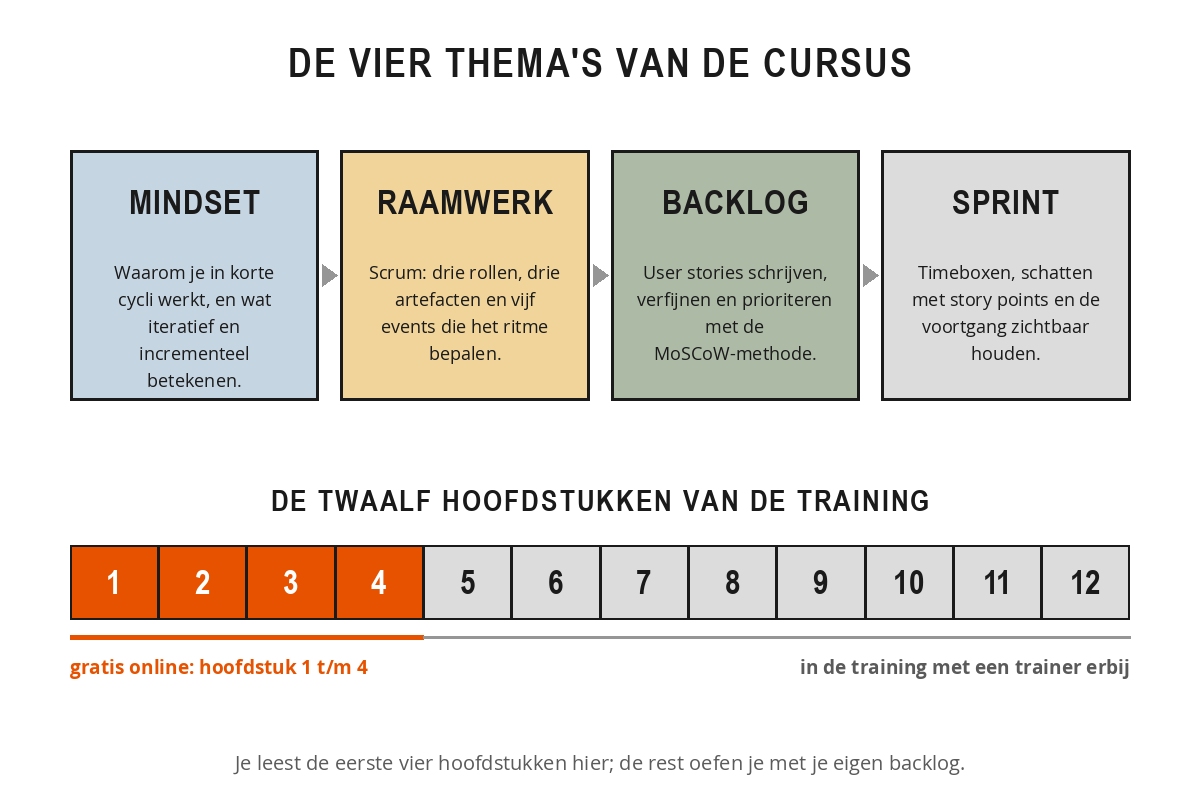
This free course contains the first four chapters: the orange part of the bar above. At the bottom of chapter 4 you will find the full course.
What you will learn
You start with the question of why you would work in short cycles. You learn the four values of the Agile Manifesto, the difference between iterative and incremental, and why the familiar project triangle is inverted in agile: it isn't the scope that is fixed, but time and budget. You also read when agile is not the best choice, because those situations do exist.
Then comes scrum: the three roles, the three artefacts and the five events that together make up the rhythm of a sprint. You learn what a Definition of Done is, and the three signs that show a team is doing scrum on paper but not in practice.
In the third chapter you fill the backlog. User stories in the format "As a <role> I want <functionality> so that <value>", the three C's, the six INVEST criteria, acceptance criteria you can actually check, and prioritising with MoSCoW according to the 60-20-20 split.
The fourth chapter is about the sprint itself: timeboxing at four levels, estimating with story points and Planning Poker, measuring your team's pace with velocity, and keeping progress visible with a scrum board and a burndown chart.
How the course is structured
The course follows four themes that build on one another. You start with the mindset: where does agile come from and why do short cycles work better in uncertain projects? Then the framework: scrum as the concrete implementation, with roles, artefacts and events. Then the backlog: describing the work and putting it in order. And finally the sprint: planning, estimating and monitoring within a fixed period of time. Each chapter contains theory, a diagram, worked examples and an exercise that you apply to your own work.
About the exam
Agile Project Management Foundation is a certification course. The exam tests terms, and it tests them literally: the four MoSCoW categories are called Must have, Should have, Could have and Won't have this time, and not something roughly resembling that. That is why the terms in this course are named exactly as they appear in the exam. Where a Dutch word is in common use, we use it. Where everyone in practice uses the English word, we stick to the English word, because that is what the exam does too.
Practical tips for use
- Choose one team or one project you are currently involved in and keep it in mind throughout the course. Even if scrum isn't being used there: that is precisely when you see where things chafe.
- Don't read it all in one go. One chapter a week, with time to try it out, delivers more than reading through it in an afternoon.
- Learn the terms literally. Anyone who mixes up "sprint review" and "retrospective" will stumble both in the exam and in practice.
- Do the exercises on paper. Writing three user stories takes ten minutes and teaches you more than the chapter about them.
- Do you work in an environment with PRINCE2 or a traditional project approach? Then read chapter 1 particularly carefully. The choice between the two is one of the exam topics.
Each chapter ends with a short knowledge check of three questions: answer them correctly to mark the chapter as completed. Your progress is saved automatically in your browser.
Enjoy reading, and above all: good luck with your next sprint.