Free Agile Project Management Foundation course

Free, right now

The first four chapters online, with a knowledge check after each chapter. Plus a PDF with a worksheet and cheat sheet.

You can read the lessons straight away. For the PDF, you leave your details.

Start with lesson 1

Prefer to have a trainer there with you?

The two-day Agile Project Management Foundation course. You practise with your own backlog and sit the Foundation exam.

EUR 1300,- excl. VAT

View the Agile Project Management Foundation course All Agile & Scrum courses →

You hear the words every day. Sprint, backlog, stand-up, refinement. Perhaps you are already in the thick of it: your team works in sprints, there is a board on the wall and every morning everyone stands together for fifteen minutes. And still the feeling lingers that it looks more like new names for old habits than a different way of working. The stand-up has turned into a status round for the manager, the sprint routinely overruns by a week, and what goes into the backlog is decided by whoever shouts loudest.

This free online course is the starter for our full Agile Project Management Foundation. In four chapters you learn why you work in short cycles and what the difference is between iterative and incremental, how a scrum team is put together with three roles, three artefacts and five events, how you fill a backlog with user stories and prioritise them using the MoSCoW method, and how you plan, estimate and monitor a sprint within its timebox. Each chapter ends with a short knowledge check, so you notice straight away whether it is sticking.

The full course goes on to cover PRINCE2 and the hybrid approach, the DSDM Agile Project Framework with its eight principles and six phases, agile leadership and servant leadership, communication and team dynamics in scrum teams, retrospective techniques that genuinely improve a team, and focused preparation for the Foundation exam. Would you like to cover those topics with an experienced trainer alongside you, and sit the exam? Then have a look at the Agile Project Management Foundation course.

Agile Project Management Foundation

Chapters 1 to 3 in a single PDF, with a worksheet and cheat sheet.

Contents:

  • 0.-

    Introduction
    How this free course is structured and what you learn in the four chapters.
  • 1.-

    Why iterative working wins
    The four values of the Agile Manifesto, the difference between iterative and incremental, the inverted project triangle and when agile is precisely the wrong fit.
  • 2.-

    The roles and rhythm of scrum
    The three roles, the three artefacts and the five events, the Definition of Done and the pitfalls that give away scrum-on-paper.
  • 3.-

    Filling and prioritising the backlog
    User stories in the As-I want-so that format, the three C's, the INVEST criteria, backlog refinement and prioritising with MoSCoW along 60-20-20 lines.
  • 4.-

    Planning and monitoring the sprint
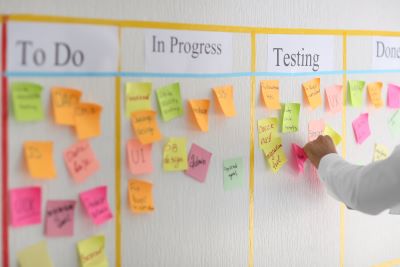
    Timeboxing at four levels, estimating with story points and Planning Poker, velocity, the scrum board and the burndown chart.
  • 5.-

    Waterfall, PRINCE2 and the hybrid choice
    The seven principles, themes and processes of PRINCE2, and how organisations combine governance and agility in a single project.
  • 6.-

    DSDM and the Agile Project Framework
    Where DSDM goes further than scrum, and the eight principles that guide every choice in a DSDM project.
  • 7.-

    The six phases of a DSDM project
    From Pre-project and Feasibility via Foundations to Evolutionary Development, Deployment and Post-project, with the kick-off and the release planning.
  • 8.-

    Agile leadership and servant leadership
    From manager to leader, clearing obstacles instead of handing out tasks, and giving successes back to the team.
  • 9.-

    Developing the agile mindset
    People over processes, learning over knowing, adapting over planning and value over completeness, and how you practise that yourself.
  • 10.-

    Communication and team dynamics in scrum teams
    Four communication channels, the forming, storming, norming and performing stages, and the difference between task, process and relationship conflict.
  • 11.-

    Retrospectives that improve your team
    Start-Stop-Continue, the four L's and the Sailboat, and how to ensure improvement actions actually make it into the next sprint.
  • 12.-

    Preparing for the Foundation exam
    The structure and content of the exam, study tips and strategy, and a summary of all the key concepts.

The trainers who deliver this course

That is the difference with a pdf: there is someone standing in front of the class who answers your questions and thinks along with your own situation.

What participants say about Learnit

I found the 'Interview Techniques' course to be good. Nothing to fault. It was also good that Job called beforehand for a short preliminary discussion. You don't see that very often. A very worthwhile course. It also had a strong element of repetition. Plenty of variety, including between theory and practice. Learned a lot, and applied it straight away during the course. And I think these learnings will also help me further when conducting interviews.
Tjeerd J
We took the Outlook, Teams and OneNote course with Roy Nieuwenhuijzen. Good content, and a few days before the course he got in touch with me (coordinator of the course, head of the secretariat). Pleasant that you can fill in the day itself as needed. The booklet for reference is rather dated, but apparently there is little up-to-date material to be found.
Inge Brouwers
In May 2024 I took the WordPress course. As an IT enthusiast with broad but not necessarily deep knowledge, I wanted to know more about WordPress. How do you install everything and how do you start building a website. This course is extremely well suited to that. From the outset you learn in 3 days how to start a website and what to look out for. I now have a solid basis for getting to work with WordPress and I know my way around the various options. The course is recommended for anyone who wants to learn in three days what WordPress can do and how to apply it.
Igno Freriksen

All 105 reviews on Google →

Our free courses and webinars

Your own motivation and commitment are essential if you want to master something new. You can get a long way with self-study. Learnit wants to contribute to this by offering valuable content such as free webinars and courses. This way you can get acquainted with new fields of learning. Once you have made a start, you may discover that there are also many advantages to taking a course at Learnit under the guidance of an experienced trainer.

  • You spend several days working dedicatedly on your learning objectives, which means you make progress more quickly
  • The trainer helps you over the bumps and spots your blind spot
  • the trainer can explore what your learning objectives are and show you the shortest learning route
  • You can practise real-life situations really well during the course
  • You get to know other participants with an interest in the same subject

In short, you achieve much more in less time.

The free courses are suitable for home study, as you can download them online as a PDF. The range of free courses consists of IT and Communication & Management courses. Would you like to learn more about these subjects, or is the subject you want to learn about not included? Then take a look at our courses.

Woman studying Excel course materials with laptop.