


Introduction
Anyone who works with people will encounter it sooner or later. A customer who raises their voice because something has gone wrong for the third time, a patient you can no longer reach, a caller who says they know where your office is. The awkward part is that at moments like that you have no time to think. Your body has already reacted before your head joins in, and what you do then often determines how the rest of the conversation goes.
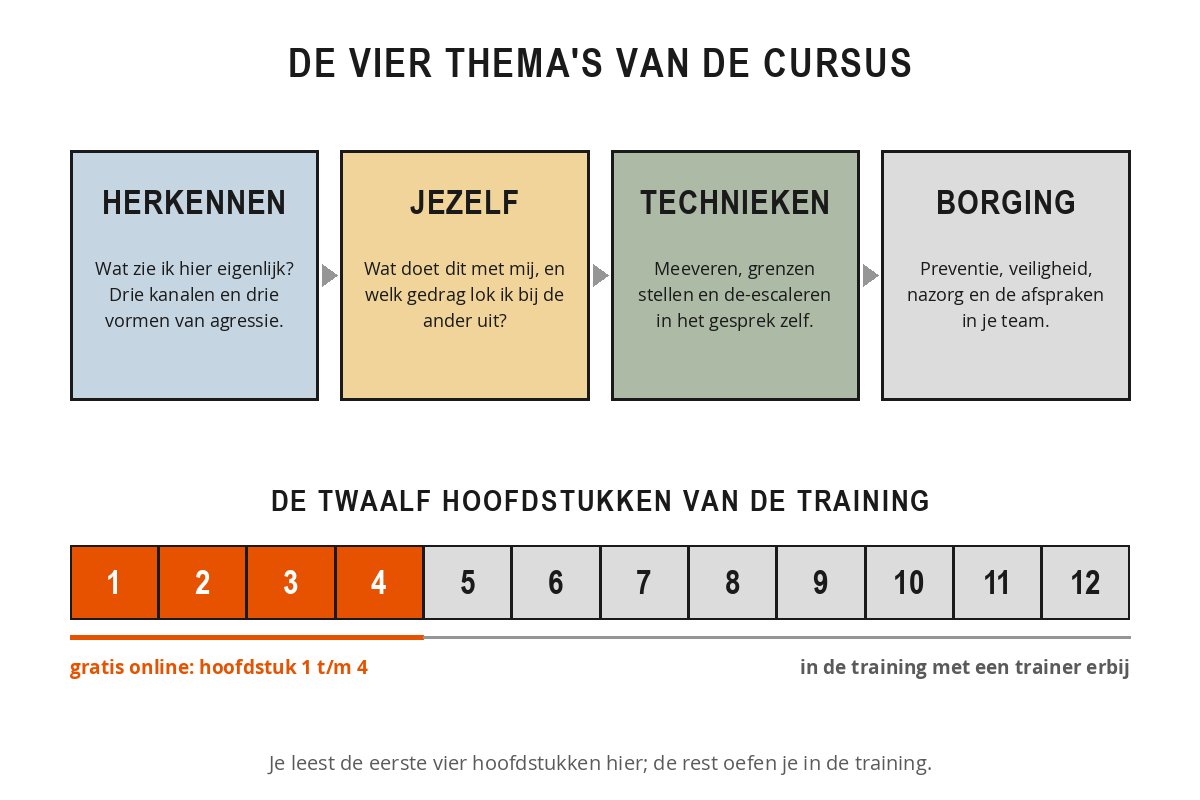
This free course contains the first four chapters: the orange part of the bar above. At the bottom of chapter 4 you will find the full course.
What you will learn
The common thread is that aggression is not one single thing. Someone brimming over with frustration calls for something very different from someone using threats to get their way. Choose the wrong approach and you make things worse: showing understanding in the face of calculated pressure rewards that pressure, and setting firm boundaries in the face of genuine frustration leaves someone feeling even less heard. So you learn to look first and only then to choose.
In chapter 1 you learn to recognise the three forms of aggression by concrete signals. Chapter 2 is about you: what happens in your body, what you convey in the first few seconds, and why behaviour provokes behaviour. Chapters 3 and 4 cover the two techniques that sit at opposite ends: going with the emotion in cases of emotional aggression, and setting boundaries with the BAKKES model in cases of instrumental aggression.
How the course is structured
The course follows four themes that build on one another. You start with recognising: what am I actually seeing here? Then comes yourself: what does this do to me and what am I provoking? Then the techniques: going with the emotion, setting boundaries and de-escalating. And you finish with embedding: prevention, aftercare and the agreements within your team. Each chapter contains theory, a model, examples from practice and an exercise you apply to your own work.
What this course is not
This is a course about handling conversations. Everything here is about verbal and non-verbal aggression: the situations in which you still have influence through your posture, your voice and your words. That covers by far the greater part of what people encounter at work.
As soon as things move towards physical violence, or someone can no longer be reached, these techniques stop working. Different rules apply then: keep your distance, leave a way out, call for help. You will read something about this in chapter 1, but a text is no substitute for safety training. If you work somewhere where this happens, that calls for your own organisation's training, with the protocols, the alarm and the agreements that apply at your workplace.
Practical tips for use
- Keep a notepad or a blank document to hand. The exercises only work if you actually complete them.
- Work with situations you have experienced yourself. General examples do not stick; that one morning at the front desk does.
- Don't read it all in one go. One chapter a week, with time to try it out, delivers more than reading through it in an afternoon.
- Practise on minor irritations. A colleague grumbling or a customer sighing is the place to learn to go with the emotion, not the incident where things really get tense.
- Discuss what you read with a colleague who does the same work. Two people often notice different things in the same situation, and that sharpens your observation.
Each chapter ends with a short knowledge check of three questions: answer them correctly to mark the chapter as completed. Your progress is saved automatically in your browser.
Enjoy the read, and above all: may your conversations be a good deal calmer.