


1. What aggression is and which form you are facing
Aggression rarely starts with the shouting. There is almost always something before it: a tone that goes up half a step, a jaw that tightens, a sentence that is just a little shorter than usual. Anyone who learns to spot that run-up gains time. And time is exactly what you need in order to choose what you are going to do, because not every form of aggression calls for the same response.
After this chapter:
- You know the difference between aggression and violence, and why that difference determines your response.
- You recognise rising tension through the three channels: the words, the voice and the body.
- You can tell emotional, instrumental and random aggression apart by concrete signals.
- You know which basic approach goes with which form, and why the wrong approach makes matters worse.
- You know what to do when you are not sure.
Aggression is more than violence
In everyday language the two words get mixed up, but they are not the same. Violence is causing physical injury or destroying something or someone. It is concrete and physical. Aggression is much broader: it includes violence, but also threatening, swearing, insulting, intimidating, needling, manipulating and dominating. The vast majority of what people experience at work is aggression without a finger being raised: a raised voice, a look, a threatening silence, someone standing just a little too close.
That distinction is not a play on words. With physical violence, your own safety is the first and only consideration: distance, a way out, help. With verbal aggression you have room to exert influence through your attitude and your words. This course is about that second category.
Three channels through which you can see it coming
Everything someone sends your way travels along three channels at once. The verbal channel is the content: the words themselves, the swearing, the threatening, the deliberate hurting. That channel is the easiest to recognise, but in tense situations it only tells you part of the story. Someone can express themselves perfectly politely and still come across as threatening.
The paralinguistic channel is about how something sounds: volume, pace, intonation, tone. Watch for a voice becoming loud, for fast talking, for a cracking sound. Watch for the opposite too: an unnaturally calm, restrained tone is often a warning sign, because that calm is usually put on.
The non-verbal channel is the first place where you see tension rising. Going red, sweating, faster breathing. Staring or, conversely, looking away. Leaning forward, hunching the shoulders, clenched fists. Pointing, waving, banging the table. A clenched jaw, pursed lips. The body rarely lies: if someone says it is no problem while their hands are clenching into fists, you are getting two messages at once. In that case, trust the body.
Train yourself to look at posture and voice first, and only then at the words. And know which channel affects you personally the most. One person is startled by a loud voice, another by someone standing too close, and yet another by a personal insult. That is the channel on which you are first at risk of losing your professionalism.
Three forms, three approaches
Aggression comes in three forms, and the difference between them is the most important thing you will take away from this course.
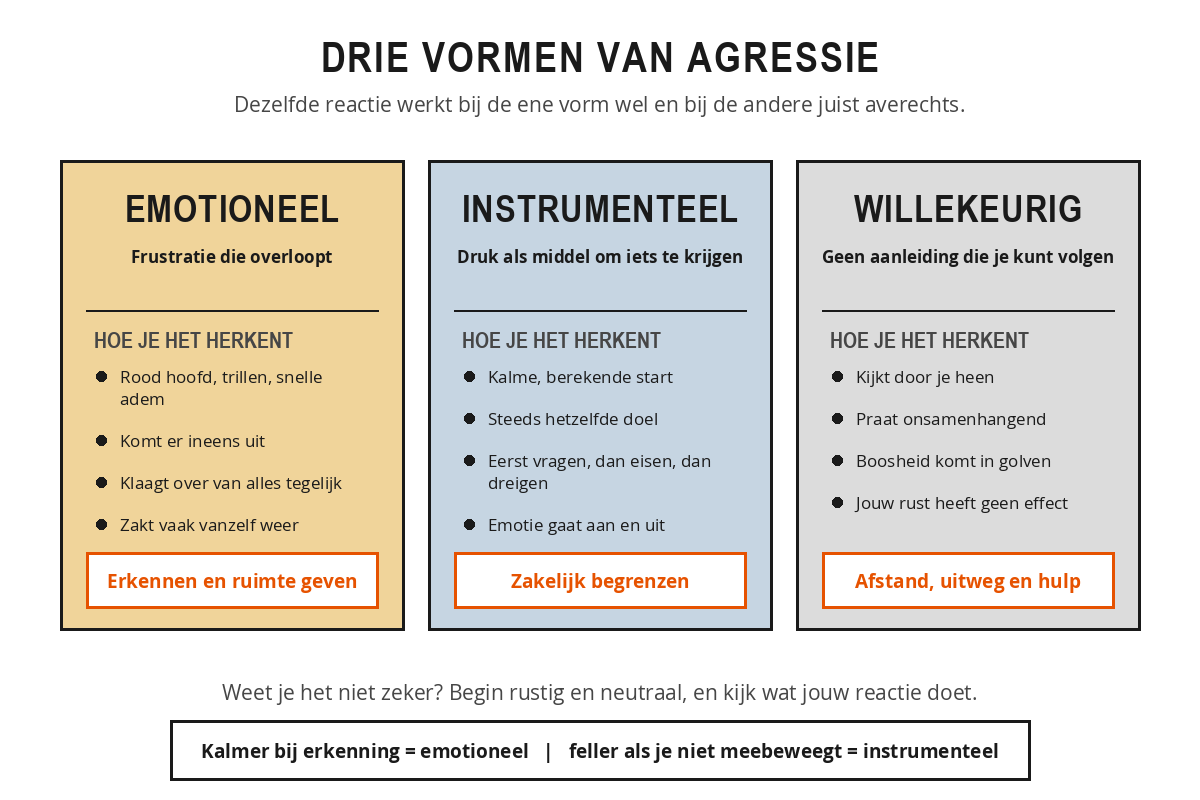
Emotional aggression arises out of frustration. Something goes wrong, then something else, and at a certain point the last straw arrives. The voice shoots up, the face goes red, words fly out that are later regretted. You recognise it by the physical signals, by its spontaneous nature, and above all by the undirected venting: everything is complained about at once, the system, the waiting time, the rules, that previous member of staff. And it usually subsides just as quickly as it came. Remember this above all: this anger is not about you. You just happen to be standing at the counter at the moment the bucket overflows. Underneath emotional aggression lies an unmet need, usually the need to be heard. That is why arguing back is counterproductive. "Sir, the system indicates that..." is petrol on the fire. Your approach is: let it blow over, acknowledge what you hear, and only then turn to the substance. That is called going with it, and chapter 3 is about that.
Instrumental aggression is a different animal. Here the anger is not a release but a tool. The other person applies pressure to push you in a certain direction, and the goal is clear: an exception, a discount, a yes. You recognise it by the calm start, by the single-mindedness with which the conversation keeps returning to that same point, and by the step-by-step build-up: first requests, then demands, then threats. The barbs become personal ("I want to speak to your manager", "I'll put this online with your name on it"). And the most treacherous signal of all: the emotion switches on and off. Someone who threatens you and turns to your colleague a second later, all friendliness, is not upset. Your approach is: stay businesslike, keep it short, repeat your boundary and do not negotiate under pressure. That is chapter 4.
Random aggression is the third form, and here the logic disappears. Someone explodes without any cause you can follow, without a negotiable aim, often wholly out of proportion. The cause lies outside your contact: alcohol, drugs, a psychiatric condition, a trauma that is touched on. You recognise it by a gaze that looks straight through you, by incoherent speech, by anger that comes in waves you cannot follow, and there is one signal that really stands out: your calm voice and your step backwards have no effect whatsoever. With ordinary anger that does have an effect; here nothing changes or it gets worse. This is where conversation techniques end. Your approach shifts from "handling this conversation well" to "staying safe": at least two arm's lengths of distance, keep a way out clear, do not put your back to a corner, speak briefly and calmly, no sudden movements, and call in help. If you are in doubt about whether to call, the answer is usually yes. Better once too early than once too late.
Mrs Aydin is standing at the counter of a housing association. It is the third time in two weeks she has come in about a leak. She dumps her bag down and says loudly: "This is ridiculous. You people are completely useless! There goes my whole morning again." Red face, trembling hands, and the story bounces from the leak to the receptionist to last year's letter. This is emotional: the cause can be followed, the emotion fits what has happened, and there is no aim other than being heard.
Two desks along stands Mr De Wit. He wants to return a product whose return period expired six weeks ago. He starts out friendly: "I'm sure you can find a way round this." At the first no he becomes more insistent. At the second no he says calmly: "I'm going to write a review about this. With your name in it. What was your name again?" No red face, no trembling voice, not a word too many. This is instrumental: there is a goal and the pressure is stepped up in stages.
Three questions when you are unsure
In practice you rarely know straight away. Someone who started out instrumentally may become genuinely angry along the way. Three questions help you sort it out quickly.
- Is there a cause I can understand? Yes: emotional or instrumental. No: think random.
- Does the emotion fit the situation? Genuine anger that matches what has happened: emotional. Calculated pressure that is switched on and off: instrumental. Emotion that seems unrelated to what is going on: random.
- Is there a visible aim? Release without any further aim: emotional. A concrete "I want you to...": instrumental. No clear aim: random.
If you still do not know, start calmly and neutrally and see what your response does. If someone becomes calmer when you give acknowledgement, you are in emotional territory. If someone steps it up as soon as you do not give way, it is probably instrumental. If someone does not respond at all to what you say or do, shift your attention to safety.
Take three situations from your own work in which you had to deal with anger or aggression. For each situation, write down briefly:
- What happened, in one sentence.
- Which form it turned out to be with hindsight.
- The two or three signals you link that to.
- What you did at the time, and whether that suited that form.
Compare your answers with those of a colleague who was there. Two people often notice different things in the same situation, and it is precisely that difference which sharpens your perception.
Summary
- Violence is physical, aggression is broader: threatening, swearing, intimidating, manipulating. Most of what you encounter is aggression without violence.
- You can see tension coming through three channels: the words, the voice and the body. If they contradict each other, believe the body.
- Emotional aggression is frustration boiling over: acknowledge it and give it room.
- Instrumental aggression is pressure used as a means: stay businesslike and repeat your boundary.
- Random aggression has no traceable cause: distance, an escape route, help. The conversation is no longer your goal at that point.
- The wrong approach makes it worse. Going along with calculated pressure rewards that pressure; setting strict limits in the face of genuine frustration leaves someone feeling misunderstood.
- If in doubt, start calmly and neutrally, and adjust your approach to what you see in response.
A customer speaks strikingly calmly, keeps coming back to the same exception and, when you say no a second time, says he is going to ring your manager. Which form is this?
Someone says, with a clenched jaw and clenched fists, that it is "all no problem at all". What do you do with those two signals according to this chapter?
What is the clearest sign that you are dealing with random aggression rather than ordinary anger?