


4. Setting boundaries with the BAKKES model
With instrumental aggression there is nothing to calm down. The other person isn't upset; they're applying pressure because it has worked in the past. Everything you read in chapter 3 works against you here: showing understanding is read as an opening, and explaining hands over ammunition. What does work is a boundary. Short, calm, and with something behind it.
After this chapter:
- You recognise when aggression is being used as a means of pressure, and why explaining then backfires.
- You know what makes a statement a boundary and what leaves it merely a wish.
- Can you apply the six steps of the BAKKES model to your own situation.
- You know how to formulate two choices that you can both live with.
- You know what you will do if your boundary is not accepted.
Why explaining does not work
Your natural reaction is to explain. You want to show that you are being reasonable, that the policy exists for a reason, that you really cannot do anything else. With emotional aggression that sometimes helps. Here every argument works against you, because every sentence of explanation is a new opening.
Say "it can't be done, the system is closed" and you'll get "then open the system". Say "my manager doesn't allow me to do this" and what follows is "then get someone who is allowed to". With every argument you give away a bit of control. If you notice that you keep coming up with new reasons to support your position, you are negotiating over something that isn't negotiable. Step back to your original boundary and repeat it in the same words. With instrumental aggression, the shorter the stronger.
When is a boundary a boundary
"I want you to speak more calmly" is a request. "I want you to speak more calmly, otherwise I will end this conversation" is a boundary. The difference lies in the consequence, and above all in the fact that you actually carry that consequence out.
Without a consequence, a boundary remains a wish. The other person hears it, may nod, and carries on. And threatening something you then fail to do is worse than setting no boundary at all: the other person learns that your words do not mean what they say, and next time they will start again at exactly that point.
Tone counts too. If your voice becomes sharp or indignant, the conversation shifts to emotion and you give the other person something to seize on ("see, now you're getting angry"). If you speak too softly or too hesitantly, your boundary sounds like a question. What helps: speaking slightly lower than your normal pitch, at a calm pace, short sentences without subordinate clauses, eye contact without staring, both feet on the ground, and the same words every time instead of a new formulation each time.
The six steps of BAKKES
The BAKKES model, developed by trainer Elzo Lerner, gives you a fixed sequence for the moment when someone fails to respect your boundary. Its strength lies in the combination: you name what is happening, you say what you want to be different, you offer two concrete choices, you see what happens, and you escalate if necessary.
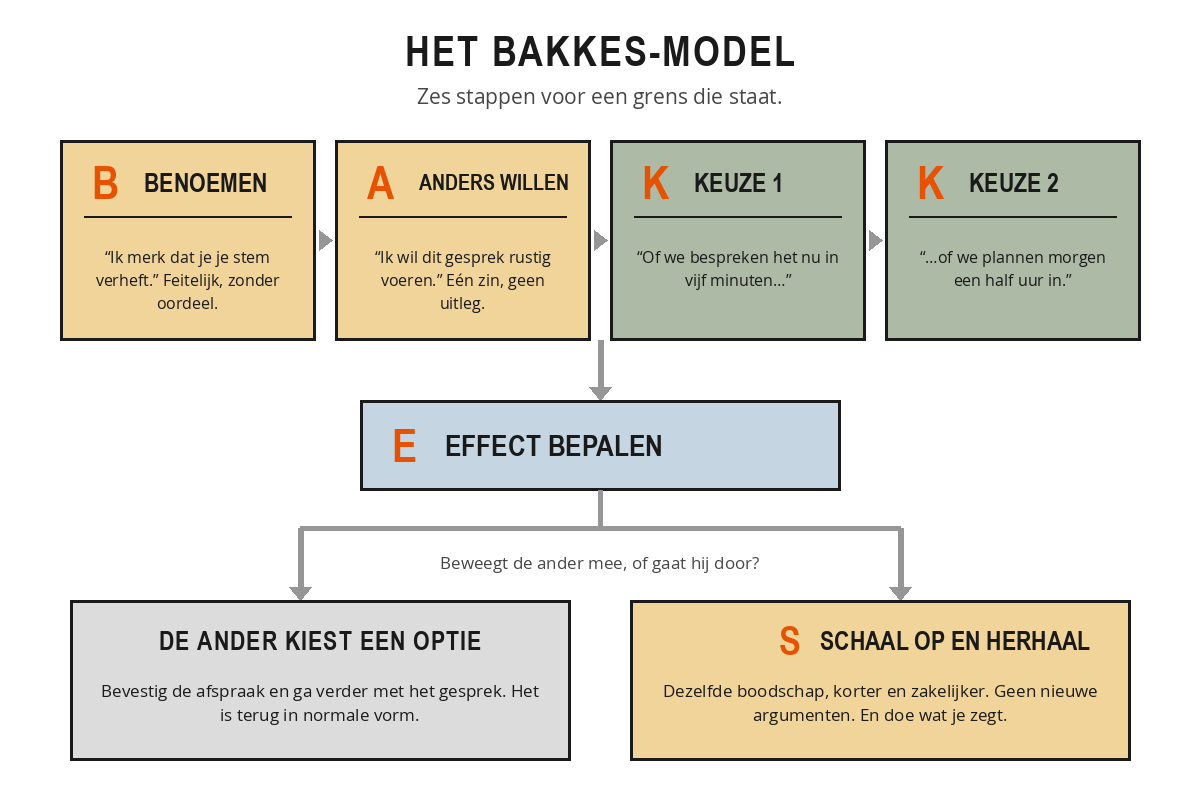
- B for Benoemen (naming it). A factual observation, without judgement and without blame. "I notice you're raising your voice." "I hear that you want this sorted out today." "I see you're standing closer to me." By naming it first you don't immediately go on the defensive, and you give the other person the chance to correct themselves.
- A for Anders willen (wanting something different). You say what you do want, not what the other person has to stop doing. "I want to have this conversation calmly." "I want to get the facts straight before I commit to anything." One sentence is enough. Do not start explaining why you want it that way, because then the discussion starts all over again.
- K for Keuze 1 (Choice 1) and K for Keuze 2 (choice 2). You offer two concrete options. No open question, no "what do you think". Two choices that you can both live with. "Either we discuss this now in five minutes, or we schedule half an hour tomorrow."
- E for Establishing the effect. You watch to see whether your boundary works. If the other person picks one of the two options, the conversation is back to normal: you confirm the arrangement and move on. If they carry on with the same tone, the same pressure, or act as if you haven't said anything, you move to the final step.
- S for Schaal op en herhaal (scale up and repeat). The same message, shorter and more matter-of-fact. No new arguments. "As I said: either we discuss it briefly now, or we schedule it in." And then the most important part: you do what you say.
Those two choices are the cleverest part of the model. The other person gets the feeling of having something to choose, which reduces the urge to put pressure on you. At the same time you determine the playing field, because both options are acceptable to you. Whatever the other person chooses, you stay in control. So use "either... or...", not "maybe" or "could". Offer two, not four, and never offer an option you cannot really live with, because then you are stuck with an outcome that does not suit you.
With instrumental aggression, repeating is more powerful than explaining. Stick to the same sentence, in the same tone. That technique is also known as the broken record, and it feels impolite while it is not: you simply keep giving the same honest answer.
Mr De Vries is standing at the reception desk of a training institute. He wants to cancel a course for which the fourteen-day period has long passed. When Nadia says that isn't possible, he stays calm: "If you don't sort this out, I'll file a complaint against you personally. And I'll make sure your manager hears about it."
B: "I hear that you want to file a complaint if I don't make an exception." A: "I want to handle this on the basis of the terms and conditions, not under the pressure of a complaint." K1: "Or you accept that I follow the standard procedure, and then you will be told in writing today why that is." K2: "Or you submit a complaint, and then my manager will assess it." E: Mr De Vries sighs, nods and opts for the justification in writing. The boundary works. S: Had he kept up the threats, it would have been: "My answer stays the same. You choose, I follow the procedure."
The second example comes from inside the organisation, because instrumental pressure just as often comes from a colleague. Thijs says to Nadia: "I need your approval on this proposal. Today. If you don't sign, the project grinds to a halt and I'll have to tell the management team that it's because of you." B: "I notice that you are putting me under time pressure and saying that it will be my fault." A: "I want to see the substance of what I am signing before I agree." K1: "Or we go through it together now for half an hour, and then I will decide today." K2: "Or I'll read it myself and you'll hear from me tomorrow morning before ten." E: Thijs goes for the first option. S: Had he insisted on signing without reading, it would have been: "I don't sign anything I haven't read. Pick one of the two."
Doing what you say
The last step is the step where things go wrong in practice. If you have announced that you are ending the conversation, then you end it. If you have said that you will involve your manager, then you do so. So never say anything you are not going to carry out, and think about that in advance: which consequence can you genuinely deliver in your role? Hanging up is usually allowed; removing someone from the building on your own usually is not. If you are not sure, ask your manager before you need to know.
If things do go wrong, report it. A threat you keep to yourself will not be on file tomorrow for someone else going through the same thing, and you are left carrying it on your own. That is the part the full training course takes time over: prevention, aftercare and the agreements within your team.
Think of a situation in which someone deliberately put pressure on you to get something done. Write out the six steps:
- B: what did you actually see or hear? Write it down without judgement.
- A: what did you want instead? One sentence.
- K1 and K2: which two options could you have offered that you could both live with?
- E: how would you have noticed whether your boundary was working?
- S: which consequence can you genuinely deliver in your role?
Then say the sentences out loud once, even if that feels odd. Words you have never spoken before will not come out at a tense moment.
Summary
- With instrumental aggression there is nothing to calm down. You set a boundary.
- Every argument is a new opening. The shorter you keep it, the stronger your position.
- A boundary without a consequence is a wish. A consequence you don't carry out is worse than no boundary at all.
- BAKKES: Benoemen (name it), Anders willen (say what you want instead), Keuze 1 (Choice 1), Keuze 2 (Choice 2), Effect bepalen (set the consequence), Schaal op en herhaal (scale up and repeat).
- Two choices give the other person a sense of control while you determine the playing field.
- Scaling up means fewer words and a steadier voice, not more explanation or a louder one.
- Choose a consequence in advance that you can genuinely deliver in your role, and report it afterwards.
What turns "I want you to speak more calmly" into a real boundary?
Why do you offer two choices at the K steps rather than an open question or four options?
After your two choices, the other person carries on threatening you unperturbed. What does scaling up mean according to this chapter?
Ready for the next step?
You have completed the free starter of Dealing with Aggression. The next chapter in the full course is Communication as a foundation: Sender and receiver, the four laws that play a part in every conversation and the difference between the content and the relationship.
Take the 2-day course →From €1250,- excl. VAT · with an experienced trainer included