


3. Rolling with emotional aggression
Someone comes at you, voice raised, arms wide, shouting that this is ridiculous and that he has been standing here for half an hour already. You feel two things at once: the urge to explain why it took so long, and the urge to tell him to calm down. Both have the opposite effect. An explanation feels like a wall, and "calm down" feels like a slap in the face to someone who is already angry. There is a third option.
After this chapter:
- Understand why going with the emotion works with emotional aggression and arguing doesn't.
- Know the difference between going with the emotion and giving in, and be able to acknowledge without conceding the point.
- You can carry out the three movements of going with the flow: noticing, naming and giving space.
- Recognise the turning point at which you can switch from emotion to substance.
- Know how to summarise, ask follow-up questions and close the conversation with an agreement that holds.
Why rolling with it works
Emotional aggression comes from frustration. Something has gone wrong, someone does not feel heard or feels let down by a rule, a system or a person. The anger you see is usually the sum of a whole series of small irritations that you know nothing about.
As long as that emotion is there, the other person is unable to listen. The body is in survival mode, exactly as in chapter 2: heart rate up, breathing high, thinking narrowed. Arguments do not land. Solutions do not land. What does land is the feeling that there is someone opposite you who sees it. Rolling with the emotion does nothing other than that: you show that you notice the emotion and take it seriously. That takes the pressure off, and only then does room arise to talk further.
Going with the emotion is not giving in
This is where things go wrong most often. Rolling with the emotion does not mean saying that the other person is right. You do not say that the rule is nonsense, that your colleague is making a mess of it or that the policy will be changed. You make no promises in order to dampen the anger, because you will have to take those back later.
What you do instead is acknowledge what you see and hear. Compare two sentences. "You're absolutely right, this really is ridiculous" is giving in, and you probably don't even think so yourself. "I hear that you find this ridiculous, and that's not a pleasant feeling" is going with the emotion. In the second case you stay close to the truth: the other person finds this ridiculous, and you can see that. You confirm the emotion, not the position. The same applies to "I understand this is frustrating for you" as opposed to "You're right, this should never have happened." The difference is small in words and large in consequences.
The three moves
Going with it consists of three small movements that you make one after another.
- Noticing. You register what you see and hear: the words, the voice, the posture, the tension. Without judgement, so without saying anything yet.
- Naming it. You put into words, calmly and factually, what you observe. "I can see this really matters to you." "I notice you have been waiting for some time."
- Giving space. You let a silence fall. You don't jump straight to the solution. Often a second wave follows, and only after that does the tension subside.
That third step is the one everyone skips. After the naming, "but the reason it is taking so long is that..." follows almost automatically, and at that moment you are no longer someone to talk to but an opponent. The anger flares up again. The silence feels uncomfortable to you, but for the other person it is the first place in this conversation where he is allowed simply to be.
Going with the emotion is not a technique you only use in heated situations, it's a basic attitude. Practise it on small things: a colleague grumbling about the printer, a customer sighing audibly. The more often you do it on a small scale, the more natural it becomes when it really counts.
Recognising the turning point
How do you know when you can move on? From small signals. The voice drops half a tone. The shoulders become slightly less tense. The breathing slows down. The stream of words becomes shorter, or a silence falls. Sometimes someone sighs, and then it is no longer a sigh of frustration but of relief: someone is listening.
That is the turning point. Move to the substance too early and the anger comes back. Keep going with the emotion too long and the conversation starts to drift, leaving the other person feeling they're being kept busy. It's a matter of watching and listening, and it's precisely the part you don't learn from a text but by doing it.
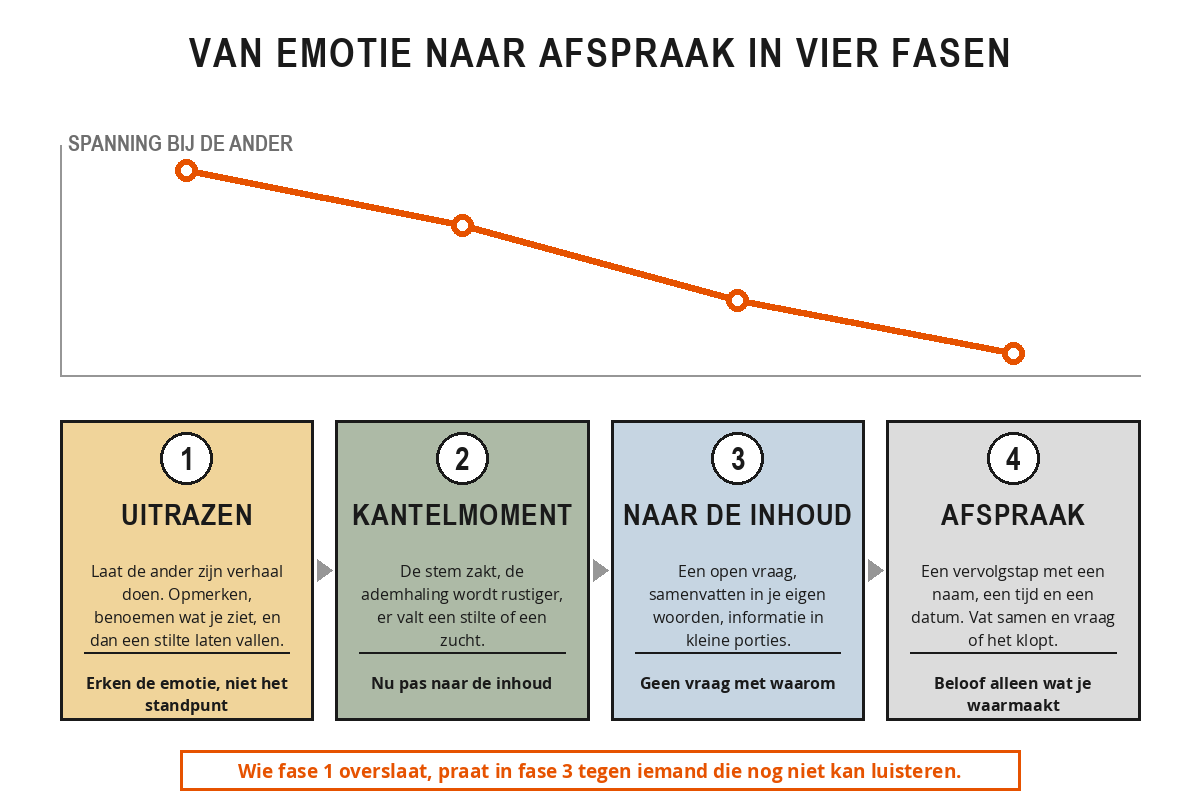
So the conversation runs through four phases. In phase one the other person vents and you acknowledge what you hear, without responding to the content. In phase two comes the shift turning point: the tension drops and space opens up. In phase three you move from emotion to content with an open question, a summary and information in small portions. In phase four you close you close off with a specific agreement. Anyone who skips phase one starts on phase three with someone who is not yet able to listen, and then the whole build-up has been for nothing.
From emotion to content
Once the steam is off, you don't start with the solution but with an open question. The reason someone gives when they walk in is often not the real problem. Underneath the anger there is frequently an earlier experience, a misunderstanding or an expectation that nobody has corrected. Questions that work: "What exactly happened?", "What are you running into?", "What do you need most right now?" Avoid questions with "why", because they quickly sound like an accusation. And ask one question at a time; three questions in a row feels like an interrogation.
After that you summarise. Not parroting, but giving back the essence in your own words, briefly and factually. A good summary does three things at once: it proves that you have listened, it gives the other person the chance to correct you, and it takes the pace out of the conversation. Listening, summarising and asking further questions are known together in training courses as the LSD technique, and it is no coincidence that it is precisely those three that keep coming back.
Only then do you give information, and in small portions. Someone who has just come down from a high emotion still has a full working memory. Keep your sentences short, leave out jargon and abbreviations, and check along the way whether it is landing. Compare: "On the basis of article 4.2 of the regulation your application has been rejected because the stated conditions were not fully met within the applicable period" with "Your application has been rejected. That's because one document arrived after the deadline. Shall I explain what you can still do now?"
Mrs Aydin from chapter 1 is still standing at the housing association's front desk. Third time, a leak, red in the face. Joost, the employee, says nothing about the maintenance team's schedule. He says: "I can see this really matters to you." And then he stays quiet. A second wave does indeed follow, twenty seconds long, about the receptionist and about last year's letter. Joost nods, says "Three visits for the same thing, that's rubbish", and lets another silence fall. Mrs Aydin sighs and says: "Yes, well." That's the turning point.
Joost asks: "What do you need most right now?" It turns out not to be the leak, but the uncertainty: she doesn't dare let her daughter sleep in that room. Joost summarises: "So what you mainly want to know is whether that room is safe, and nobody has given you an answer on that yet." Correct. Then the agreement: "I'll call the contractor this afternoon and I'll ring you back on this number by twelve o'clock tomorrow at the latest. Does that work for you?" No promise about the leak itself, because Joost cannot deliver on that. But a name, a time and a number.
A next step and a good ending
A solution is not always what the other person wants. Sometimes you simply cannot take the problem away. What you can always do is offer a specific next step. That step is specific (it contains an action, a time, a name or a date), achievable (you only promise what you can deliver) and it gives the other person a sense of control (there is a choice in it, or at least clarity about what will happen now). Compare "I'll see what I can do" with "I'll call my colleague this afternoon, and she will ring you back on this number by twelve o'clock tomorrow at the latest." The second gives the other person something to walk away with.
Close with a short summary of the agreement and a question after it: "Is that correct?" Then the other person can still make adjustments, and you prevent the dissatisfaction from only coming back after the conversation. Finally, acknowledge that someone has come in. Not that the anger was justified, but that the effort was. "I'm glad you said it" is enough; excessive compliments have the opposite effect.
And watch the last minute. That's the pitfall: the tension has gone, and then you casually add something about colleagues who are always just as busy, or you let out a sigh. The other person picks up on that immediately, precisely because they have just calmed down. Keep the same calm tone right through to the goodbye.
Take a conversation in which someone came to you angry and go through it on paper:
- What was the other person's opening line, as literally as you can recall it?
- What did you say first at that moment? Was that acknowledging, explaining or setting limits?
- Write down a sentence you would now use to name what you see, without conceding the point.
- At what point did space open up to move on to the substance, and did you seize that moment?
- How concrete was your next step? Did it include a name, a time or a date?
Choose one thing you'll do differently next time. One, not five.
Summary
- As long as the emotion is there, the other person cannot listen. Arguments and solutions do not land.
- Going with the emotion means acknowledging what you see and hear, not admitting that the other person is right.
- The three moves are noticing, naming and giving space. Almost everyone skips that third one.
- You can spot the turning point in the voice, the breathing and the posture: only then do you move on to the substance.
- Listening, summarising and asking follow-up questions move the conversation from emotion to facts. Avoid "why".
- Give information in short portions, without jargon, and check whether it lands.
- Close with a next step that is concrete and achievable, and keep your tone consistent right up to the goodbye.
Which of these sentences is rolling with the emotion and not giving in?
Which of the three movements of going with the emotion is skipped most often, according to this chapter, and why is that a problem?
You have not been able to solve an angry customer's problem. According to this chapter, what makes the difference when closing the conversation?