


Introduction
You walk out of the meeting room and only in the corridor do you work out what you actually wanted to say. Or the other way round: it did come out, but sharper than you intended, and you spend the rest of the afternoon with a nagging feeling. Between swallowing your words and lashing out there is a third option. It can be learned, but first you have to recognise when you end up in one of the other two.
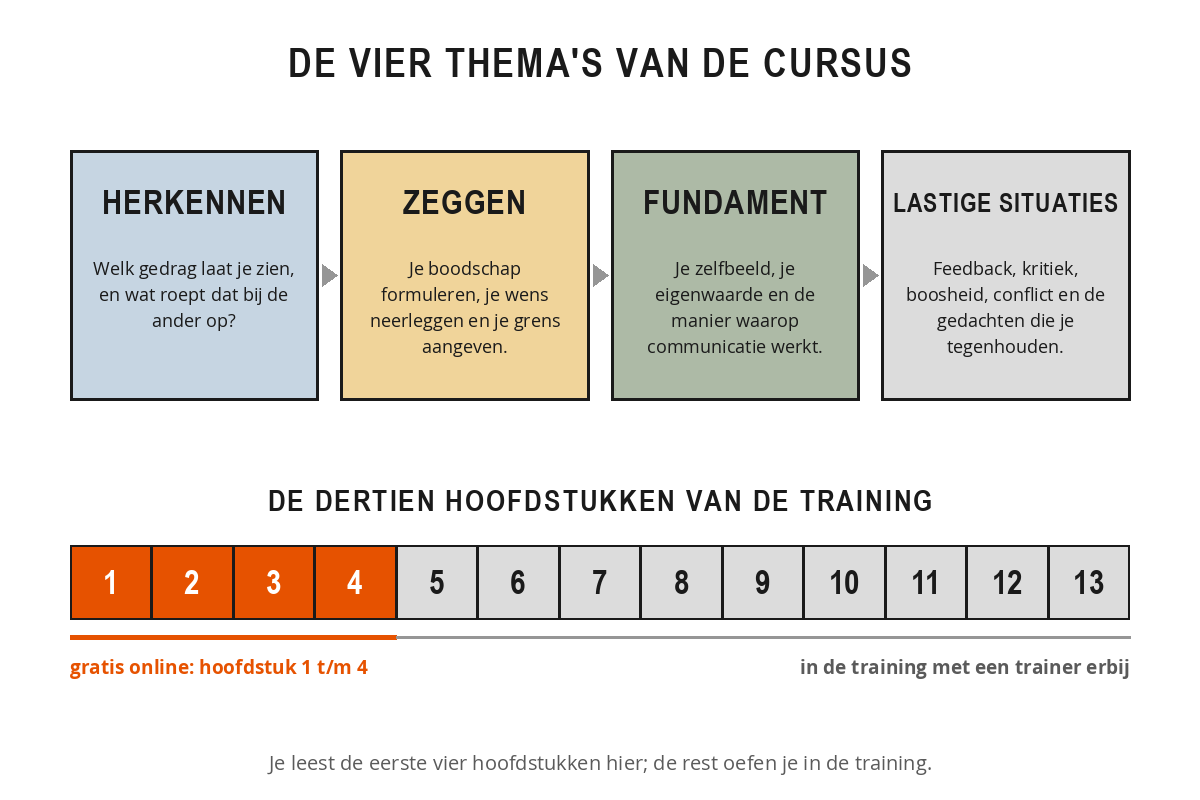
This free course contains the first four chapters: the orange part of the bar above. At the bottom of chapter 4 you will find the full course.
What you will learn
You start by learning to recognise which behaviour you yourself display when things get tense: ducking out, hitting back, or simply stating your point. After that, Leary's Rose shows you why you keep ending up in the same pattern with the same people, and what you can do to break that pattern. In the third chapter you start building: a conversation goal that makes sense, a conversation in four phases and an I-message that does not get lost in softeners. And in the fourth chapter you learn to say no, briefly, without the string of apologies that invites the other person to keep pushing. The common thread: assertiveness is not a character trait but behaviour, and behaviour can be changed.
How the course is structured
The course follows four themes that build on one another. You start with recognising: which behaviour do you display, and what does that bring out in the other person? Then comes speaking up: formulating your message and stating your boundary. After that the foundation: your self-image, your self-worth and the way communication works. And you finish with difficult situations: feedback, criticism, anger, conflict and the thoughts that hold you back. Each chapter contains theory, a model, examples from practice and an exercise you apply to your own work.
Practical tips for use
- Keep a notepad or a blank document to hand. The exercises only work if you actually complete them.
- For each chapter, choose one conversation from your own work that you are dreading, and use it as a testing ground.
- Don't read it all in one go. One chapter a week, with time to try it out, delivers more than reading through it in an afternoon.
- Start small. Practise first with someone you trust, not straight away with the colleague you dread most.
- Expect it to feel uncomfortable the first few times. That tension is not a sign that you are doing it wrong, but that you are doing something new.
Each chapter ends with a short knowledge check of three questions: answer them correctly to mark the chapter as completed. Your progress is saved automatically in your browser.
Enjoy the read, and above all: good luck with the first conversation in which you say what you want.