


1. Sub-assertive, assertive and aggressive behaviour
Most people think assertiveness is something you either have or do not have. That is not correct. It is behaviour, and behaviour differs from situation to situation. The same person who effortlessly defends his price in a client meeting does not dare to say at home that he does not feel like going to that birthday party. This chapter shows which three forms that behaviour can take, how to recognise them, and why only one of them keeps both your own interest and that of the other person intact.
After this chapter:
- You recognise subassertive, assertive and aggressive behaviour by the language, the voice and the posture that go with them.
- You know what each style delivers in the short term and what it costs in the long term.
- Do you understand why assertive behaviour is not a half-hearted compromise between the two extremes.
- Can you work out the same situation in three responses and name the consequences of each.
- You know which style comes to you first when the tension rises.
Not the volume, but the interests
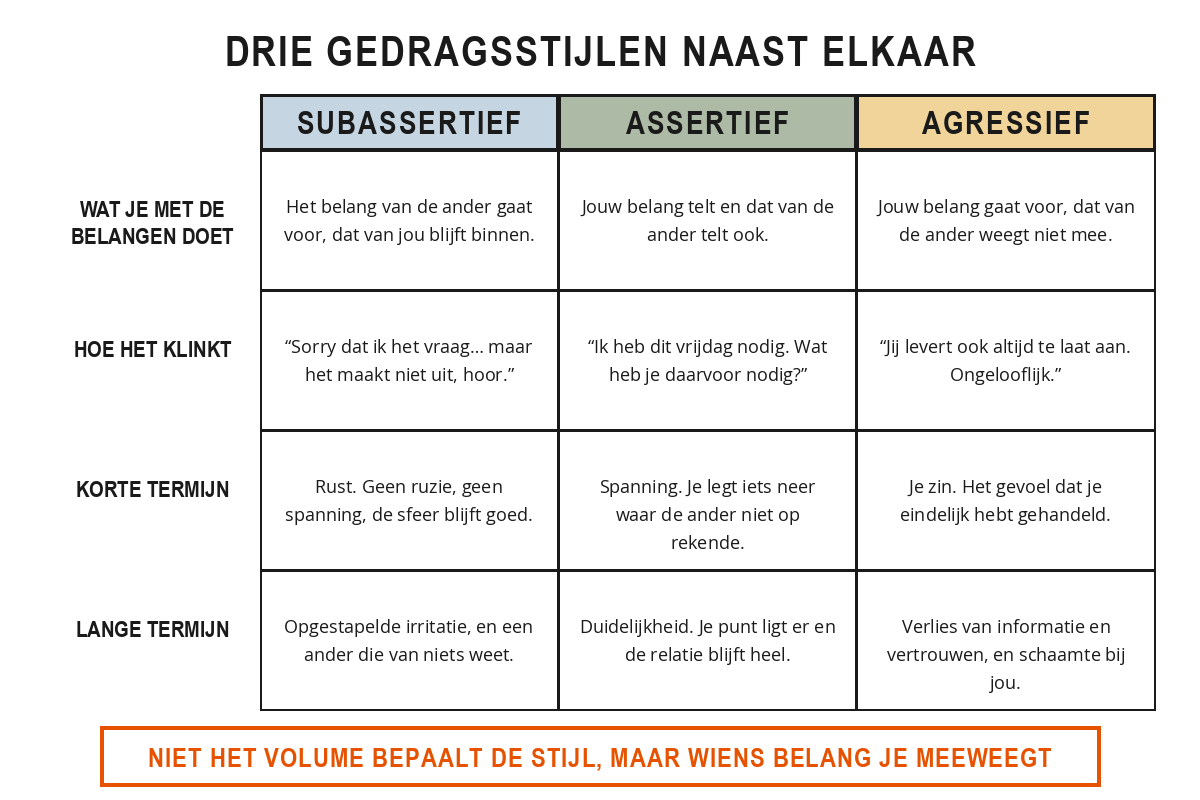
The difference between the three styles is not in how loudly you speak. It is in whose interests you take into account. With sub-assertive behaviour you place the other person's interests above your own, even when there is no reason to. With aggressive behaviour you do the opposite: your own interest comes first and the other person's does not count. With assertive behaviour both are on the table. Your interests count, and so do the other person's.
That is a useful distinction, because it also works in conversations where emotions run high. A calm, friendly-sounding sentence can be utterly aggressive, and a firm sentence delivered in a raised voice can be entirely assertive. So do not listen to the volume but to the subject of the sentence: is it about what you need, or about what is wrong with the other person?
Subassertive: your boundary never makes it into the conversation
With subassertive behaviour you usually know perfectly well what you want. You just do not say it, or you say it so cautiously that it passes the other person by. The boundary you have in your head never makes it into the conversation.
You can hear it in the language. Sentences start with "sorry to ask" or end with "but it really doesn't matter". You soften with "actually", "maybe", "a bit" and "if it doesn't suit you, that's fine too". Your voice rises at the end of the sentence, which makes a statement sound like a question. Your posture becomes smaller: shoulders forward, eyes on the tabletop, an apologetic smile that already withdraws your own message.
In the short term this brings calm. There is no argument, the atmosphere stays pleasant and you do not have to carry the tension of the moment. The price comes later. You pile up irritation about things you never mentioned, you start to undervalue yourself because you keep withdrawing, and the other person has no idea that anything is wrong. Someone who says nothing gives no signal, and without a signal nothing changes. Eventually the elastic snaps. Then it all comes out at once, usually over something trivial, and your reaction seems completely out of proportion.
Aggressive: you stand up for yourself, by walking over someone else
Aggressive behaviour does not have to be loud. A cool remark, a joke at a colleague's expense or an email with four people in cc is just as hard as shouting.
The language shifts from I to you. "You always deliver late", "you haven't read this again", "you lot never do anything either". You generalise with "always" and "never", you ask questions that are not questions ("do you think that's normal?") and you fill in the other person's intentions in advance. Your voice becomes louder and faster, you interrupt, you lean forward, you point with your pen. Sighing, sarcasm and rolling your eyes belong in the same category.
This too works in the short term. You often get your way and you feel you have taken action. What you lose is information and trust. People start carefully rationing what they tell you, because every message could set off an outburst. The other person shuts down, fights back, or quietly works against you from that point on. And something lingers with you: the shame about how it came out, even though you were right on the substance.
Assertive: both interests on the table
Assertive behaviour is not a half-hearted middle ground in which you swallow a bit and lash out a bit. You say what you want, in plain language, while at the same time allowing that the other person may see it differently.
You can tell by the form. You speak about yourself ("I need this on Friday") instead of about the other person ("you are always late"). You state facts, not judgements. Your sentence is short, the message comes first, and after the main point you let a silence fall instead of papering it over with arguments. Your voice stays calm and drops at the end of the sentence. You maintain eye contact without staring, and you make yourself neither bigger nor smaller than the other person.
Assertive does not mean that you get your way. It means that your point is on the table and that the conversation continues.
Not sure whether a response was assertive or aggressive? Volume is not the yardstick, but the subject of your sentences is. Was it about what you need, or about what is wrong with the other person? The first form invites discussion, the second invites defensiveness.
One situation, three responses
You see the difference most clearly when you play the same situation out three times. The content stays the same, only the form changes.
Bas drops by at half past four on Thursday afternoon to ask whether you would finish his part of the report. You have a deadline of your own at nine o'clock on Friday morning.
Subassertive. "Er, yes of course. I'm not sure whether I'll manage it, but I'll see what I can do. It's no problem." Bas thanks you and leaves. You work on until seven and hand in your own piece just in time. What Bas does not know is that his request was too big. He has had no signal at all, so next week he will be back again.
Aggressive. "At the last minute again. You really never plan anything, and then I get to sort it out." Bas defends himself or walks away. You have let off steam for a moment, but the problem is not solved and the report is still waiting. The real damage lies in what is no longer said: next time Bas will only report a problem when it is too late to help.
Assertive. "I have a deadline myself tomorrow morning, so tonight won't work. Tomorrow after eleven I can put an hour into it. What would help you most with that?" During the conversation you feel tension, because you are setting a limit Bas was not expecting. Afterwards it is calm. Bas knows where he stands and can look for another solution. Your deadline stays intact and so does the relationship.
The assertive response is not the longest and not the friendliest. It is the only one in which both your interests and Bas's are on the table.
Your pattern is often part of a chain
Almost nobody is the same in every situation. Many people are subassertive with requests and aggressive with criticism, and that is not a contradiction but a chain: what you hold in for too long comes out sharply at an awkward moment.
Ramon is a team leader and is shocked when he sets his own behaviour side by side. In four weeks he has taken on extra work three times that he had no time for: twice finishing a colleague's presentation and once spending an evening on a quotation. Three times yes, three times not a word about the cost. In the fourth week he explodes in a team meeting over two spelling mistakes in a junior's report, with everyone present.
His area for improvement is not in that moment of criticism. It is in the third request he did not turn down. If he had said 'no, I can't manage that this week' at that point, there would have been nothing to explode about in that meeting.
Make a short self-scan of your own preferred style.
- Note down three situations from the past two weeks in which you did not say something you were thinking.
- Also note down one situation in which you reacted more sharply than you intended.
- For each situation, note down: the first words you used, what your voice did and what your posture did.
- For each situation, determine which style you used and what effect that had on the other person.
- Choose the situation that recurs most often in your work and write down what you could have said there assertively in one sentence. Requirement: first person, maximum fifteen words, no "actually", "maybe" or "sorry".
Then look at whether there is a chain in it: are those three times you swallowed it and that one time you lashed out connected?
Summary
- The three styles differ in whose interests you take into account, not in volume.
- Subassertive: the other person's interests come first. Calm in the short term, accumulated irritation in the long term and someone who knows nothing about it.
- Aggressive: your interest comes first and the other person's does not count. Short term you get your way, long term you lose information and trust.
- Assertive: both interests are on the table. Short-term tension, long-term clarity and a relationship that stays intact.
- Assertive is not a compromise between swallowing it and lashing out, and it is no guarantee that you get your way.
- Subassertive with requests and aggressive with criticism is usually one chain: what you hold in comes out the wrong way.
According to this chapter, how do subassertive, assertive and aggressive behaviour differ from one another?
According to this chapter, what is the long-term price of subassertive behaviour?
At half past four a colleague asks whether you will finish his report this evening, while you have a deadline yourself tomorrow morning. Which response is assertive?