


4. Setting boundaries and saying no
"Sure, no problem." You hear yourself say it and at the same time you feel your stomach tighten. Somewhere between the question and your answer something was skipped: the moment when you could have considered whether this was actually possible. This chapter is about that moment. About how to notice your own boundary in time, how to voice it, and how to stick to it when the other person pushes.
After this chapter:
- Recognise the three channels through which your boundary makes itself known: your body, your feelings and your thoughts.
- You sharpen a vague signal into a boundary you can put into words.
- You know the difference between a hard boundary and a negotiable one.
- You build a refusal in six steps, with your no in the first sentence.
- You calmly stick to your core message when the other person comes up with new arguments.
Where is your boundary?
A boundary is the point at which going along with something comes at the expense of something that matters to you: your time, the quality of your work, your peace of mind, your health or something you hold to on principle. Setting boundaries means naming that point and attaching a consequence to it. You say what you will do, what you will not do, and what happens if the other person pushes on regardless. That last part is what distinguishes it from grumbling: complaining only describes that it is too much, while setting a boundary says how far it goes.
Your boundary usually announces itself before your thoughts recognise it, and it does so through three channels. Physical: a tightened stomach, warm cheeks, raised shoulders, quickened breathing or the feeling that you can't think of anything for a moment. Emotional: irritation out of proportion to the size of the request, reluctance, tiredness at the mere thought of it, or a brief moment of panic when you think of your diary. In your thoughts: the inner commentary, with sentences such as "why is he asking me this again", "I'll never manage this" or "there's no way out of this". That last one in particular is a reliable sign that you are swallowing your objections. It helps to know which channel goes off first for you, because that is your own alarm bell.
From vague irritation to a boundary you can put into words
A signal is not yet a boundary. As long as you only know that something grates, you cannot take it to the other person. You make it usable in three steps. First you describe factual what happened: who asked what, when, and how often before. Then you state what it costs, in hours, in work left undone, in an evening that disappears or in quality you can no longer deliver. And then you determine your point: what will you still do, what not any more, and from when does that apply? Only after that third step do you have something you can actually say. Without that step it stays at a sigh and the hope that the other person will notice it themselves.
Not every boundary has to be equally firm, and it doesn't need to be. With a hard boundary there is nothing to discuss: you don't work at weekends, you don't put your name to a report you don't stand behind. With a negotiable boundary the direction is clear but the details are not: you can pitch in for an hour this evening, provided something else comes off your plate. The distinction is a practical one. If you present a negotiable boundary as a hard one, the conversation becomes unnecessarily tense. If you present a hard boundary as an opening bid, the other person will quite logically start negotiating over it. And your boundaries are not fixed for good: they shift with your workload, your personal circumstances and your relationship with the other person.
On Thursday at half past four, Sanne is asked whether she will finish a colleague's presentation. She feels her shoulders rise and thinks: this is the third time this month.
She works through the three steps. Fact: taken on work that is not hers three times in four weeks. Costs: two evenings, and a backlog on her own report. Point: she doesn't want to do it tonight, and she wants this kind of request to come before Wednesday.
What she says: "I'm not doing this tonight, I still have my report to finish. If you come to me in good time, I'm happy to think along about the structure, but not on the day itself." That is a negotiable boundary, and she presents it as such.
Saying no in six steps
A no is about the request, not about the person making it. You lose that distinction the moment you start wrapping your answer in apologies: the longer your run-up, the more you invite the other person to keep pushing. Answering briefly is therefore friendlier than it seems.
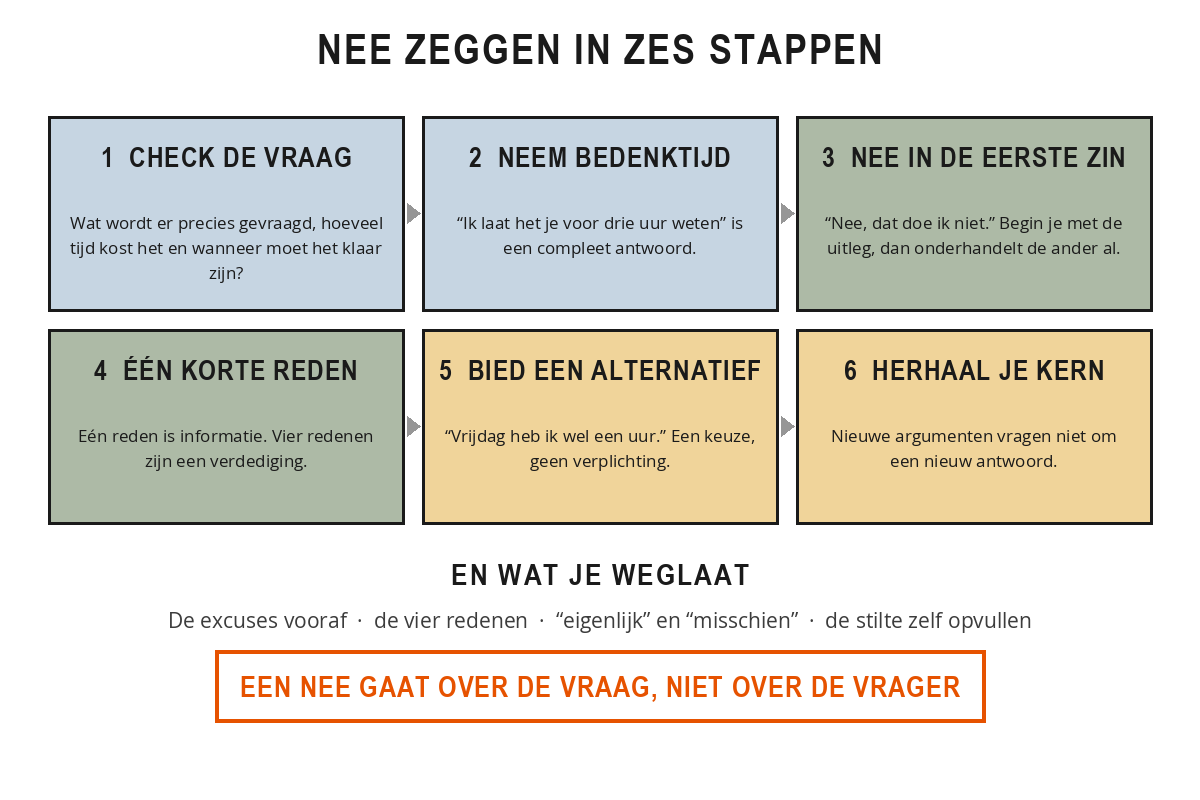
- Check the request. Ask what exactly is expected of you, how much time it will take and when it has to be finished. Without that information you are refusing an assumption rather than a request.
- Take time to think if you need it. "I'll let you know before three" is a complete answer. Many people think a request calls for an immediate yes or no, and therefore say yes.
- Put your no in the first sentence. "No, I'm not going to do that" or "I'm not going to make that deadline". If you start with the explanation, the other person hears a run-up and starts negotiating before you have reached your point.
- Give one short reason. One reason is information; four reasons are a defence. With four reasons, the other person looks for the weakest one and goes for it.
- Offer an alternative if you want to. An alternative is a choice, not an obligation. "I do have an hour on Friday" or "Wouter knows this file too" keeps the relationship smooth without you withdrawing your boundary.
- Repeat your core message when pressed. New arguments from the other person do not call for a new answer.
What you leave out matters just as much: the apologies beforehand, the four reasons, the word "actually", and the silence that you fill yourself with a way out for the other person.
Sticking to your core
That sixth step involves a technique with an old-fashioned name: the broken record. A record with a scratch keeps repeating the same line, and that is exactly what you do. You calmly restate your core message in almost the same words, without responding to each new argument. Your tone stays friendly, your volume steady and your sentence short. What you do not do is engage with the substance of the counter-argument, because that starts the conversation all over again.
Colleague: "Can you review this report this evening?"
You: "No, not tonight. I have my own deadline tomorrow morning."
Colleague: "It's only eight pages."
You: "I understand, and I'm not doing it tonight."
Colleague: "Then I'll be thrown to the lions tomorrow."
You: "That's difficult for you. Tonight isn't possible for me. Tomorrow after eleven I have room."
Three times the same core message, three times without reproach. And note the posture that goes with it: upright, eye contact, and your voice going down at the end of the sentence. A boundary you voice with a questioning tone is heard by the other person as an opening to negotiate further.
A brief acknowledgement beforehand softens the repetition without stretching your boundary: "I understand" or "that's difficult for you", and then straight to your core message. Leave out the word "but", because it cancels out your own acknowledgement.
Making a request yourself falls into the same category
Many people who find it hard to say no also find it hard to ask something of others. The request then disappears into a roundabout approach: "I don't know if it's possible, but perhaps you might be able to have a quick look at..." The other person hears no question but hesitation, and therefore says no more readily. A clear request has five components: the task described in terms of behaviour ("will you check the January invoices", not "will you do something about the administration"), the why so that the other person can make their own choices, the scope with outcome, deadline and room to decide, a genuine response question after which you let the silence stand, and one agreed feedback moment. And if it isn't a question but an instruction, say so. What you avoid is dressing up the instruction as a question and then getting irritated by the answer.
Mark is a project manager and for three weeks he has been asking a colleague to "just have a look at the test report". Nothing happens. In the fourth week he puts it differently: "Will you check the test report for sprint 12 against the four outstanding findings? I need it on Thursday for the steering group meeting, so Wednesday five o'clock at the latest. Count on about two hours. You can decide for yourself whether to bring in the developers. How do you feel about that?"
His colleague replies that two hours is tight and that he could do Tuesday or Wednesday morning. They agree on Wednesday at eleven for a short feedback. The difference with the first three weeks is not the colleague's willingness, but the request: there wasn't one.
Take one request that comes up regularly in your work and that you would rather say no to.
- Fact: who is asking what, when, and how often have they asked before?
- Signal: what do you notice in your body, your feelings or your thoughts?
- Costs: what has it actually cost you in time, energy or quality?
- Type: is this a hard boundary or a negotiable one?
- Core sentence: your no in no more than eight words, as the first sentence.
- Reason: one short reason, in one sentence.
- Alternative: what you do offer, or the note "no alternative".
Then think of the three counter-arguments the other person is likely to use. Under each counter-argument, write down the same core sentence again, in slightly different words. That way you can see in black and white that your answer does not have to shift.
Summary
- Your boundary announces itself on three channels: your body, your feelings and your thoughts. Learn which channel goes off first for you.
- A signal only becomes a boundary once you describe it factually, name the costs and determine your point.
- A hard boundary is not open to discussion, a negotiable one is. Present each in its own way.
- This is how you say no: check the request, take time to think, no in the first sentence, one reason, an alternative if appropriate, and repeat if the other person insists.
- If they persist, you repeat your core message in almost the same words, without engaging with new arguments.
- Acknowledging the other person first helps, the word "but" afterwards cancels it out again.
- When you make a request yourself, you use task, why, scope, a genuine question for a response and one feedback moment.
Why does this chapter advise giving one reason when you refuse, rather than four?
After your no, a colleague comes up with a new argument. What do you do according to the broken record technique?
What is the difference between grumbling about too heavy a workload and setting a boundary?
Ready for the next step?
You have completed the free starter of Assertiveness. The next chapter in the full course is Self-image and self-knowledge: How your self-image comes about, the Johari window and the distortion of under- and overestimation.
Take the 2-day course →From €1250,- excl. VAT · with an experienced trainer included