


3. Saying what you want: the conversation and the I-message
Knowing which behaviour you want to show is one thing. Actually doing it in the moment is another, because as soon as the tension rises your habits take over. A conversation in which you stand up for yourself therefore rarely goes well on improvisation. If you know in advance what you want to achieve and which words you choose for it, you stay in control even when things get uncomfortable.
After this chapter:
- You formulate a concrete conversation goal and see the difference between a topic and a goal.
- Build up a conversation in four recognisable phases.
- You can formulate an I-message in four parts: behaviour, effect, feeling and wish.
- Recognise the pseudo I-message and the weakeners that undermine your message.
- Use open and closed questions deliberately and combine listening, summarising and probing.
A goal, not a topic
Many people go into a difficult conversation with a topic in mind, not with a goal. "I need to talk about that schedule again" is a topic. A conversation goal is what is different after the conversation than before, and it is described in terms of behaviour.
Put two formulations side by side. "I want him to understand that this doesn't work" versus "I want an agreement that changes to the schedule are with me by Wednesday at the latest". The first is a feeling you hope to bring about in someone else, and you have no influence on that. The second is an agreement that you can get a yes or a no to. A clear goal also makes it visible when you are finished, so that you don't keep talking out of uncertainty and end up watering down your own message after all.
Four phases in the structure
A fixed order helps above all at the moments when your nerves want to take over, because you then know which step comes next.
- Opening and stating your goal. In one or two sentences you say what the conversation is about and what you want to get out of it. "I'd like to talk to you about next week's planning, and I'd like us to agree something about the deadline."
- Exchanging. You set out your side and you draw out the other person's side. This is where most of the time should go, and this is usually where things move too fast.
- Working towards an agreement. You summarise what is on the table, name what you agree on and make the agreement concrete: who, what, when.
- Closing. You check whether you both have the same picture and close the conversation. Briefly, without hollowing out the agreement after all with "and if it doesn't work out, it's not the end of the world".
The I-message in four parts
As soon as the other person's behaviour comes up, your language shifts almost automatically to "you". A you-message is a judgement: "you always deliver late". The other person hears an attack and sets out to prove that "always" is not true. An I-message keeps the message with you and therefore keeps it open to discussion.
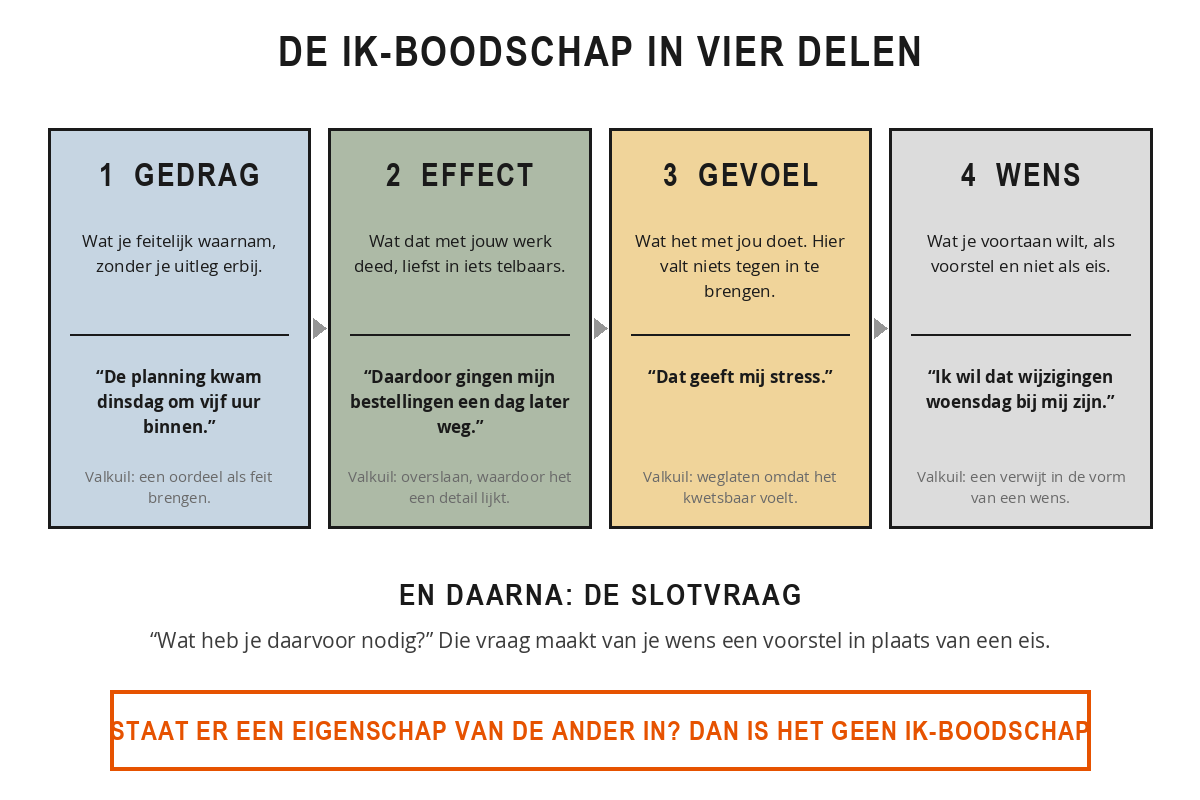
Each of the four parts does its own work.
- The behaviour. The observation you are both talking about, without the explanation you have already attached to it in your head. "The schedule came in on Tuesday at five o'clock", not "you couldn't be bothered again". The pitfall is presenting a judgement as a fact.
- The effect. What that behaviour did to your work, preferably in something countable. "As a result I could no longer do the purchasing and production stood still for half a day on Wednesday." The pitfall is skipping this, which makes it look as though you are making a fuss about a detail.
- The feeling. What it did to you. "That causes me stress." This part makes your message personal and therefore hard to refute: nobody can dispute that you are experiencing tension. The pitfall is that you leave it out because it feels vulnerable, and that is precisely the part that keeps your message out of a did-you-didn't-I argument.
- The wish. What you want from now on. "I want us to agree that changes reach me by Wednesday." The pitfall is a wish that is not a wish but a reproach in disguise: "I just want you to keep to your agreements."
Close with a question: "What do you need for that?" That closing question makes the difference between a demand and a proposal. You put your wish on the table and then leave room for the response.
There is also such a thing as a pseudo I-message. "I think you are unreliable" starts with "I" and is still a judgement about the other person. The test is simple: if your sentence contains a characteristic of the other person, it is a you-message in disguise.
Karin works in purchasing and normally receives the weekly schedule on Monday morning. For the past three weeks it has arrived on Tuesday at around five o'clock. She can then no longer place her orders that same day, which pushes the deliveries back by a day. Three ways of raising it:
Sub-assertive: "Sorry to bring this up, it's probably nothing, but could it possibly be a bit earlier?"
Aggressive: "You never keep to agreements. I've had enough."
Assertive, in four parts: "For the past three weeks the schedule has come in on Tuesday at five o'clock. As a result my orders went out a day later and the deliveries also arrived a day later. That causes me stress, because production calls me about it. I want us to agree that changes reach me by Wednesday at the latest. What do you need for that?"
Note what it does not contain: no "always", no "never", no assumption about why it went wrong. Only what happened, what it cost, what it does to her and what she wants.
Asking questions and not filling in the blanks
Most conversations get stuck on an assumption that nobody has checked. You hear something, you fill in the rest yourself and you respond to your own version of the story. Asking questions is the tool that prevents this. There is a fixed cycle of three actions that you can repeat in any conversation, and each round replaces a piece of assumption with information.
Listening is focusing your attention fully on the other person and parking the answer that is already lined up in your head. You notice that you are really listening when you hear something you had not expected. Summarising is giving back in your own words what you have understood, followed by a check question: "Is that right?" That way you let the other person correct your interpretation before it does any damage. Asking follow-up questions is asking a question about the part that is still vague. Not about what you already know, but about what you are still missing.
It helps to know what your question does. An open question starts with what, how, who, where or when, and lets the other person decide how detailed the answer will be. A closed question produces a yes, a no or a number, and pins something down. Both are useful, and the order determines the effect: first explore with open questions, then pin down with closed ones. Two pitfalls lie close together. The leading question already puts the answer in the other person's mouth: "You find this awkward too, don't you?" And the why-question sounds open but is often heard as a reproach. "Why didn't you report that?" produces a defence; "what led to it not being reported?" produces information.
Joost wants an extra day of training budget from his manager. He goes into the conversation with the topic "I want to talk about my development" and gets nowhere: the conversation spends twenty minutes on how busy the department is and ends with "we'll come back to it".
The second time he formulates a goal: the commitment that he may take two course days in the fourth quarter, with a decision before the end of the month. He opens with that goal in two sentences, then sets out his side, and asks: "What would you need in order to say yes to that?" The answer is that staffing levels in November are the bottleneck, not the money. He would never have thought of that. They agree on two days in October, and the conversation takes eleven minutes.
Choose a conversation you are actually going to have soon and prepare it.
- Topic: what is it about?
- Conversation goal: what will concretely be different after the conversation, described in terms of behaviour?
- Opening sentence: the two sentences in which you state your topic and your goal.
- I-message: write out the four parts separately, behaviour, effect, feeling and wish, each in one sentence.
- Closing question: the open question with which you let the other person speak.
- Agreement: which who-what-when do you want to pin down?
Then read your I-message out loud and delete every word that weakens it: "maybe", "actually", "a bit", "just". Does it still contain a characteristic of the other person? Then it is a pseudo I-message and you write it again.
Summary
- Go into a conversation with a goal, not with a topic: describe what will concretely be different afterwards.
- The four phases are opening and stating your goal, exchanging, working towards an agreement, and closing.
- The I-message has four parts: the behaviour you observed, the effect on your work, the feeling it gives you and what you want.
- The feeling is the part people leave out most often, and it is precisely that part that keeps your message out of the argument.
- "I think you are unreliable" is a pseudo I-message: it states a characteristic of the other person.
- Listening, summarising and asking follow-up questions take the assumptions out of a conversation. Explore with open questions and pin things down with closed questions.
- Replace the why-question with "what led to...", and you get information instead of a defence.
Which of these formulations is a usable conversation goal?
Why is the feeling an important part of the I-message?
"I think you are unreliable." What is wrong with this sentence?