


4. Recognising and turning around resistance
Resistance is a signal, not an enemy. As soon as someone pushes back, drops out or is suddenly very busy with other things, something is going on below the surface. Anyone who pushes that resistance away pushes their own message away. Anyone who listens to it hears what is really going on.
After this chapter:
- You can explain what resistance is and where it comes from.
- You recognise the four sources that underlie resistance.
- You can tell the difference between open and hidden resistance.
- You pick up the early signals in behaviour, tone and words.
- You can turn resistance into cooperation in four steps.
What resistance is
Resistance is the force with which someone opposes what you are trying to achieve. It is any reaction with which the other person slows down, blocks or brushes aside your attempt to influence them. Someone does not go along with it, does not take part, or pretends to take part and changes nothing. That opposition can be hard and visible, but equally quiet and wrapped up.
Resistance is almost never unwillingness without a reason. Behind every bit of opposition lies something: fear of change, an interest that is coming under pressure, a bad experience in the past, the feeling of not being heard, or simply too little information. Resistance is the way someone shows that there is still something standing between you and them. In that sense it is valuable information.
Where resistance comes from
Resistance arises on the playing field from chapter 1: the gap between what you want and what the other person still wants. The bigger that gap, and the more at stake for the other person, the stronger the resistance. There are four sources that keep coming back.
- Loss or threat. The other person sees something valuable disappearing: time, influence, certainty or a familiar way of working.
- No involvement. You have thought something up for the other person rather than with them. People resist things that happen to them, even when the substance is right.
- Mistrust. The other person does not trust your intentions, or has previously experienced a commitment not being kept.
- Too much, too fast. The message lands too harshly or too early, without the other person having had time to move along with it.
Open and hidden resistance
Resistance is not always easy to spot, because not everyone says out loud that they disagree. One person digs their heels in, another smiles pleasantly and then does nothing. Broadly speaking, resistance comes in two guises.
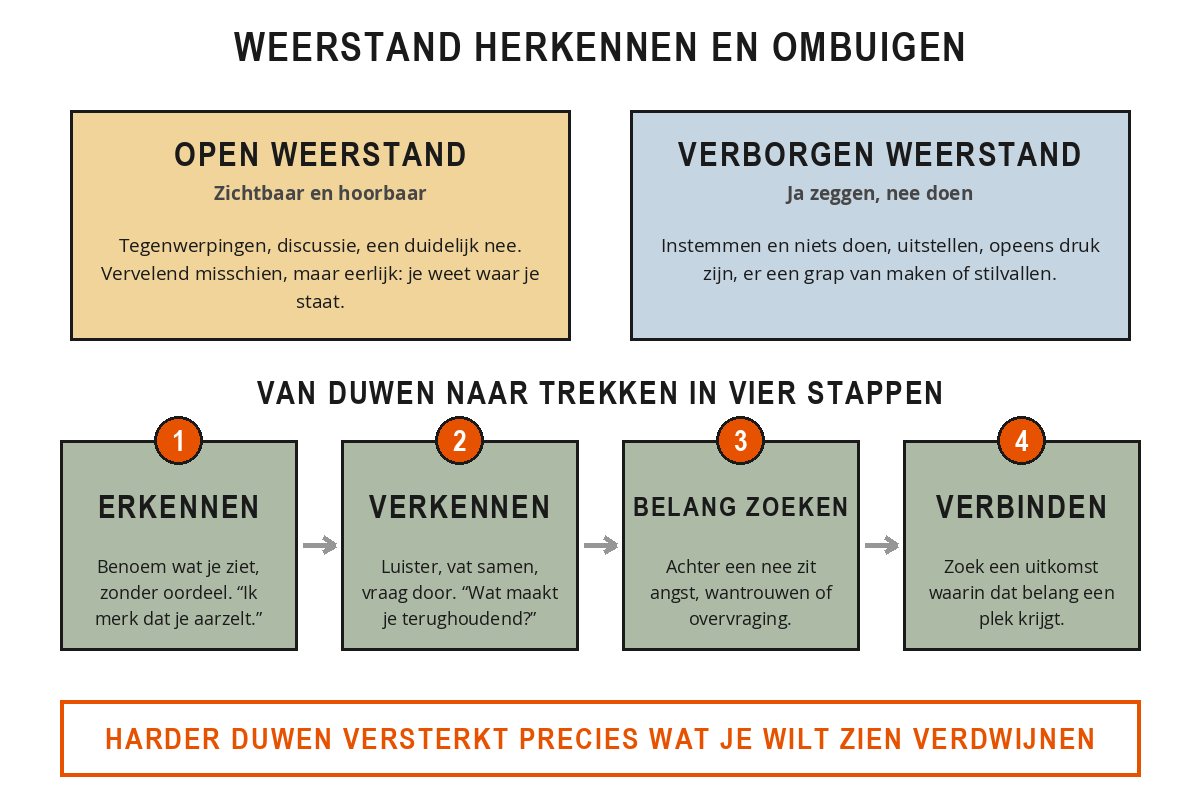
Open resistance is the visible variety. The other person pushes back, raises objections, argues or simply says no. Awkward perhaps, but pleasantly honest: you know where you stand and you have something to probe further.
Hidden resistance is more difficult. The other person seems to agree, but then does nothing. Or they put things off, suddenly become very busy, turn it into a joke, or fall silent. Here you need to look more closely, because the words say yes while everything else says no.
Resistance often announces itself before anyone puts it into words. In the words you hear it in "yes, but", in vagueness, and in delaying phrases such as "I need to think about that a bit longer". In the tone you hear it in hesitation, curt replies, a suddenly flat tone or a sharp edge. In the posture you see it in averted eyes, crossed arms, a tense face or a body that pulls back.
Pay particular attention to the moment the atmosphere shifts. If the conversation was going pleasantly and suddenly becomes uncomfortable, you have probably just touched on something that matters to the other person. That turning point tells you exactly where the interest lies.
The biggest mistake: pushing harder
Resistance is not a wall you run into. It is a signal that something is going on with the other person that is not yet on the table. The biggest mistake you can make is to push harder. If you notice resistance and put even more force behind it, you reinforce exactly the behaviour you want to see disappear. The other person digs in, you push harder, and the conversation grinds to a halt.
Resistance calls for the opposite: you stop pushing and start pulling. You focus on the other person instead of on your own message. That feels counterintuitive, because you want to move forward. Even so, this is the quickest route.
Four steps from pushing to pulling
This is how you turn resistance around, in four steps.
1. Acknowledge. Name what you see, without attaching a judgement to it. "I notice that you are hesitating" or "I hear doubt in your voice". You let the other person know that it may be seen. Acknowledging is not the same as conceding: you say "I understand that this feels quick" without withdrawing your proposal. You acknowledge the feeling, not necessarily the position. That distinction keeps you firm on the content and warm on the relationship.
2. Explore. Use listening, summarising and asking follow-up questions from chapter 2 to find out what is going on. Ask open questions: "What is making you hesitant about this?" Not leading, and not with an answer already in mind.
3. Looking for the interest beneath the position. Behind a no there is almost always an interest: fear of loss, a lack of trust, or the feeling of being asked too much. As long as that interest remains hidden, nothing changes.
4. Connect. Look for an outcome in which the other person's interest also has a place. It often turns out that you have more in common than it seemed.
Saskia proposes a new way of working to her colleague Marloes. Marloes replies curtly: "I'm not sure that's going to work." Saskia senses the resistance. Instead of repeating her arguments, she switches to pulling. Saskia: "I notice you're not immediately enthusiastic about it. What's making you hesitant?" Marloes: "We tried something like this last year and it fell apart." Saskia: "So you're afraid we'll make the same mistake again." Marloes: "Exactly. All it did back then was cost extra time." Now the real interest is on the table: Marloes doesn't want to waste time again on something that doesn't work. That isn't resistance to the idea, but a concern about the implementation. Saskia can work with that, and together they look at how this approach differs from last year's.
What acknowledgement does
Acknowledgement disarms. As long as someone feels their objection is not being heard, they will keep repeating it, often ever more loudly. The moment you show that you genuinely understand the objection, the need to keep pushing falls away. The other person relaxes and room for a conversation opens up.
Joost wants his department of twelve people to keep Friday afternoons free for administration from now on. His colleague Fenna says nothing in the meeting, but three weeks later still has not delivered anything. That is hidden resistance. Joost walks past and says: "I see the Friday block isn't getting off the ground with you. Is that right, and what's in the way?" It then turns out that Fenna serves her two biggest clients on Fridays and that this is the only time they are available. Joost was right that the administration had to be done, but his solution did not fit her week. They agree that Fenna will do it on Tuesday mornings. The proposal was not wrong; the assumption that it would work out the same for everyone was.
Tailoring to the person
Not every form of resistance calls for the same response. With open resistance you can name and explore the objection straight away. With hidden resistance you first have to make sure the atmosphere is safe enough before someone dares to voice their real objection. Tailor your approach to the person in front of you and to what the situation requires, as you saw in chapter 3.
And bear in mind that resistance is sometimes simply justified. Your proposal isn't quite right, or your timing is wrong. Anyone who genuinely explores it discovers that resistance also gives you valuable information. So you don't always have to win the other person over; sometimes you improve your own plan.
Think of a recent conversation in which you wanted to convince someone of something and noticed it was not going the way you wanted. Work out the following points:
- The signal: which behaviour, which tone or which words made you feel resistance?
- The form: was it open or hidden resistance? How did you notice?
- The source: which of the four sources played a part, in your view?
- The acknowledgement: write down one sentence with which you acknowledge the resistance without withdrawing your proposal.
- The question: formulate one open question with which you look for the interest beneath the position.
Finally, consider what an outcome looks like in which both your objective and the other person's interest have a place.
Summary
- Resistance is a signal that an interest is at play that is not yet on the table, not unwillingness without a reason.
- The four sources are loss or threat, lack of involvement, distrust, and too much too quickly.
- Open resistance is visible: objections, discussion, a clear no. Hidden resistance is saying yes and doing no: putting things off, being busy, making jokes or falling silent.
- Early signals are in the words ("yes, but"), in the tone (hesitant, curt) and in the posture (averted eyes, folded arms).
- Pushing harder reinforces the resistance. The solution is to switch to pull energy.
- You turn resistance around in four steps: acknowledging what you see, exploring by listening, summarising and asking follow-up questions, looking for the interest beneath the position, and connecting the interests.
- Acknowledging is not conceding. You acknowledge the feeling and keep your proposal on the table.
- Sometimes the resistance is justified and sharpens your own plan.
A colleague agrees amiably to your proposal in the meeting, but three weeks later nothing has changed. What are you dealing with?
What does acknowledging mean in the first step of the four-step plan?
You notice resistance and decide to set out your arguments once more, but more firmly this time. According to this chapter, what happens?
Ready for the next step?
You have completed the free starter of Influencing Skills. The next chapter in the full course is The playing field of influencing: Why you exert influence, where the line lies between influencing and manipulating, and how to map out the playing field of a situation.
Take the 2-day course →From €1250,- excl. VAT · with an experienced trainer included