


3. Choosing your style and building trust
Sometimes you do not change someone's mind with a better argument, but with a better relationship. Someone you trust is more likely to let you near their convictions. Beneath influencing there is therefore a deeper layer: the relationship itself, and the question of which of the four forces suits the person sitting opposite you.
After this chapter:
- You know which three layers an attitude consists of and why it is so stubborn.
- You understand why arguments alone rarely shift an attitude.
- You can determine where the blockage lies with the other person and which force fits it.
- Recognise your own preferred style and its pitfall.
- You know the four behaviours with which you build trust.
Why an attitude is so stubborn
An attitude is a more or less fixed way in which someone looks at a subject, a person or a situation. Such an attitude consists of three layers: what someone thinks, what he alongside it feels, and how he relates to it in his behaviour, so what he does. Your colleague has an attitude towards working from home, towards the new system and towards your proposal to overhaul the team meeting. That attitude did not come about in a single afternoon, and it will not disappear in a single afternoon either.
The fact that an attitude consists of those three layers immediately explains why it is so stubborn. If you only change the thinking with a good argument, the feeling and the doing simply stay as they were. On paper your colleague agrees with you; in practice he does exactly what he always did. The thinking said yes, the feeling said no.
The temptation is then strong to put everything on reason. You build a strong line of argument and think: no one can get around this. Yet you get stuck. An attitude largely sits in the feeling, and feeling cannot be reasoned away. In fact: the harder you push with arguments, the more firmly the other person digs into their own position. That is due to the frame of reference through which someone looks at your message. If that person does not feel seen or taken seriously, they will filter out your arguments before they get through. In terms of content your story is sound, but acceptance remains at zero.
Kayleigh wants her team to switch to a shared planning system. In the meeting she lists seven advantages: less duplicated work, a better overview, fewer missed deadlines. Her colleague Bram nods at every point, but says at the end: "It all sounds logical, but I'm sticking with my own lists." Bram does not dispute a single argument. His resistance is not in the thinking but in the feeling: he is attached to his own system and feels safe with it. Kayleigh was right seven times over, but addressed the wrong layer.
The route runs via feeling and doing
If thinking alone is not enough, where do you start? With the other two layers. Connecting with the feel means you first explore what drives the other person. The exploring strength from chapter 2 comes in useful here. Before you try to change anything, you want to understand where the current attitude comes from. What makes Bram hold on to his lists? Perhaps he once had a bad experience with a system that crashed. As long as you do not know that, you are talking past him.
Connecting with the doing means that you make the new behaviour so small that the threshold is low. You are not asking for a complete about-turn, but for a first small step. If Bram uses the planning alongside his own lists for one week, it costs him little and he finds out for himself whether he likes it. Change that someone experiences for themselves sticks better than change you have talked them into.
If you want to change someone's attitude, first look at which layer is stuck. Does the other person say "I understand, but..."? Then the blockage is in the feeling or the doing, not in the thinking. More arguments will not help. You are better off asking a question: "What makes you hesitate?"
Where is the blockage?
Chapter 2 covered four forces. The question isn't which force is best, but which one fits the person and the moment. And that depends on one thing: where the other person is stuck.
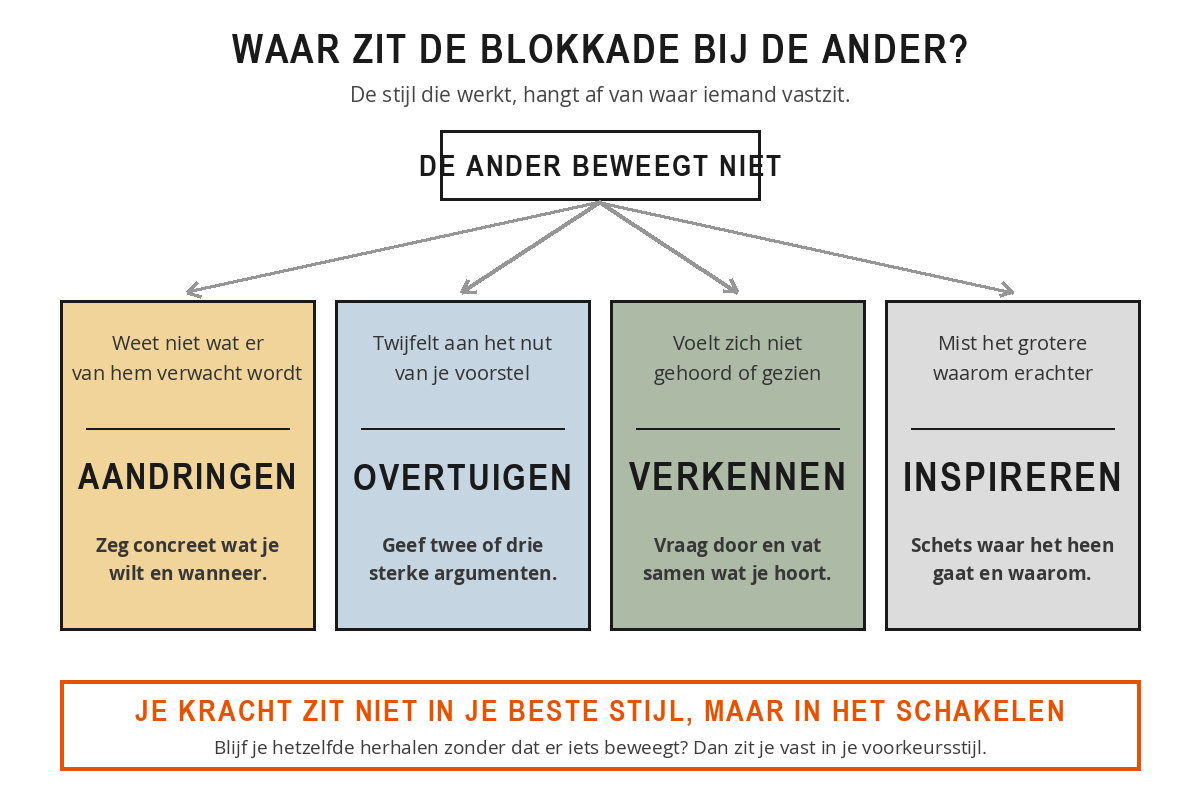
Someone who does not know what is expected of him, has no need for a story about the future. They need a clear instruction, so press the point. Say concretely what you want and when. Someone who doubts the point of your proposal, will not be moved by a deadline. They want to hear arguments, so persuade. Two or three strong points, properly worked out.
If the blockage lies deeper, the picture changes. Does the other person feel not heard, then no amount of reasoning will help. In that case you first explore what's going on, by listening, summarising and asking follow-up questions. And someone who the bigger why is missing, you achieve with a picture of where things are heading, so by inspiring.
Why one style falls short
Most people have a preferred style. One likes to persuade with facts, another naturally asks further questions. That is fine as long as it works, but it becomes a pitfall the moment you apply that one style to everything. Anyone who always persuades keeps stacking up arguments for someone who is actually hesitating on a gut level. Anyone who always probes keeps exploring while the other person has long been ready for a clear instruction. Your effectiveness does not lie in your strongest style, but in your ability to switch.
Do you notice that you keep repeating the same thing without anything moving? Then you are probably stuck in your preferred style. It helps to pause and ask yourself: where is the other person really blocked? The chances are that a different strength will get you further.
Attuning with empathy
Before you choose a style, you want to know who you are dealing with. Attuning means adapting your approach to the person and the situation, and for that you need two things: empathy and trust.
Empathy is the ability to put yourself in the position of what the other person thinks, feels and needs. You do not have to agree with them in order to empathise. You are only trying to understand what the situation looks like from their chair. That is more than being nice, it is a source of information. Anyone who empathises sees more quickly where the other person is stuck and can therefore choose more precisely which style fits.
Dennis proposes a new way of working and his colleague Fenna responds curtly. Without empathy he thinks: she is not cooperating. With empathy he asks himself what lies behind that curtness, and says: "I notice that you are responding with reservation. What is going on?" It then turns out that Fenna came a cropper with a similar plan with the board last week. Now that Dennis knows this, his approach changes. He does not need to push harder, he first has to take her concern seriously.
Building trust
Trust is the expectation that you can rely on the other person, and they on you. Without trust no message lands, however well your style fits. Someone who doesn't trust you looks for a hidden intention behind every word. You don't build trust in a single conversation. It grows through a series of small moments in which you show that you can be trusted.
Four behaviours carry that trust. Being reliable: do what you say and say what you do. Every commitment you keep is a brick in the foundation; every commitment you break takes two away. Being open: be honest about what you want. Don't hide your goal, because sooner or later the other person will sense a hidden agenda. Giving acknowledgement: take the other person seriously, even if you disagree with him. Acknowledging is not the same as agreeing; you show that you have heard his concern. Showing reciprocity: give something before you ask for something. Trust grows when the other person notices that it is not only about your own interest.
You lose trust faster than you build it. One broken promise weighs more heavily than ten agreements kept. So promise something small that you will certainly deliver rather than something big that you may not achieve.
Think of someone you have a difficult conversation with coming up and work out these points:
- The person: who is it and what do you want to achieve?
- The blockage: where is this person stuck? Does he not know what is expected, does he doubt the point of it, does he feel unheard, or is he missing the bigger why?
- The fitting style: which strength goes with it, insisting, persuading, exploring or inspiring?
- Empathy check: what does the situation look like from the other person's chair?
- Trust: on which of the four behaviours is there most to gain in this conversation?
Then discuss your answer with a colleague and see where your estimates differ.
Summary
- An attitude consists of three layers: thinking, feeling and doing. If you change only the thinking, the other two stay where they are.
- The harder you push with arguments, the more firmly someone digs in. Acceptance runs through feeling and doing: explore first, then ask for a small first step.
- Which style works depends on where the other person is stuck: insisting when things are unclear, persuading when there is doubt, exploring when someone doesn't feel heard, inspiring when the why is missing.
- Sticking to your preferred style is a pitfall; your strength lies in switching.
- Empathy helps you see where the blockage lies and which style fits. You do not have to agree with the other person in order to put yourself in their position.
- Trust grows in layers: being reliable, being open, giving acknowledgement and showing reciprocity. You lose it faster than you build it.
Which three layers does an attitude consist of according to this chapter?
An employee says he does not understand what exactly is expected of him on a new task. Which force applies here according to this chapter?
According to this chapter, which of these four behaviours carries trust, and what does it mean?