


4. Checking the outcome
The trickiest error a language model makes is the answer that reads fluently and yet makes no sense at all. No warning light comes on, and the text does not sound uncertain. Anyone who sends out AI output under their own name is responsible for every figure, every source and every sentence in it. This chapter is about the checking that goes with that.
After this chapter:
- You understand why a language model invents facts without noticing that it does so.
- You recognise the signals that reveal an invented answer.
- You know which five types of claim you should always mark.
- Choose a verification source that is independent of the model.
- You can determine how much checking a particular piece of work deserves.
Why it happens
A language model continually predicts what is likely to follow on from what is already there. It has no list of facts to look something up in and see whether it is correct. Ask it for the author of a book the model does not know, and "I don't know" is a statistically unusual answer to such a question. A plausible-sounding name fits the pattern better. The result is a fluent sentence with an invented core. In the field this is called a hallucination, and the term covers it reasonably well: the model sees something that is not there.
The same mechanism lies behind the weak spots in numerical work. Predicting is not the same as calculating. Small sums usually go well, because those combinations appear thousands of times in the training data. But with a discount on a discount, VAT on an amount that already includes a margin, working days between two dates or "give me exactly 150 words", the answer becomes a plausible guess in numerical form. It is often close and just not right.
The signals
Five things in an answer deserve extra suspicion.
- Suspicious precision. Exact case numbers, page references or percentages to two decimal places appear without you having supplied a source yourself.
- Familiar name, unfamiliar work. The model links an existing author or organisation to a report you cannot find anywhere.
- Slick certainty on a niche question. The more specialised your question, the thinner the material the model was trained on. A fluent answer about an obscure Dutch regulation is suspect.
- Links you cannot open yourself. Invented web addresses are a classic, certainly when the model is not searching the web live.
- Answers that confirm exactly what you suggested. If your question contains an assumption, the model will happily build on it, even if that assumption is incorrect.
Sanne works in HR and asks: "What does article 7:658a of the Dutch Civil Code say about home workstations?" She gets three tidy paragraphs back setting out the employer's obligations, plus a reference to case law from 2019. It all reads professionally and she copies two sentences into a memo to the board.
The only problem is that the article is not about home workplaces. Her question contained the assumption, and the model duly filled it in. Had she asked "which article governs the duty of care for the home workplace, and if there isn't one, say so", she would have got a more honest answer. A neutral question produces less invented confirmation.
Don't ask "why is method X more effective than Y", but "compare method X and Y and indicate where the evidence is weak". Without a built-in conclusion, the model has nothing to build on.
Proofreading is not checking
When proofreading, you look out for what sounds odd, and that is exactly where the problem lies: invented passages do not sound odd. They often read more pleasantly than the truth, because the model chooses the most common phrasing. A fact check therefore works differently. You do not read by feel but by category, and every flagged claim gets an outcome: it is correct, it is incorrect, or it cannot be traced. That third outcome is not a halfway version of the first: a claim you cannot verify is one you remove or rewrite.
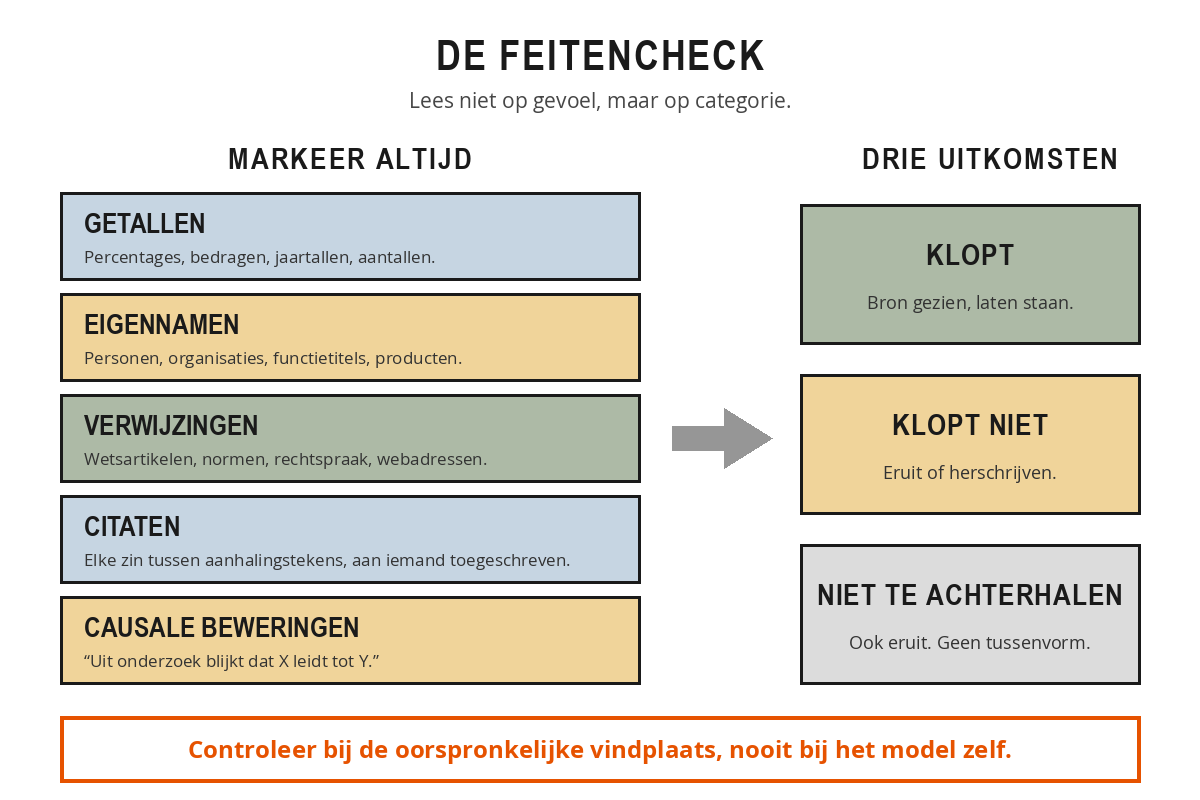
- Numbers. Percentages, amounts, years, quantities and market figures. The model fills in plausible values here effortlessly.
- Proper names. People, organisations, job titles, product names. Things go wrong particularly with Dutch names and small organisations.
- References. Legal provisions, collective agreement clauses, standards, case law, page numbers and web addresses. The more precise the reference, the sooner you should check it.
- Quotations. Every sentence in quotation marks that is attributed to someone. An invented quote is both factually wrong and damaging to reputation.
- Causal claims. "Research shows that X leads to Y." The phrasing suggests evidence that is not always there.
Where to check
The source you check against must not come from the same stable as the claim. Asking the model whether its answer is correct mainly produces agreement, and a second AI assistant trained on similar material makes the same error with the same confidence. What is useful is the place the fact comes from: wetten.overheid.nl for legislation, CBS for figures, the annual report of the organisation in question, the original article behind a quotation. You use a search engine to reach that place, not to read a summary of it.
This still applies even when the model searches the web itself. You are then shown links, and those links are real. What the summary of that link says is still generated. Opening the source remains your job.
How much checking is enough
Verifying everything often takes more time than the answer saved you, which defeats the purpose. The measure is the potential damage: the more visible the output and the harder it is to undo, the more thoroughly you check. A list of angles for an internal brainstorm needs a glance. A letter to a client, a grant application, a quotation or a text on your website needs all five categories, line by line.
Joost is drawing up a quotation for a client and has the accompanying text written for him. Out comes a fluent paragraph with the sentence: "Organisations that follow this approach save an average of 23 per cent on their lead time, according to research by TNO." It reads convincingly, the figure is neatly odd, and the source sounds authoritative.
He flags three things: the figure (23 per cent), the proper name (TNO) and the causal claim (this approach leads to savings). He searches for ten minutes and finds no research that matches. Outcome for all three: cannot be traced. He removes the sentence and puts in something he can stand behind himself: "With our last three clients in this sector, lead times went down by about a fifth." That sentence costs him no research, because he knows it is true. Had the quotation gone out with the TNO figure in it, one alert buyer would have been enough.
Have an answer produced on a subject you know well, and one that contains facts: figures, names, rules.
- Mark every claim that falls into one of the five categories.
- For each marking, note which source you need in order to check it.
- Actually verify the three riskiest claims.
- Count: how many checked, how many confirmed, how many incorrect, how many untraceable.
Finally, write down in two sentences what would have happened if you had sent this text out unchecked.
Summary
- A language model predicts what is likely to follow; it checks nothing, so it invents without noticing.
- Numerical work is weak for the same reason: the answer is often close and just not right.
- Signals: suspicious precision, a familiar name with unfamiliar work, smooth certainty on a niche question, links that do not open, and answers that confirm your own assumption.
- Ask neutral questions, because an assumption in your question comes back as confirmation.
- Proofreading does not work: invented passages do not sound odd. Read by category.
- Always mark figures, proper names, references, quotations and causal claims.
- Check at the original source, never with the model or with a second AI assistant.
- The more visible and irreversible the output, the more thorough the check.
Why does a language model invent an author's name for a book it does not know?
You want to establish whether a legal provision mentioned in an answer actually exists. What counts as a valid check?
A marked figure turns out to be untraceable. What is the right conclusion?
Ready for the next step?
You have completed the free ChatGPT starter. The next chapter in the full course is How a language model works: Predicting the next word, what a model is trained on and how a raw language model becomes a chat assistant.
Take the 1-day training course →From €675,- excl. VAT · with an experienced trainer included