


2. How much direction does someone need?
You now know when coaching is appropriate. The next question is how much room you can give this person on this task. Paul Hersey and Ken Blanchard created a tool for that which fits into two questions and which you will use for the rest of your career.
After this chapter:
- You know the two core questions of situational leadership and can apply them to a specific employee.
- Assess motivation and competence separately from each other instead of lumping them together.
- You can place someone in one of the four quadrants for a given task.
- You know which style goes with each quadrant and what you should specifically avoid doing there.
- You recognise resistance as a signal that your style does not fit.
There is no best style
The model is based on something that is constantly forgotten in practice: there is no style that always works. The right style depends on the task and on the person carrying it out. The same employee may need a great deal of direction on one subject and virtually none on another. The experienced controller who can produce any set of annual accounts with his eyes closed is simply a beginner again when it comes to chairing a client meeting.
To determine that style, you ask yourself two questions about one specific task. The first concerns motivation: does this person want to do this, and with how much energy and confidence? The second concerns competence: can this person already do this, in terms of knowledge, experience and skill?
The two do not always run in parallel, and that is the whole value of the model. A new employee is often highly motivated and at the same time not yet competent. Someone who has been doing the work for ten years may be perfectly capable and secretly done with it. Lump the two together into "he is performing well" or "he is performing moderately", and you miss exactly the information you need in order to decide what to do.
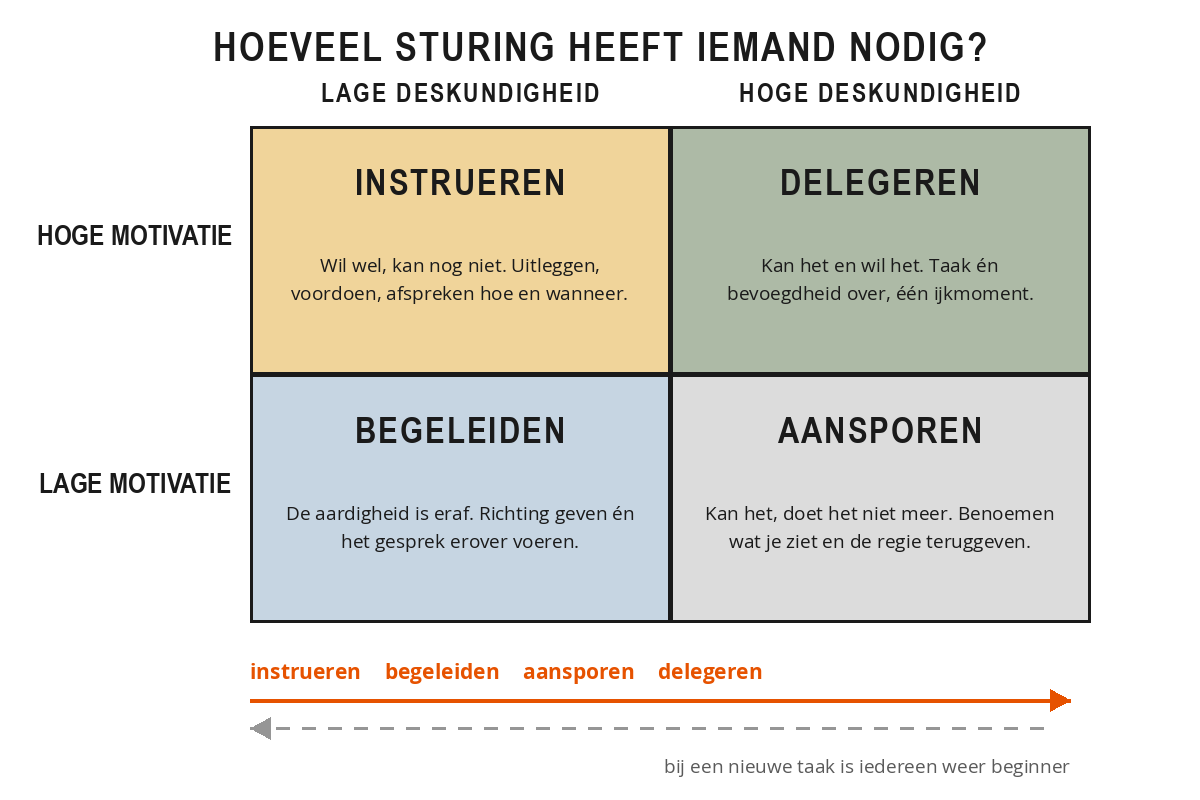
The four quadrants and what they require
High motivation, low competence: instructing. The enthusiastic beginner. He is keen and does not know yet. If you ask him "how would you tackle this yourself?", you are not helping him, because he simply does not know and it makes him unsure. Here you give direction on the content: you explain, you demonstrate, you make agreements about how and when. The pitfall is mistaking enthusiasm for competence and letting go too soon.
Low motivation, low expertise: guiding. The first excitement has worn off and it turns out to be harder than expected. Here you give direction on two fronts at once: you still provide direction on the content, and you invest in the conversation about what it is doing to him. Explaining alone does not work here, because the problem is not just that he cannot do it. Asking alone does not work either, because he does not yet have the knowledge.
Low motivation, high competence: encouraging. He is technically perfectly capable and no longer puts any energy into it. Explanation is actually insulting here. What does work is attention to the question of why the motivation has drained away. You rarely recognise this quadrant from the quality of the work, because that usually holds up for a while. You see it at the edges: the work is finished at the last moment, no more initiative is shown, questions are dealt with in short answers.
High motivation, high competence: delegating. He can do it and he wants to do it. You hand over the task including the scope for decision-making and you focus on the result, not on the route towards it. You agree what has to be completed, when, and within what boundaries. After that, you let go.
Nadia has been working at customer services for three weeks. She asks a lot of questions, stays on longer and wants to do everything well. Her motivation is high, her competence still low: the instructing quadrant. In the opening conversation her team leader asks: "How would you tackle a complaint like that yourself?" Nadia falls silent, says she does not know and spends the following week checking everything twice before sending anything out. The question was well meant and precisely wrong.
Peter has been doing the same work for nine years. He knows every system and every exception, but he calls in sick more often and keeps conversations short. His competence is high, his motivation has dropped: the supporting quadrant. His team leader schedules a briefing session for him on the new complaints procedure. Peter sits through it, says nothing and afterwards carries on exactly as before. Here too, the style was the problem, not the person.
How to make the assessment
- Choose one specific task. Not "how is Sander doing", but "how is Sander doing when handling complaint conversations". A judgement about an entire person does not produce a usable style.
- Rate the competence. Look at what you have seen him do, not at what he says he can do. On a new task, people systematically rate themselves too high or too low, and both distort your choice.
- Score the motivation. Pay attention to energy, initiative and the extent to which he raises the subject himself. Someone who never brings it up is saying something by doing so.
- Place him in the quadrant and see which style goes with it. Compare that with what you are actually doing now.
Do you find it hard to see motivation and competence separately in someone? Then there is usually a judgement about the person getting in the way. Ask yourself the question: if he suddenly felt like it again tomorrow, would he be able to do it? The answer separates the two after all.
Encouraging: what you do and what you don't
The quadrant where managers most often choose the wrong style is supporting. The reflex is to explain or to check up, and both make things worse. Supporting means you give little direction on the content and invest heavily in the relationship and the conversation. Four steps:
- Name what you observe. You name the difference between what you saw before and what you see now. Factually, without judgement: "You always submitted your documents two days in advance; over the past month they have been arriving on the morning itself."
- Ask about the cause and then stay silent. A silence of a few seconds yields more here than a second question. Usually there is something behind it that has nothing to do with ability: boredom, a proposal that was turned down earlier, doubt about whether this work still suits him, or trouble outside work.
- Hand back the reins. You ask what he needs to regain his enthusiasm, and what he can do about that himself.
- Make one agreement. Small and specific, with a moment at which the two of you come back to it.
Three things you leave out: giving instructions, taking over the work and building in extra checks. All three confirm the feeling that the trust has gone, and that pushes motivation down further.
Resistance is information about you
If someone responds curtly, with "I already know that" or in fact with "just tell me what to do", you are seeing resistance. Resistance is the opposition that arises when your approach does not match what the other person needs at that moment. It is not an unwillingness to cooperate, it is information about your choice of style.
"I already know that" usually means: you are instructing someone who is well past that point. "Just tell me what to do" usually means: you are coaching someone who still lacks the knowledge. And "everything's fine, really" while you see something different is the sound of the supporting quadrant. In all three cases, the response to resistance is not to push harder, but to switch style.
Delegating, and the dotted arrow back
Delegating is the end point of the scale, and two things often go wrong there. You delegate the task but not the authority, which means the other person has to come back for every step. Or you delegate and disappear entirely, leaving them on their own when things go wrong. A brief check-in halfway through solves both, as long as you agree on it in advance and do not suddenly introduce it midway. A check you add unannounced reads as distrust.
And then the arrow back. Someone who works completely independently in their own field is simply a beginner again on a new task. You then switch back to instructing, and that is not a relapse or a disqualification. That is exactly what the model asks of you.
Choose two people from your own working environment and note down for each person:
- The name and the specific task you are looking at.
- Competence on that task: low, average or high, with one observation to support it.
- Motivation on that task: low, average or high, with one observation to support it.
- Which quadrant they end up in, and which style goes with it.
- What you are actually doing now, and whether that matches.
Then choose one task that you currently do entirely yourself and that someone else could take over. Which quadrant is that person in for that task? Which decisions do you hand over as well, and which do you keep? When will you schedule the review moment?
Summary
- There is no best style. The right style depends on the task and on the person carrying it out.
- Two questions per specific task: does he want to do it (motivation) and can he already do it (competence)? Assess them separately.
- High motivation, low competence: instructing. Explaining, demonstrating, making agreements.
- Low motivation, low expertise: guiding. Giving direction and having the conversation about what it does to him.
- Low motivation, high competence: supporting. Name what you see, ask what lies behind it, hand back the reins.
- High motivation, high expertise: delegating. Hand over both the task and the authority, with one pre-agreed checkpoint.
- Resistance says something about your choice of style, not about the person. The answer is to switch style, not to push harder.
- On a new task, the most independent employee is a beginner again. Switching back is part of it.
Why does this chapter assess motivation and competence separately from each other?
An employee has been doing his work faultlessly for years, but over the past few months he has been delivering at the very last moment and no longer comes up with suggestions. Which style fits here?
You ask an employee an open coaching question and get back: "Just tell me what to do." According to this chapter, what does that say?