


Introduction
A text that sells is rarely the text that sounds the most beautiful. It is the text that says the right thing at the right moment to someone who has something to gain from it. That asks two things of you at once, and those two do not automatically go hand in hand. You have to think clearly about who you are addressing and what you want to achieve. And you have to dare to play with language, because a text that does everything right and surprises no one gets clicked away among all the other texts that also do everything right.
This free course is about texts with a job to do. A landing page that has to make visitors click, a mailing that has to generate responses, a job advert someone has to apply to, a quotation that has to be signed. What these texts have in common: there is a reader at the other end with their own worries, their own hurry and an excellent reason to click away.
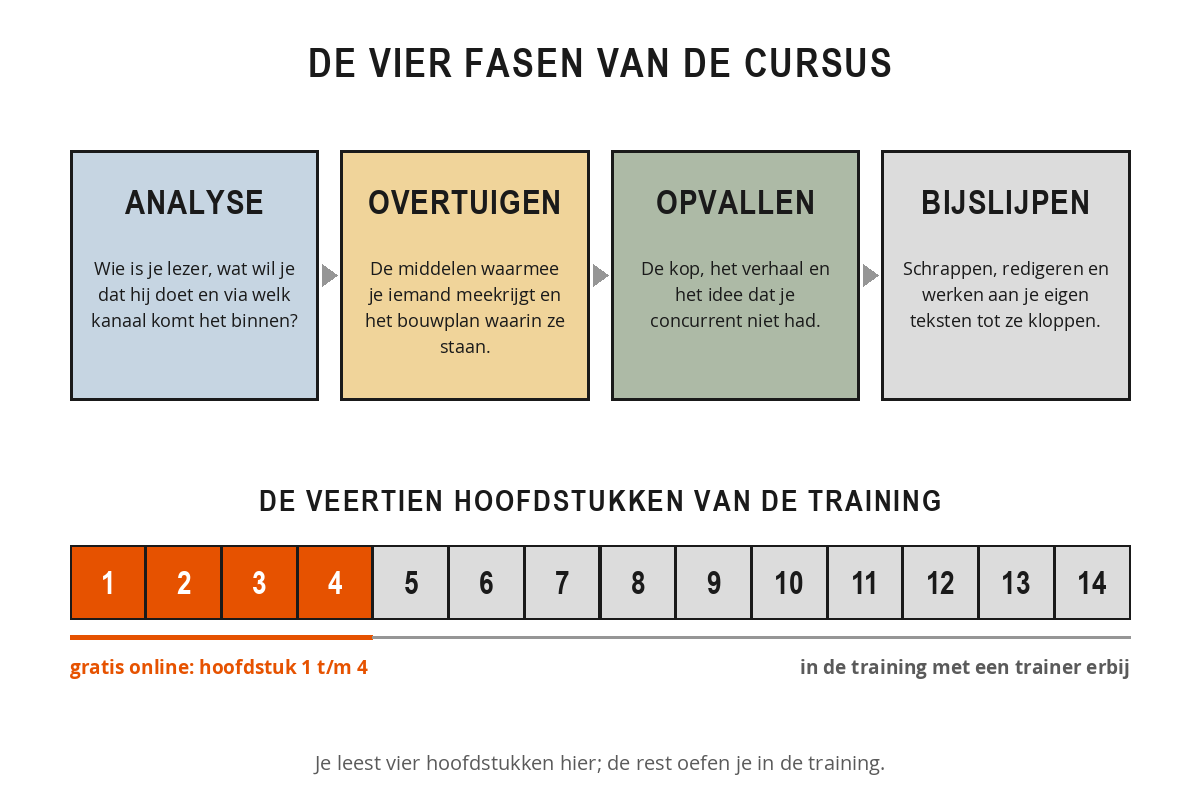
This free course contains four chapters from the course: the orange part of the bar above. They are not the first four in the book, but the four you can use today on a text that is already on your desk. At the bottom of chapter 4 you will find the full course.
What you will learn
You begin with the question of why anyone should take you at your word. In chapter 1 you learn how credibility, emotion and argument together move a reader, how to turn a feature into a benefit, and what evidence you put underneath a promise. In chapter 2 you put that material into a structure: the four steps of AIDA, an opening that makes a promise and a closing that asks for action instead of waiting hopefully. Chapter 3 is about the first two seconds: the headline, the lead, and the dip halfway through where most readers quietly disappear. Chapter 4 is the playful part. There you use the double diamond, SCAMPER and four distortion techniques to bring up ideas that go beyond your first thought.
The common thread is that commercial writing is not a matter of fine words, but of order and evidence. First work out what your reader gains from it, and only then think about the sentence in which you say it.
How the course is structured
The course runs through four phases that build on one another. You start with analysis: who is your reader, what do you want them to do, and through which channel does your message arrive. Then comes persuading: the means by which you bring someone along and the structure in which you place those means. After that comes standing out: the headline, the story, the idea your competitor didn't have. And you finish with polishing: cutting, editing and working on your own texts until they are right.
Every chapter here contains an explanation, a diagram, examples from practice and an exercise on your own material. The exercises are the real work, because you don't learn to write by reading about it.
Practical tips for use
- Before you start, find two or three texts you have written yourself and are not happy with. An old quotation, a job advert, the text on your website. You will use these for every exercise.
- Keep an empty document or a notepad open. The exercises only produce something if you actually fill them in.
- Don't read it all in one go. One chapter, then rewriting a text, then carrying on, works better than reading through for an entire afternoon.
- Take a baseline measurement: note down which type of text you write most often and where you usually get stuck. At the end you will look back on it.
- Ask someone else to read it. For almost every exercise in this course, the reaction of an outsider is worth more than your own judgement.
Each chapter ends with a short knowledge check of three questions: answer them correctly to mark the chapter as completed. Your progress is saved automatically in your browser.
Enjoy the read. And when you start on your first rewrite: don't throw away your first version, because seeing the difference is half the work.