


1. Persuading with ethos, pathos and logos
Persuading is not a matter of shouting louder. Anyone who gets a reader moving mixes three things in the right proportion: a reason to believe you, a feeling that strikes home, and a line of reasoning that holds up. Aristotle described those three more than two thousand years ago, and they work in a quotation today exactly as they worked in the marketplace of Athens.
After this chapter:
- You recognise ethos, pathos and logos in a text and you know which of the three is missing.
- You deliberately choose a mix that suits your reader and your writing objective.
- You know Cialdini's six principles and you know why you use only one or two of them per text.
- You use the and-so question to climb from a feature to a benefit and on to what it means for your reader.
- For every promise, you provide the kind of proof your reader needs.
The three sources of persuasive power
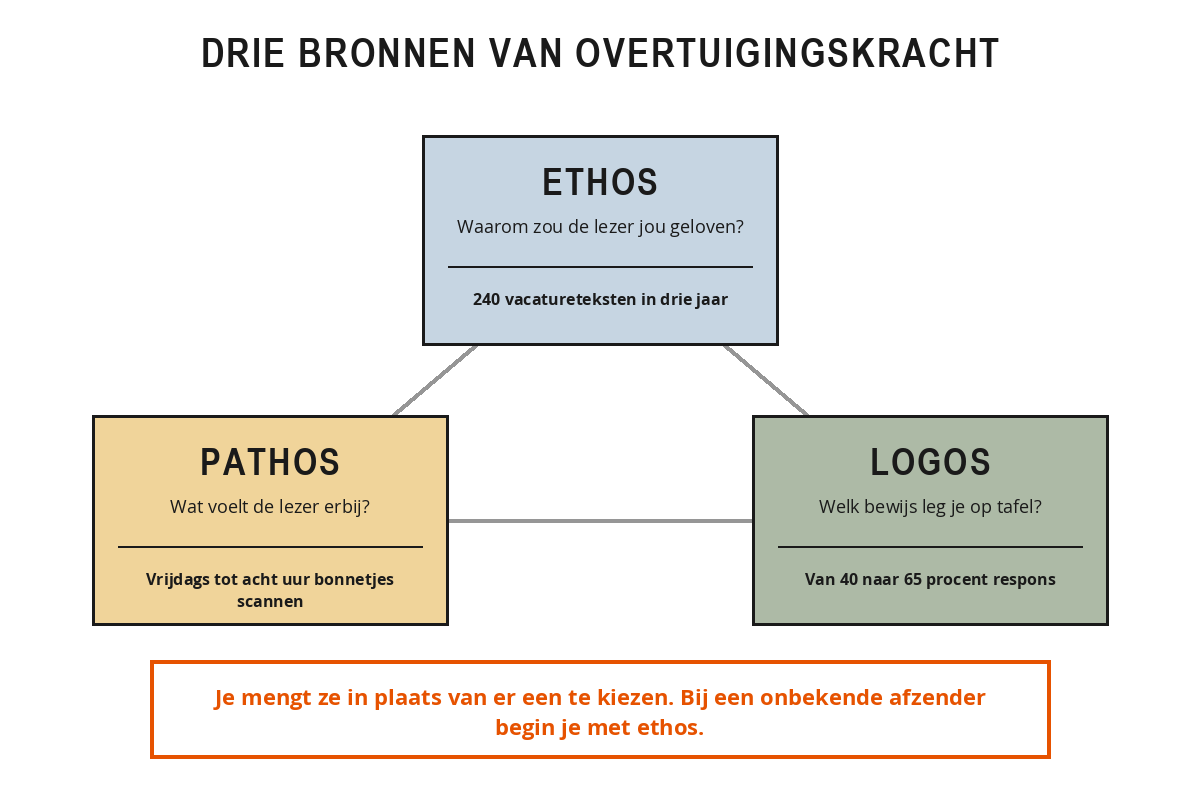
Ethos is your credibility as the sender. Within a few seconds your reader weighs up whether you have anything to say on this subject, and that judgement rests on signals: experience you mention, customers you have helped, a quality mark, or simply the way you write. A text full of typing errors undermines your ethos more than any argument can. And you build ethos with facts about yourself, not with adjectives. "We are a leading agency" says nothing, because your competitor writes that too. "Over the past three years we have written 240 job advertisements for technical roles" says everything.
Pathos is the feeling you evoke. That need not be tears: recognition, irritation, relief, curiosity or enjoyment count just as much. Pathos works through imagery and detail. "The administration takes up too much time" stays abstract. "Every last Friday of the month you sit scanning receipts until eight o'clock" lets your reader feel it, because he can see himself sitting in that kitchen. Your reader's frustration is therefore your most important fuel, and usually the best first sentence you have.
Logos is the reasoning: figures, a comparison, cause and effect, a calculation, a guarantee. Logos turns a feeling into a decision your reader can defend to his manager, his partner or himself. Someone buys on feeling and justifies it with figures, and you have to give him both.
Incidentally, too much logos works against you. A four-page quotation full of specifications gives your reader everything to compare and nothing to look forward to. Conversely, a text that runs purely on feeling collapses the moment someone asks what it costs and what it delivers.
Shifting the balance
The three are not a menu to choose from. You mix them, and how you mix them depends on your reader and your goal. Three rules of thumb will get you started. The higher the investment and the more businesslike the reader, the more weight logos and ethos carry. The lower the threshold and the shorter the decision moment, the more room pathos gets. And with a sender the reader does not yet know, you always start with ethos, because without credibility no argument lands.
Two openings of the same quotation for a writing course.
Version A: "Learnit has been providing communication training courses since 1996. Our range is broad and our trainers are experienced." This is almost pure ethos, and vague ethos at that. The reader feels nothing and learns nothing.
Version B: "Of the ten quotations you sent out last quarter, six received no response. That may be down to the price. More often it is down to the first paragraph. In two days your four account managers rewrite their standard quotations, with feedback on every version. With the previous group, the share of quotations answered within a quarter went from 40 to 65 per cent."
Version B opens with pathos (the pain point the reader recognises), moves into logos (the figures) and builds ethos along the way (the previous group, the concrete method). The same message, a different order, a different result.
In a text of your own, put an E, a P or an L after every sentence. If one letter dominates, you know straight away what your text is missing. Most business writers have far too much L and hardly any P.
Cialdini's six principles
Where Aristotle describes how you build a message, the American psychologist Robert Cialdini describes why people say yes. From years of research among salespeople, fundraisers and advertisers he distilled six principles that come back time and again. They work not because people are stupid, but because nobody has the time to reason through every decision in full.
Reciprocity: those who receive something first want to give something back. Offering something of value before you ask for action works: a checklist, a scan, knowledge you would normally invoice for. Commitment and consistency: a small yes makes a big yes more likely, so first ask for a step with a low threshold and refer back to it later. Social proof: when in doubt, people look at what others are doing, and the more those others resemble your reader, the stronger the effect. Liking: you are quicker to take something on board from someone you like, and in writing, likeability lies in your tone, in admitting a drawback and in something human. Authority: expertise made visible beats expertise claimed, so "we are experts" does nothing and "our trainers spent sixteen years editing at a publishing house" does. Scarcity: what is available only in limited quantities becomes more attractive, although invented scarcity that your reader sees through costs you your ethos in one go.
Work out one or two principles per text. A quotation in which you try to work in all six at once reads like a market stall. The principles reinforce a message that already holds up, they do not replace it.
From feature to benefit to meaning
Most texts that yield nothing are not untrue. They are written from the wrong side of the table: they state what the product is, while your reader wants to know what it does for them. You climb from one side to the other with a three-rung ladder, and with one question you keep repeating: and so?
On the bottom rung is the feature, the factual property, in language you would also use with a colleague. "The course has a maximum of eight participants." Then you ask the question. And so? That is the benefit: "So everyone gets personal feedback on their own text every round." And then you ask it one more time. And so? That is the significance: "So on Monday you go to work with a finished job advert, not with a folder full of theory." You stop as soon as the answer is about time, money, peace of mind or standing. Go any further and you end up at "so you will be happier", and nobody believes you there.
Which rung you stand on depends on your reader. A technical buyer wants to see the feature and will climb up unaided. A director who leaves the subject to someone else wants the significance. Often the strongest sentence is a combination: you open on the top rung and add the feature behind it as evidence.
Three versions of the same sentence from a quotation for a time registration package.
Feature only: "Our time registration synchronises in real time with your accounting package." True, but the reader has to work out for himself what he gains from it.
Meaning only: "You finally have your administration under control." Pleasant, but there is nothing to verify, so your reader only half believes it.
The ladder in one sentence: "Your month-end close now takes half an hour instead of two days, because the time registration runs in real time alongside your accounting package." That version opens high, lands on the feature, and is therefore both appealing and verifiable.
Proof with your promise
The higher you climb the ladder, the bigger your promise becomes, and the harder your reader wonders whether it is true. Every rung up therefore calls for a rung of evidence to go with it. Where you climbed up with "and so?", you climb back down with "what shows that?". Any promise that does not survive that question is a claim without backing, and you are better off deleting it than leaving it in.
There are five types of evidence that cover almost everything you can deploy in a commercial text. Figures: measurable outcomes with a source and a period attached, strong with readers who have to account for their decisions themselves. Customer stories: a concrete situation at a concrete customer, with a name and a result, and the more that customer resembles your reader the more weight it carries. Demonstration: a trial set-up, a free scan, a sample report; in other words, evidence your reader can check for themselves and so does not have to take on trust. Independent judgement: a quality mark, a review score, an industry award, where the authority comes from outside and that is precisely why it works. And the guarantee: you take on the reader's risk, which is expensive to give and convincing for precisely that reason.
An installation company puts on its website: "We are known for our fast service." That is a claim without backing. The question "what is the evidence for that?" yields four possible answers, and each answer is a different type of evidence.
With figures: "In 2025, our engineers were on the doorstep within four hours for 94 per cent of all fault reports." With a customer story: "Bakery Roodenburg rang at seven on a Saturday morning about a cold store. By half past nine it was running again." With a guarantee: "If we are not there within four hours, the call-out charge is waived." With an independent verdict: "4.7 on Google, across 212 reviews."
Which one you choose depends on your reader. A purchaser at a care institution wants the figure; the owner of a bakery wants the story of that other baker.
Your proof is best placed as close as possible to the promise it belongs to. A page with all the logos and reviews at the end works less well than a single client quote directly beneath the sentence it supports. Proof at a distance feels like decoration; proof right next to it feels like cover.
Take a commercial text from your own practice of no more than one A4 page: a quotation, a job advert or a page from your website.
- Put an E, a P or an L after every sentence. Sentences that do none of the three get a dash. Then count per letter and note the ratio, for example 3-1-14.
- Does that ratio suit this reader and this purpose? Back up your answer in two sentences and then rewrite your opening paragraph, the same length as the original, with the missing element included.
- Mark every sentence in which you promise or claim something. For each claim, ask the question: what shows that?
- For each claim, note which of the five types of evidence you have to hand, or that you have nothing. Delete one claim you cannot support with anything.
- Add one sentence of evidence to your most important claim, directly after the promise.
Finally, put your old and your new version side by side and ask yourself which of the two you would want to receive.
Summary
- Ethos is the reason to believe you, pathos the feeling you evoke, logos the reasoning that makes the decision defensible. You mix them; you do not pick just one.
- The higher the investment and the more business-minded the reader, the more weight ethos and logos carry. With an unknown sender, you always start with ethos.
- You build ethos with facts about yourself, not with adjectives.
- Cialdini offers six amplifiers: reciprocity, commitment and consistency, social proof, liking, authority and scarcity. Use one or two of them per text.
- The ladder runs from feature to benefit to meaning. You climb up with "and so?" and stop as soon as the answer is about time, money, peace of mind or standing.
- You climb down with "what is the evidence for that?". Five types of evidence: figures, customer stories, demonstration, an independent judgement and a guarantee.
- Put your proof directly next to the promise it covers, not at the end of the text.
You are writing a cold email on behalf of an agency the recipient has never heard of. According to this chapter, what do you start with?
Your quotation says: "The course has a maximum of eight participants." You ask the and-so question twice. Which answer is on the top rung of the ladder?
You have a strong customer case and a page with reviews. Where do you put them according to this chapter?