


4. Creative techniques for new ideas
The first idea that comes to mind is usually also the idea your competitor had. That is no coincidence: you read the same trade journals, you write for the same market, and under time pressure your mind reaches for whatever is closest to hand. Anyone writing texts that stand out therefore needs a working method that goes beyond that first reflex. Not because inspiration doesn't exist, but because you can't wait for it at half past three on a Thursday afternoon.
After this chapter:
- You know what diverging and converging are and why you never do them at the same time.
- You know the four ground rules of a divergence round.
- You work with the double diamond, from a vague brief to a sharp idea.
- You apply the seven thinking moves of SCAMPER to a headline, a sentence or an entire offer.
- You distort a text that is correct but does nothing, and pull usable sentences out of it.
Broad first, then sharp
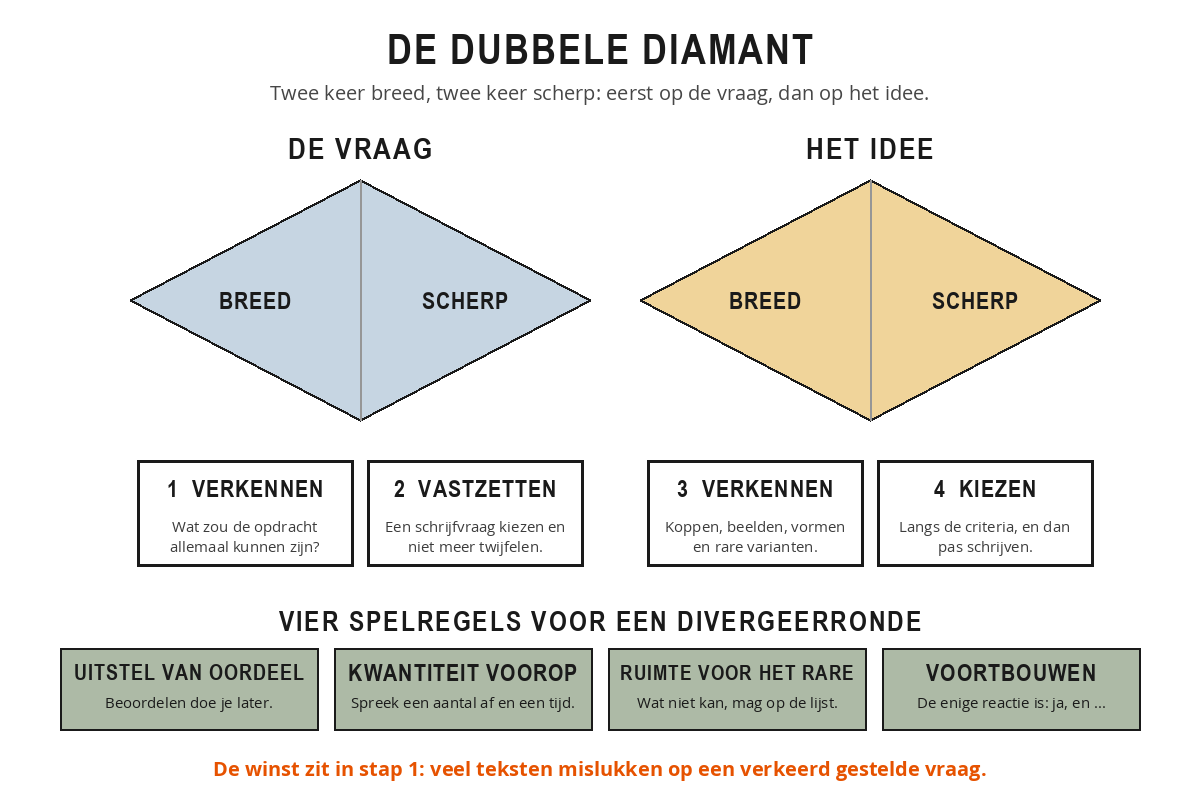
Diverging is opening up your thinking. You collect as many possibilities as you can without judging a single one of them. Quantity is the only goal at that stage, because a long list simply contains more usable material than a short one. Converging is the opposite: you weigh up, cut, combine and choose. That is where judgment does belong.
The mistake most writers make is doing both at the same time. You come up with a headline, immediately hear "the director won't like that" in your head, and the idea is dead before it reaches the page. Judgement is a brake, and with the brake on you don't get far enough to come across anything new. That is why you separate the two movements in time: first ten minutes of nothing but producing, and only then selecting.
The double diamond
You don't make those two movements once, but twice. In the first diamond you work on the question, in the second on the idea.
You start with exploring the question. You note down everything the brief could possibly be about. Is this job advert about finding a mechanic, about the company's image, about the number of applicants, or in fact about the kind of applicants you want to put off? Then comes fixing the writing question: you choose one formulation and set it alongside your writing goal and your reader. Everything that follows serves that one question. The waist of the diamond is the moment you stop doubting the assignment.
Then you open up again, now at idea level: exploring the angles. You collect images, openings, headlines, comparisons, formats and absurd variants. Everything goes on the list. And finally choosing what to develop: you hold your harvest up against a few criteria and end up with one direction. Only then do you start on your first version.
The gain lies mainly in that first step. Many texts fail not because the idea was weak, but because the question was wrongly framed. Half an hour at the front end saves three rounds of rewriting at the back end.
An installation company is looking for a service engineer. The first question seems to be: how do we write an attractive job advert? After a round of diverging on the question itself, a sharper one remains: how do we show an engineer who already has a job that he'll spend less time on hassle here?
That single reformulation changes the whole harvest. Instead of "competitive salary" and "a nice team", angles come to the table such as a day from a mechanic's logbook, the number of minutes the paperwork takes per job, and a headline about the Friday afternoon that really does end at four. None of those three would have made the list under the first phrasing of the question.
Four ground rules for a divergence round
Deferring judgment. During the round there is no such thing as a bad idea, not out loud, not in your head and not with a dash in the margin. Judging comes later.
Quantity over quality. You agree on a number and a time limit. Twenty headlines in ten minutes works better than "let's brainstorm a bit". The first seven are clichés, the last five are interesting, and that is precisely why you must not stop at seven.
Room for the odd. Ideas that can't be done are allowed on the list. An unworkable idea is often the outside of a workable one. You tame it later.
Building on instead of tearing down. With every idea you ask what else could go alongside it. If you're working with a few colleagues, "yes, and ..." is the only permitted response.
A timer helps. A divergence round without a time limit collapses into a discussion about feasibility within three minutes. With ten minutes on the clock the pressure to produce stays on, and it is precisely that pressure that delivers the ideas you did not expect.
Converging with criteria
Selecting on gut feeling almost always ends with the safest idea, because that one feels the most familiar. Four questions keep you sharp. Does it fit your core message? A brilliant idea that leaves a different thought behind than you intended is a brilliant idea for another text. Does it fit the stage your reader is in? A humorous angle does not work for someone who is about to decide and is waiting for proof. Can it work in this channel? An idea that needs four hundred words will not fit into an eight-word banner. And is it surprising? If your competitor could have arrived at this too, there is probably something better still on your list.
SCAMPER
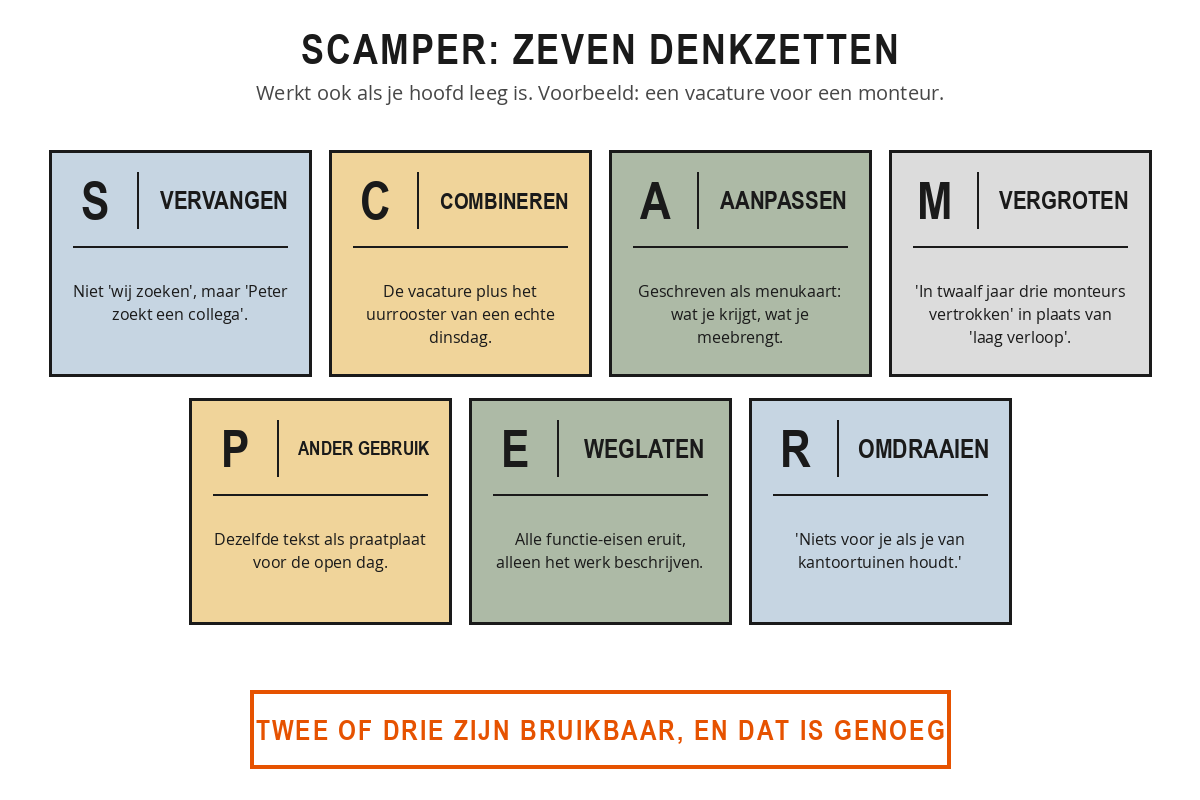
Free association works, but it grinds to a halt as soon as your head is empty. SCAMPER solves that by force: seven fixed thinking moves that you apply to your subject, even when you are not feeling anything. The technique comes from product development, and works just as well on a heading, an opening sentence or a complete offer.
Substituting. You take out one element and put something else in its place: the subject of your sentence, the place where your scene is set, or the person speaking. "Our writing course" becomes "the Friday afternoon when your quote has to be finished".
Combine. You stick together two things that normally stand apart: a client case plus a calculation, a vacancy plus a day from the logbook, two channels that refer to each other.
Adapt. You borrow a form that already works elsewhere. How would a sports commentator present this? What does a package insert look like, a menu, a weather forecast? The form drags along a tone you would not have come up with yourself.
Magnify or minify. You play with scale. You make the number bigger, "per year" instead of "per month", or make it smaller and closer, "every Wednesday morning". You stretch your promise until it is almost unbelievable and see what remains once you scale back.
Put to another use. You place your text or your offer in a situation it was never meant for. Who else uses your product? Where else would this paragraph come in handy, in a sales conversation or on a trade fair stand?
Eliminate. You cut something essential and see whether it really was essential. The company name in the first paragraph goes. The introduction goes. All the adjectives go.
Reverse. You turn the order on its head or claim the opposite. You start at the result and work backwards. Or you write the heading "Why you would be better off not taking this course" and notice how sharp you suddenly become.
That same installation company has a job advert that starts with "We are a dynamic organisation". Seven thinking moves yield seven starting points.
Substitute: not "we are looking for", but "Peter is looking for a colleague", with the team leader as sender. Combine: the vacancy plus the shift schedule of a real Tuesday. Adapt: written as a menu, with "what you get here" and "what you bring". Magnify: "in twelve years, three engineers have left" instead of "low turnover". Put to another use: the same text as a talking point for the open day. Eliminate: cut all the job requirements and describe only the work. Reverse: "This job is not for you if you like open-plan offices."
Of those seven, two or three are usually usable. That is exactly enough, because you were looking for one way in, not seven.
Distorting your text
The techniques above help you generate ideas. Distortion techniques do something else: you reach for those when a text already exists and that text is tame. You force your existing sentences into a shape that does not fit, and it is precisely that friction that shakes loose formulations you would never have written down in polite writing. You always distort a copy, never your original, because you want to be able to demolish it without hesitation.
Shortening in steps. You take a paragraph of a hundred words and cut it back to forty. Then to fifteen, and finally to six. At every step you have to choose what really matters. That six-word version is rarely your final text, but it often is your heading.
Stretching. The opposite. You take one sentence, for example "our service is fast", and turn it into ten lines with a time, a name and a place in them. Stretching forces you to show instead of claim, because vagueness cannot sustain ten lines.
Reverse. You write the text from the opposite point of view. What would a dissatisfied customer say? What does your reader's week look like if he does nothing? The negative version almost always yields more concrete details than the positive one, and you move those details back across.
Switching voice or channel. You rewrite the same content as a text message to a friend, as a ten-second radio spot, or in your customer's own words. The tone that comes out of it is looser than your normal business voice.
What you are left with is usually not a complete text, but a handful of sentences that stand out from the rest. Those sentences move across to your real version. The distorted versions you throw away, and that sometimes takes effort, because by now you have grown attached to them.
A software company has this on its website: "Our support department is here for you every day and aims to handle your questions quickly and carefully." Correct, and completely interchangeable.
Stretched out to ten lines, this comes out: "You call at 8.40. Marieke picks up, not a menu of options. She has your installation in front of her while you talk, so you don't have to explain which version you're running. With seven out of ten questions, the phone is back down within a quarter of an hour." Cut back to six words, that gives: "Marieke picks up, no menu options."
The stretched version is too long for the page and the six words are too bare for a paragraph. But together they are the new text: the six words become the heading, two sentences from the long version go underneath. The original sentence goes.
Four minutes per distortion is enough. Without time pressure you start editing instead of distorting, and then the effect disappears.
Take a writing assignment that is on your desk at this moment.
- Five minutes: write down five different formulations of what the assignment actually is. Each formulation starts with "how" and is about your reader, not about yourself. Choose one and write it out as a writing question.
- Ten minutes: note down at least fifteen angles or headlines for that question, without crossing anything out or judging it.
- If you get stuck, apply SCAMPER: seven thinking moves yield seven new starting points.
- Score your five favourites against the four criteria with a plus, a zero or a minus. Note down which idea is left and why it is stronger than the first idea you wrote down.
- Then choose one paragraph from your text that is correct but does nothing. Copy it four times: cut it down to six words, stretch it out to ten lines with a time of day and a proper name in it, write it from the opposite point of view, and write it as a text message to a close acquaintance.
In all four versions, underline the sentences that surprise you, and rebuild your paragraph with at least two of those sentences in it.
Summary
- Diverging is collecting without judgment, converging is weighing up and choosing. You never do them at the same time, because judgment acts as a brake.
- The double diamond puts those two movements one after the other twice: first on the question, then on the idea.
- Many texts fail not on a weak idea but on a wrongly framed question. Half an hour at the front end saves three rounds of rewriting.
- Four ground rules for diverging: defer judgement, quantity over quality, room for the odd, and build on rather than tear down.
- Converge on four questions: does it fit your core message, does it fit the stage your reader is at, does it fit this channel, and does it surprise?
- SCAMPER offers seven thinking moves: substituting, combining, adapting, magnifying or minifying, putting to other uses, eliminating and reversing.
- You apply distortion techniques to an existing, tame text: shortening, stretching, reversing and switching voice. Always on a copy, always with a timer. The result is raw material, not a finished text.
Why do you separate diverging and converging in time?
You rewrite "We are looking for a service engineer" into "Peter is looking for a colleague". Which SCAMPER thinking move are you applying?
What do you produce with a distortion technique such as stretching or shortening?
Ready for the next step?
You have completed the free starter of Commercial and Creative Writing. The next chapter in the full course is The reader in view: The reader profile, drawing up personas, your reader's pain points and the question of what it gains them.
Take the 2-day course →From €1250,- excl. VAT · with an experienced trainer included