


3. The headline as a door
Attention isn't a given but a loan. Your reader gives you two seconds, and what you do in those two seconds determines whether they ever see the rest. The headline is the door they come in through, the lead is the corridor behind it, and halfway along lies a valley where you'll still lose them if you do nothing.
After this chapter:
- You know how your reader's attention develops and where they drop off.
- You know the three things a headline must do at the same time.
- You choose deliberately from six headline types and know which one suits which purpose.
- You write a lead that delivers on the headline instead of warming up.
- You use four hooks to counter the dip halfway through your text.
The attention curve
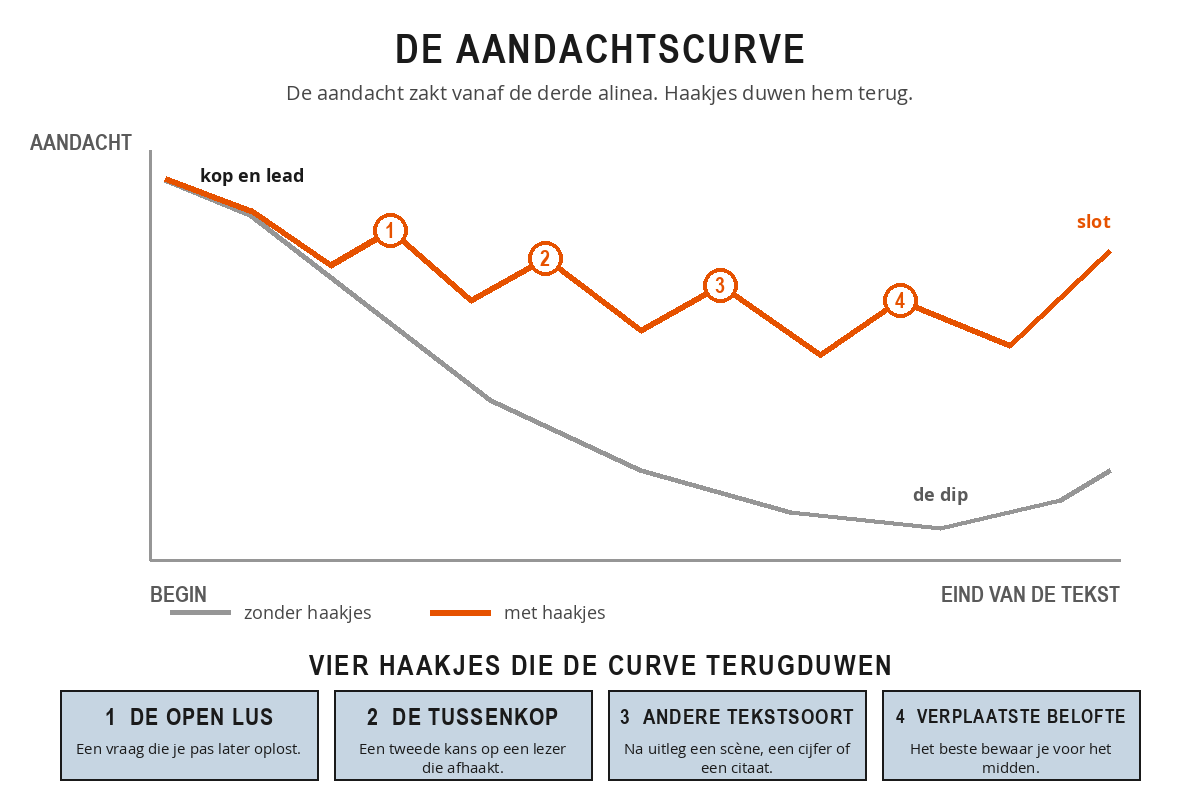
Attention is not a straight line. It starts high, because your reader still has to decide whether this is something for them. After that it drops, and that decline begins earlier than most writers think: somewhere around the third paragraph. Every subheading, every blank line and every concrete scene is a recovery point at which the curve can go up again for a moment. At the end it picks up briefly, because your reader senses that something is about to be asked of them.
That curve explains why texts fail in places where the writer sees nothing wrong. You read your own text with full attention, in a quiet room, with all the context in your head. Your reader reads it with declining attention, scanning, while a phone is buzzing. What you see as a fine build-up to the core, they see as four hundred words before anything happens.
Print your text and pencil in the curve you expect. At the point where you yourself would drop out if you hadn't written the text, put a cross. That is where a subheading, an example or a cut belongs.
What a headline must do
The headline is the sentence your reader uses to decide whether to come in. It sits at the top of your blog, in the subject line of your email, above your job advert or in the first line of your advertisement. Everything you write after it is only read if the headline has done its work, and a headline does three things at once: it promises something, it is concrete, and it does not lie.
The promise is the answer to the question your reader unconsciously asks: what do I get out of it if I put time into this? "Our new services" promises nothing. "Within two weeks, a job advert that does get responses" promises something your reader can count on.
Concreteness is the difference between a category and a detail. "More return from your adverts" stays up in the air, because everyone wants that and it appears everywhere. "Why your advert gets three times as many clicks on a Tuesday" has a day, a number and a surprise.
Don't lie sounds obvious and yet goes wrong most often. A headline that promises more than the text delivers earns you one click and costs you a reader. That trade always works out against you, because a disappointed reader does not come back and a click only counts once.
Six types of headline
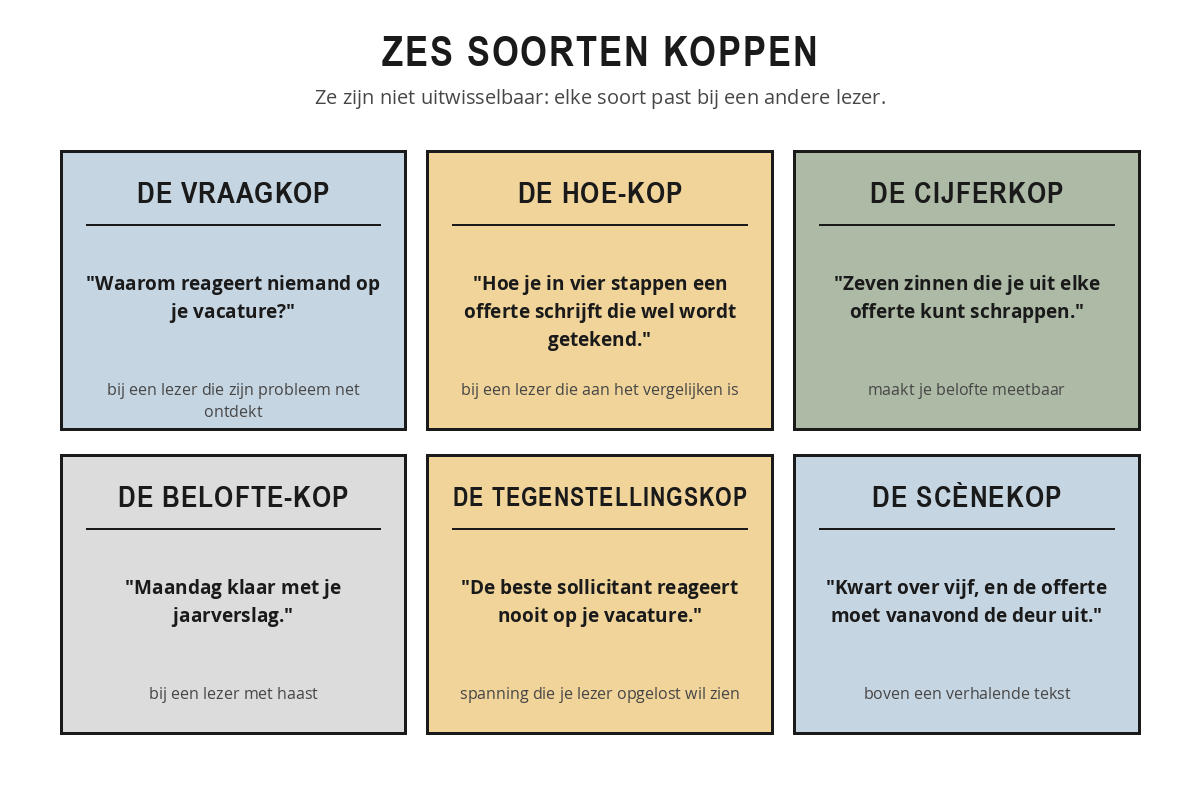
Most headlines you come across in the wild are variations on six forms.
The question headline asks the question your reader already has: "Why is nobody responding to your job advert?" That works for someone who is only just discovering their problem. The pitfall is the question no reader asks. The how-to headline promises a route to a result: "How to write a quote in four steps that does get signed." That's the most useful form for blogs, for someone who is comparing options. The number headline puts a number up front: "Seven sentences you can cut from every quotation." A number makes your promise measurable and lowers the threshold for getting started, because the reader knows how long it will take.
The promise headline states baldly what the reader gets out of it: "Your annual report finished by Monday." It surprises little and moves fast, and with readers in a hurry it beats any play on words. The contrast headline puts two things side by side that do not go together: "The best candidate never responds to your job advert." Your reader wants to see that tension resolved, so they read on. And the scene heading opens with an image rather than a conclusion: "Quarter past five, and the quote has to go out tonight." Above a narrative text, that works best.
A training provider puts this at the top of a page: "New copywriting course at our premises." What the reader gets is information about the sender. No promise, no detail, no reason to read on.
The same page in three other headline types. As a promise headline: "Two days from now you'll be writing the job advert you're dreading today." As a number headline: "Seven sentences that appear in every job advert and convince nobody." As a contrast headline: "Your job is attractive. Your job advert is not."
All three promise something and all three are concrete. Which one you choose depends on who comes in: someone who already knows their job adverts aren't working wants the promise. Someone who hasn't realised that yet needs to be shaken awake with the contrast first.
Your first headline is almost never your best headline; it's simply the first one that occurred to you. Always write two more variants in a different headline type and only then choose. In all three variants, first delete every word that adds no meaning.
The lead
Your headline has done its job as soon as your reader starts on the first line below it. From that moment the lead takes over: the first paragraph under your headline, the bridge between your promise and the content. Three or four sentences are enough. A strong headline with a weak lead brings in visitors who are gone again within ten seconds, and that costs you more than a mediocre headline: you raised the expectation and then failed to deliver on it.
A lead has three tasks, in a fixed order. First the delivering on the headline: the reader clicked on something, and that something comes back in the first sentence, in different words. If your headline promised two days to a job advert that gets responses, your lead does not start with the labour market. Then the bring the image into focus: you make concrete what the headline only pointed at, and one scene from your reader's week does more than a paragraph of explanation. And finally a give a reason to read on: you put down something that still has to be resolved, a question, a contrast or an announcement of what comes next.
Three types of lead do exactly the opposite, and you recognise them at once as soon as you look for them. The warm-up lead starts with the world instead of with the reader: "At a time when the labour market is getting ever tighter, finding good staff is a challenge." That's a writer warming up and keeping their reader waiting. The sender lead starts with yourself: "At Van Dijk Installaties we have been working on comfort and sustainability for 35 years." The reader clicked on a headline about their own problem and gets an anniversary. And the giveaway lead tells the whole story already, sums up the entire text and leaves nothing more to be had. For a news item that is fine, but for a text that has to convince, it takes all the tension out.
Headline: "Two days from now you'll be writing the job advert you're dreading today."
Weak lead: "Writing job adverts is a challenge for many organisations. In this course we teach you the key principles of persuasive writing, so that you achieve better results."
Strong lead: "You open the document, type 'We're looking for an enthusiastic colleague' and stare at your screen for half an hour. Sound familiar? Most job adverts don't founder on the wording, but on the question underneath it: what makes this job worth it for this one person? That's where this course begins."
A strong lead delivers on the headline with a scene, names the pain point in the reader's own words and raises a question that still has to be answered.
Always write your lead last. As long as you do not yet know where your text ends up, it is impossible to promise in four sentences what it delivers. On rereading, many writers discover that their real lead was in paragraph three, with two warm-up paragraphs in front of it that can go.
Four hooks against the dip
After the headline and lead, attention drops slowly but inevitably, until a trough forms halfway through. That is where texts lose their readers, and rarely at the point the writer expects. That curve is not a law of nature: you can push it back up at three or four points with a hook, a small element that gives the reader a new reason to stay with you a little longer.
The open loop is a question or announcement that you don't resolve straight away: "The most expensive mistake in this quote is on page two, and almost nobody spots it." Your reader wants to see the loop closed and reads on. The subheading as a new entry point is your second chance with a reader who was about to drop out: if you work with meaningful subheadings, each heading makes a miniature promise all over again. The switch of text type keeps up the pace: after an explanation you put a scene, then a figure, then a quote, because three paragraphs of the same type in a row feel like one long paragraph, however short they are. And the relocated promise deliberately saves something good for the middle and gives that away in the lead: "At the bottom is the sentence you can copy into every quotation." Now your reader has a reason to get through the dip.
A consultancy publishes a 900-word blog about tenders. The first half reads well, then come four paragraphs explaining the assessment criteria. The statistics show that the average reader stops after 55 per cent, exactly at those four paragraphs.
The writer puts two hooks in it. The lead gets a relocated promise: "Halfway down is the question that, according to our buyers, most bidders fail to answer." And the third explanatory paragraph is replaced by a scene of an assessment committee opening the seventh tender on a Thursday afternoon. Not a word more or less, just a different type of text in the right place. Average reading time then rises to 80 per cent.
At the end of the curve, attention picks up briefly. That's the moment for the callback and for your call to action, in that order. Put a new argument there and you lose that upturn to confusion.
Take a text of your own of at least 400 words whose headline is still tame.
- Write down the existing headline word for word and add five new ones, each in a different headline type.
- Put the variants to a colleague who doesn't know the text, with one question: what do you expect to find below this? Choose the headline whose expectation comes closest to your actual content.
- Look at your lead: is it a warm-up lead, a sender lead or a giveaway lead? Rewrite it so that it delivers on the headline, brings the image into focus and gives a reason to read on.
- Print the text, read it aloud and put a mark in the margin where your attention drops off. Ask a colleague to do the same without seeing your marks. Where are your marks at the same point? That is your dip.
- Choose one of the four hooks and build it in just before that dip.
Have a third reader read the new version, with one question: where would you have stopped?
Summary
- Attention starts high, drops from about the third paragraph onwards, has a trough halfway through and picks up briefly at the end.
- A headline promises something, is concrete and doesn't lie. A headline that promises more than the text delivers earns you a click and costs you a reader.
- Six headline types: the question headline, the how-to headline, the number headline, the promise headline, the contrast headline and the scene headline.
- Always write two variants in a different headline type before you choose. Your first headline is only the first one that came to mind.
- A lead delivers on the headline, brings the picture into focus and gives a reason to read on. Write it last.
- Three leads that don't work: the warm-up lead (starts with the world), the sender lead (starts with yourself) and the giveaway lead (tells you everything already).
- Four hooks against the dip: the open loop, the subheading as a new entry point, the change of text type, and the relocated promise.
Which headline meets all three requirements from this chapter?
Under the headline "Two days later you'll be writing the job advert you're dreading now", the text begins with: "At a time when the labour market is getting ever tighter, good staff are scarce." What's going wrong here?
You notice that readers drop off halfway through your blog. Which intervention fits the dip?