


Introduction
You say something, the other person nods, and a week later it turns out you agreed on something entirely different. Or you politely ask someone to take a look at something, and it does not happen. Communication feels like something that happens by itself, because you do it all day long. That is precisely why we rarely stop to consider how often a message changes along the way.
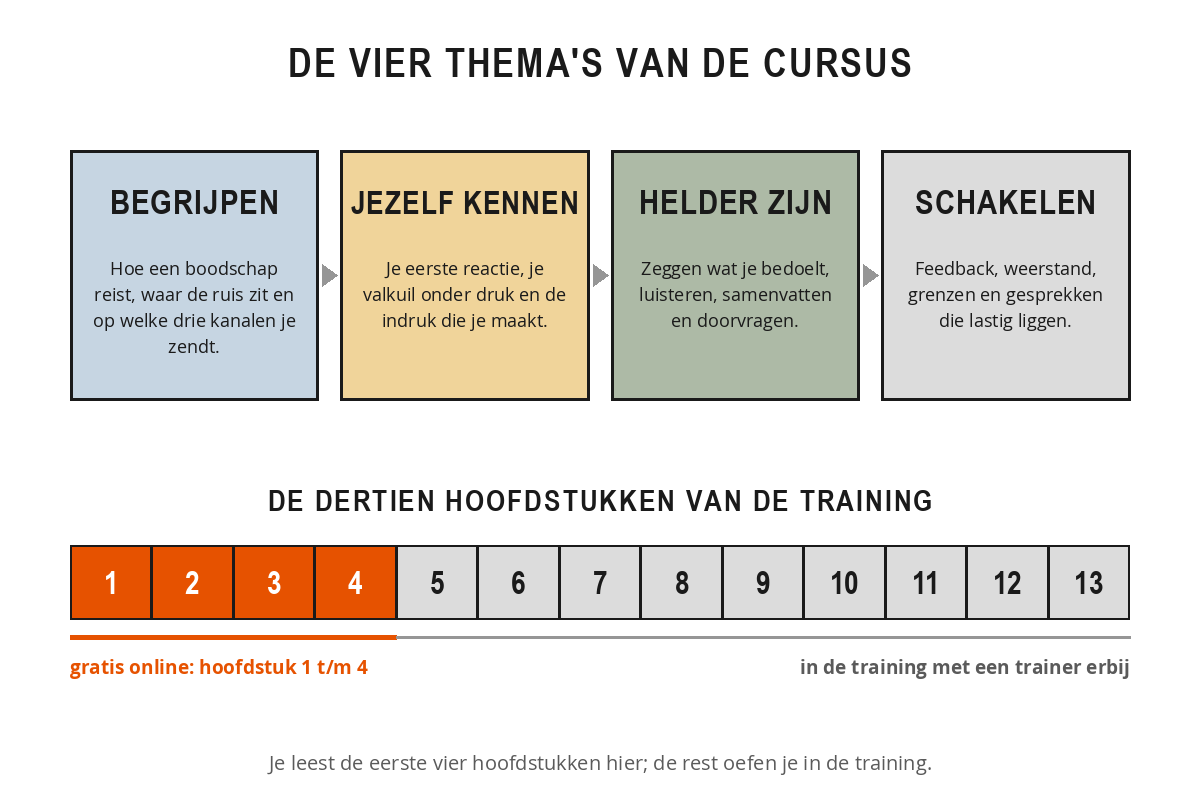
This free course contains the first four chapters: the orange part of the bar above. At the bottom of chapter 4 you will find the full course.
What you will learn
You first see how a message travels from sender to receiver, and where the noise comes in that distorts it along the way. Then you discover that you never transmit on one channel but on three at once: your words, your body and your voice. The third chapter is about yourself, about the difference between your first impulse and a considered response, and about the impression someone forms of you within seven seconds. The fourth chapter is the most practical: you learn to recognise your own vague sentences and rewrite them into sentences that need no further explanation. The common thread: you cannot control what the other person understands, but you can remove a great deal of noise.
How the course is structured
The course follows four themes that build on one another. You start with understanding: how does communication actually work and why does it go wrong? Then comes knowing yourself: what do you do in a conversation, often without noticing it? Then being clear: saying what you mean, and hearing what the other person means. And you finish with adapting: adjusting your behaviour when a conversation goes in a direction you do not want. Each chapter contains theory, a model, examples from practice and an exercise you apply to your own conversations.
Practical tips for use
- Keep a notepad or a blank document to hand. The exercises only work if you actually complete them.
- For each chapter, pick one conversation from your own work. A conversation that went differently from how you wanted is the most instructive.
- Don't read it all in one go. One chapter a week, with time to try it out, delivers more than reading through it in an afternoon.
- After a few weeks, ask someone you trust what they see you doing in conversations. That is precisely the part you have the least insight into yourself.
- Start small. Rephrasing one sentence works better than trying to be a different person from Monday onwards.
Each chapter ends with a short knowledge check of three questions: answer them correctly to mark the chapter as completed. Your progress is saved automatically in your browser.
Enjoy reading, and above all: enjoy the conversations that from now on go the way you meant them to.