


1. The communication process
Communication is everywhere: in a look, a silence, a two-word message. Even so, your message often fails to arrive the way you meant it. That is rarely down to unwillingness. It is down to the process itself, which has considerably more steps than you might think, and to everything that can force its way in between those steps.
After this chapter:
- You can say in your own words what communication is and what purpose lies beneath it.
- You know the difference between the quality and the acceptance of a message, and what the formula E = Q x A means.
- You can name the steps in the Shannon and Weaver model.
- You recognise the three types of noise and know what to do about them.
- You know why you can never not communicate, and what a frame of reference does to your message.
Communication has a purpose
Communication is conveying information to someone else. That sounds straightforward, but you send along far more than you intend. Besides the words you choose, you give off signals you never asked for: a tired look, a hesitation in your voice, a quick glance at your phone in the middle of a conversation. That is communication too.
Communicating usually has a purpose. You want to inform someone, persuade them, reassure them, give direction, or simply be liked. Often you are not aware of it. Even so, that underlying purpose largely determines how you say something and which words you pick. Someone who wants to persuade a colleague talks differently from someone who only wants to pass on a fact, even if the sentence is the same.
Communicating effectively: E = Q x A
When is communication actually successful? There are two questions for that:
- Does the other person understand my message? That is about the quality (Q) of what you say. Is it clear, is it logically structured, can it only mean one thing?
- Does the other person actually act on it? That is about acceptance (A). Does your message connect, does the other person feel taken seriously, are they willing to do something with it?
The formula behind this is: E = Q x A. Effectiveness is quality times acceptance. Note the multiplication sign. If either one is zero, your effectiveness is zero too. A crystal-clear account that the other person does not accept achieves exactly as much as a vague account that goes down well: nothing. In practice, most people steer on quality alone. They sharpen their email once more, shorten it once more, while the problem sits at the other end of the formula.
Bas is a team leader and on Monday morning sends an eight-line email: from 1 October everyone logs their hours per project, by twelve o'clock every Friday at the latest. The email is crystal clear. The quality is a nine out of ten. Two weeks later, four out of eleven people have done it. Why? Nobody knows why it has to happen, two people think it is a monitoring measure, and the rest have read it as something that will blow over. Acceptance is close to zero, so the result is too. When Bas spent five minutes on it in the team meeting and explained that the time registration was needed to demonstrate that the team was structurally understaffed, everyone joined in the following week.
The Shannon and Weaver model
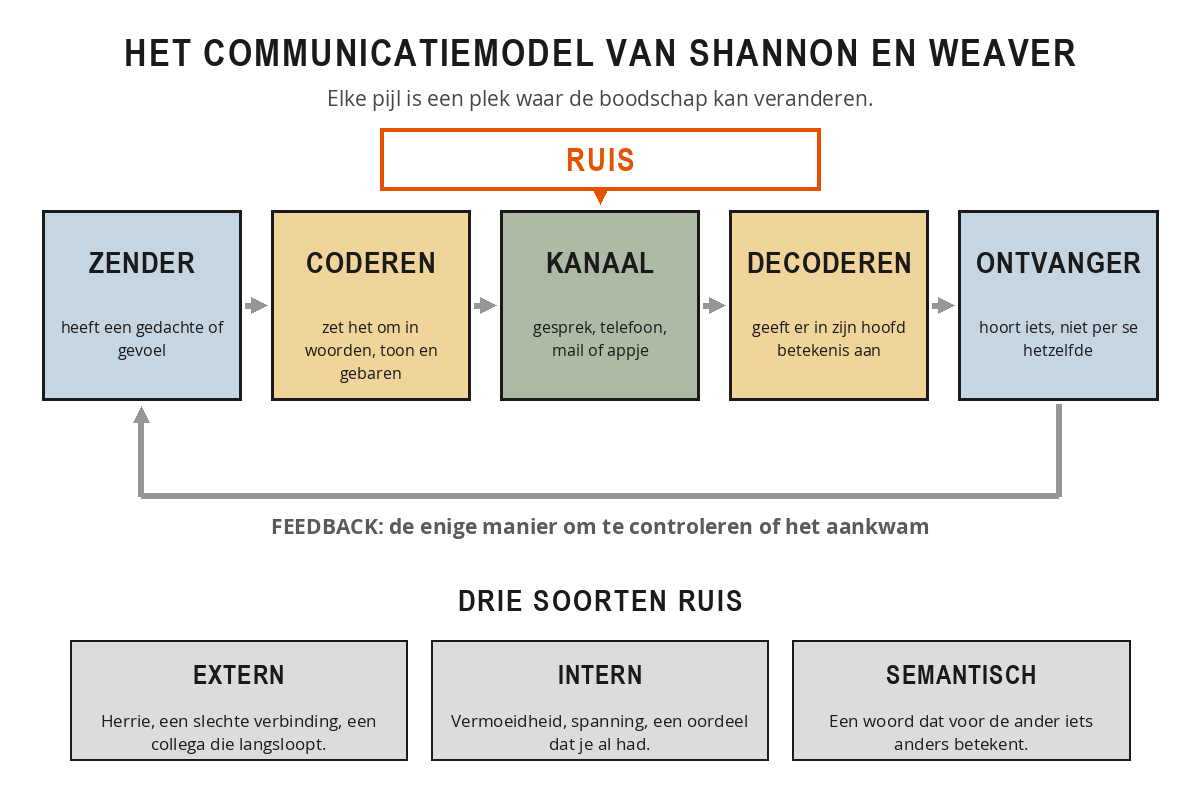
In 1948, Claude Shannon and Warren Weaver came up with a model that is still in use today. It is simple, and that is precisely what makes it useful. The sender has a thought or a feeling and turns it into words, gestures or a tone of voice. This is called encoding. That message travels through a channel: a conversation across the table, a phone call, an email, a message. At the other end, the message arrives at the receiver, who gives it meaning. This is called decodingAnd then, if all goes well, there is feedback back: a nod, a question, a response. That feedback is the only way you can check whether what arrived is what you sent.
The most important word in this model is noise: everything that comes between sender and receiver and disrupts the message. Noise comes in three kinds.
- External noise: a bad connection, background noise, a stuttering picture, a colleague walking past.
- Internal noise: tiredness, tension, thinking about something else, a judgement about the sender that you already held before they started.
- Semantic noise: a word that means something different to you than it does to the other person. Jargon, an abbreviation, a joke that falls flat.
Do you notice a conversation is running into trouble? Ask yourself where the noise is: with you, with the other person, or in the channel. An email that just won't land is sometimes sorted out in two minutes with a phone call. You simply need a different channel.
Effective communication therefore requires something from both sides. The sender has to encode clearly and choose the right channel. The receiver has to decode actively and check whether they have understood it correctly. That brings you back to the formula: a message that arrives but is not accepted still achieves nothing, and enthusiastic agreement with a vague story often leads to exactly the wrong action.
Three laws of communication
Alongside the model there are a few basic rules that always apply, whatever the situation. They sound obvious, but in practice we forget them all the time.
- You cannot not communicate. Even when you say nothing, you are communicating. Silently looking at your phone during a meeting is a message. Looking away when someone walks in is a message. Not replying to a message all day is a message. The question is never whether you are communicating, but what you are communicating.
- Feelings are largely conveyed without words. If your words and your body say different things about how you feel, your body almost always wins. That is what the next chapter is about.
- Everyone has their own frame of reference. What is logical, normal or self-evident to you need not be so for the other person. Your upbringing, education, culture, age, field of work and mood determine how you interpret a message. Two people can hear exactly the same thing and take something completely different from it.
On Tuesday morning Karin asks her colleague Ruben: "Could you just take a quick look at this?" What Karin means is: finished today, it has to go to the client tomorrow. What Ruben hears is: if you have time, no rush. On Friday it is still sitting there. Karin thinks Ruben is uninterested, Ruben thinks Karin is unreasonable, and neither of them said anything wrong. The word "quick" meant twenty minutes today in one head and sometime this week in the other. Their frames of reference differed, and nobody checked.
That third law is perhaps the most important one. You can never assume that the other person sees the world as you do. That is why checking, summarising and asking follow-up questions are not a luxury, but the heart of clear communication.
Think of a conversation from the past week that was awkward or turned out differently from what you expected. Answer for yourself:
- What was your aim in this conversation? Did the other person know that?
- Which channel did you use: in person, phone, email, a message? With hindsight, was that the most practical one?
- Where was the noise: with you, with the other person, in the channel, or in the words themselves?
- Did you check whether you had understood each other properly? If not, what could you have asked?
Summary
- Communication is purposeful: you want to inform, persuade, reassure or give direction, often without being aware of it.
- Effectiveness = quality x acceptance. Both have to be good, otherwise the result is zero.
- Shannon and Weaver's model describes the steps: sender, encoding, channel, decoding, receiver, with feedback as a loop back.
- Noise is anything that disturbs the message: external (sound, connection), internal (tension, prejudice) or semantic (the meaning of words).
- Three laws: you are always communicating, feelings are largely conveyed without words, and everyone has their own frame of reference.
- Choosing a different channel solves more than saying the same thing again.
A team leader sends a crystal-clear email about a new way of working, but hardly anyone follows it. What does the formula E = Q x A say about this?
You explain something to a colleague using four abbreviations from your field. He nods, but then does something other than what was agreed. Which type of noise is at play here?
What do we mean by the law "you cannot not communicate"?