


4. Communicating clearly
Misunderstandings rarely arise because someone isn't listening. Far more often it's because the speaker isn't clear, usually without realising it. This chapter is about your own sentences: where the vagueness creeps in, and how to get it out without becoming blunt.
After this chapter:
- You recognise the difference between direct and indirect in your own use of language.
- You know why people speak indirectly, and what it costs them.
- You can name and rewrite four forms of vagueness.
- Can you turn four veiled wishes into a clear request.
- You know why words only acquire meaning in the mind of the recipient.
Clarity starts with yourself
When a conversation gets stuck, the first reflex is to point at the other person. "He doesn't understand me." "She isn't listening properly." Yet clear communication starts with yourself. If you want clarity, you have to be clear yourself. That sounds simple, but in practice it is harder than you think.
People speak indirectly for all sorts of reasons. Out of embarrassment ("I don't want to hurt the other person"), out of fear ("they'll think I'm blunt"), out of habit (you have always done it that way), or to protect the relationship. Those motives are understandable. The only problem is that the message fades along the way. The other person then fills in for themselves what you probably meant, and that interpretation is often wrong.
Four forms of vagueness
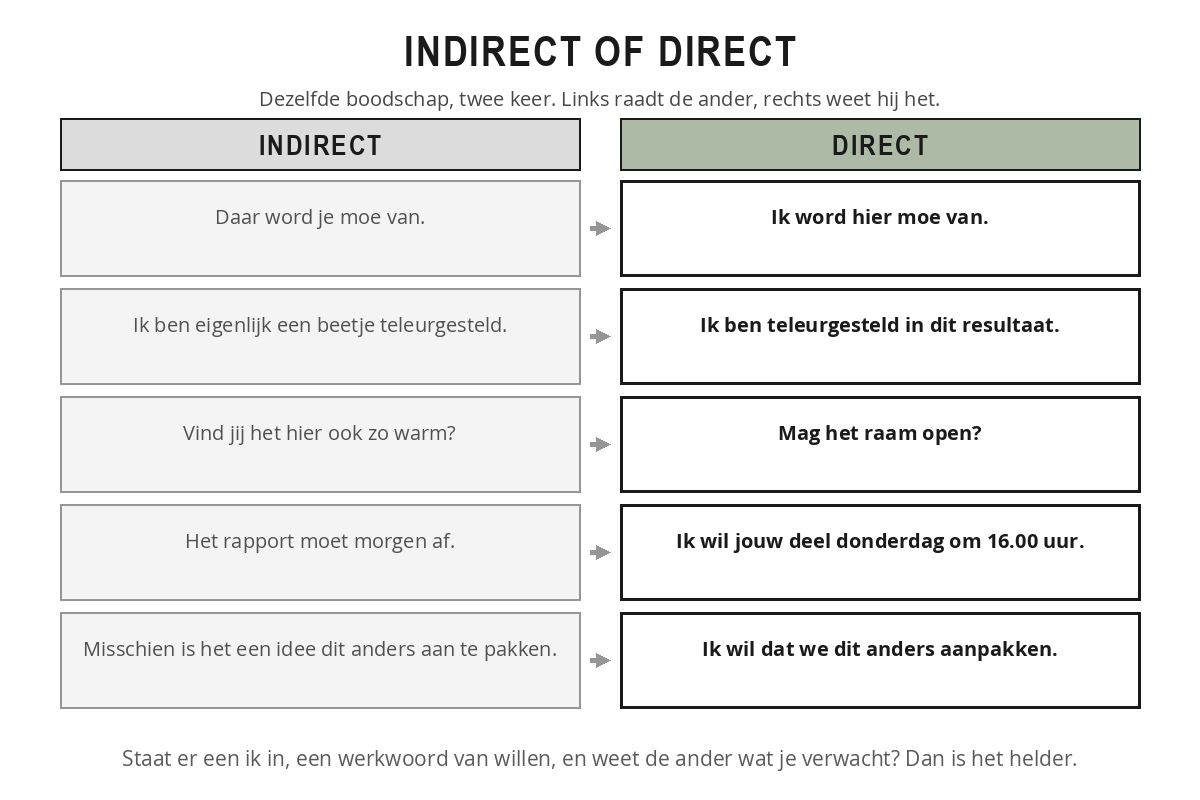
Vagueness mainly creeps in through four patterns. They sound polite or modest, but they leave the listener guessing.
- Vague pronouns: you say "you", "they" or "people" where you mean "I". "That wears you out" hides the fact that it wears YOU out. The other person doesn't know whether you're talking about yourself, about them, or about the world in general.
- Softeners: words such as "actually", "a bit", "perhaps", "might possibly" and "somewhat" make a message softer, but also less clear. "I'm actually a bit disappointed" leaves room for the other person to think it isn't that bad.
- Indirect questions: instead of making a request, you ask a question and hope the other person picks it up. "Do you find it warm in here too?" when you mean: "Can we open the window?" The other person is then free to answer honestly, "No, it's fine by me", and that puts you in a bad mood again.
- Absent expression of intent: you describe a situation, but don't say what you want. "The report has to be finished tomorrow" doesn't say who has to do it. "I find this difficult" doesn't say what you're asking of the other person.
Hanneke works with a colleague on a report that goes to the board on the fifteenth of every month. Her colleague has submitted his part on the fourteenth three months in a row, which means Hanneke has to work late each time. Three times she has said: "It would be nice if you could deliver your part a bit earlier, if that's possible." Three times nothing changed, and three times she went home grumbling. The fourth time she says: "I want your part of the report by Thursday at 16.00 at the latest, so that I can finish it on Friday." Her colleague says: "Fine, I didn't know that." He had heard the first three sentences as a wish, not as an agreement. He was not wrong.
Direct is not the same as blunt
A common misconception: direct communication is supposedly blunt or impolite. That isn't true. Being direct is about the clarity of the content, not about your tone. You can speak calmly, pleasantly and respectfully and at the same time be perfectly clear about what you think, want or feel. The tone lies in your voice, your choice of words and your attitude. The clarity lies in the structure of your message. Those are two different dials, and you can operate them independently.
Take a colleague who delivers late. "Your deadline was yesterday, I need this today" is very direct, but may come across as harsh. "I don't know whether you've seen it, but there may have been something with the planning" is so cautious that he will probably read straight past it. The middle option combines both: "I'm still missing your input. When can I expect it?" Clear on content, friendly in tone.
Four ways of packaging a wish
Indirect expressions of intent take recognisable forms. Once you learn to spot them, you can replace them in your own language.
- The disguised question as a statement: "I see the report is not finished yet." What you mean: "When will the report be finished?" or "I want to receive the report today."
- The suggestion as a wish: "Maybe it's an idea to approach this differently." What you mean: "I want us to approach this differently, and in this way."
- The question as a reproach: "Didn't you know the meeting started at ten?" What you mean: "I find it annoying that you were late."
- The wish as an impersonal rule: "It would be nice if people responded on time." What you mean: "I want you to respond before Friday."
Not sure whether a sentence is clear enough? Check three things: does it contain an "I", does it contain a concrete verb (want, ask, expect), and does the other person know exactly what you expect of him after hearing it? Three times yes? Then your message is clear.
Words take on meaning in the other person's head
Even if you are grammatically crystal clear, a conversation can still go off the rails. That's because words have no fixed meaning. They only acquire it in the head of the person hearing them. And that head is full of quite different experiences, images and associations from yours.
Your frame of reference is the whole of your experiences, knowledge, upbringing, profession, culture and personality, and it is through this that you interpret everything that comes in. The same remark is read in completely different ways by two people. A line manager who says "this could be better" is giving one person useful feedback and another a personal attack.
In a team meeting of four people you discuss the approach to a client visit. You say: "We'll handle this professionally." To you that means: a written agenda, firm agreements, everything recorded. To your colleague it means: calm, composed, with a clear overview. To the third it means: thinking on your feet and making decisions on the spot. All three of you nod in agreement and all three of you do something different. Only during the visit itself does this become apparent, and then in front of the client.
You cannot switch off your frame of reference, but you can make it visible. You do that by being concrete. Not "we need to handle this professionally", but "I want a written plan with tasks and dates on Monday". Not "could you respond a bit more quickly", but "I want an answer within 24 hours". Not "I don't find this very pleasant", but "I don't want you looking at your phone during my presentation". Concrete language leaves less room for different interpretations. And if you notice that the other person still understands something different from what you meant? Then ask: "What do you mean by...?" That way you make the difference in frame of reference something you can discuss, instead of quietly letting it cause interference.
Take an email or a message you sent in the past week. Read it back with these questions in mind:
- Are there indirect questions in it that you could have asked more directly?
- Do you use vague words (quickly, briefly, soon, professional) that may mean something different to the other person than they do to you?
- Does every question state who has to do something, and by when?
Rewrite the message in a direct version. What changes in terms of length, tone and clarity? And which of the two would you rather receive yourself?
Summary
- Clarity starts with the sender, not the receiver.
- Four forms of vagueness: vague pronouns, softeners, indirect questions and missing expressions of intent.
- Four wrapped-up wishes: the veiled question as a statement, the suggestion, the question as a reproach, and the wish as an impersonal rule.
- A direct expression of intent contains an "I", a verb of wanting or asking, and a concrete request.
- Direct is not blunt: the tone lies in your voice and posture, the clarity in the structure of your message.
- Words take on meaning in the mind of the receiver; concrete language and the question "what do you understand by that?" make differences visible.
"It would be nice if people responded on time." Which form of indirect language is this?
According to this chapter, what is the difference between direct and blunt?
Three colleagues agree that they are going to tackle something "professionally" and then all three do something different. What is going on here?
Ready for the next step?
You have completed the free starter of Communication. The next chapter in the full course is Core qualities and pitfalls: How a strong quality tips over into behaviour with the opposite effect, and which challenge and allergy go with it.
Take the 2-day course →From €1250,- excl. VAT · with an experienced trainer included